 ultimate-guide
How Much Can Attic Insulation Save on Energy Bills
Table of Contents
- How Much Can Attic Insulation Actually Save on Your Energy Bills
- Understanding R-Value and Thermal Resistance
- Recommended R-Value for Attic Insulation by Climate Zone
- The Role of Air Sealing in Maximizing Energy Savings
- Cost to Insulate Attic Per Square Foot and ROI Timeline
- Attic Insulation Tax Credit 2024 and Rebate Opportunities
- Signs Your Attic Needs More Insulation
- Conclusion
Last Updated: August 16, 2026
How Much Can Attic Insulation Actually Save on Your Energy Bills
Attic insulation is one of the most cost-effective home upgrades available. Your attic is where most heat loss occurs in winter and unwanted heat gain in summer, making it critical to energy efficiency. At RTS Comfort Cooling & Heating, we've helped homeowners understand that proper attic insulation directly impacts monthly utility costs year-round.
Savings depend on several factors: your current insulation level, climate zone, attic size, and home sealing. A homeowner in a cold climate with minimal insulation will see different savings than someone in a moderate climate with partial insulation already in place. Understanding these variables is critical before investing.
Below, we'll break down exactly how much attic insulation can save on energy bills, what determines those savings, and how to calculate your potential return on investment.
Understanding R-Value and Thermal Resistance
R-value measures thermal resistance, how effectively insulation resists heat flow. The higher the R-value, the better it performs at slowing heat transfer. An R-value of 30 stops heat transfer twice as effectively as an R-value of 15.
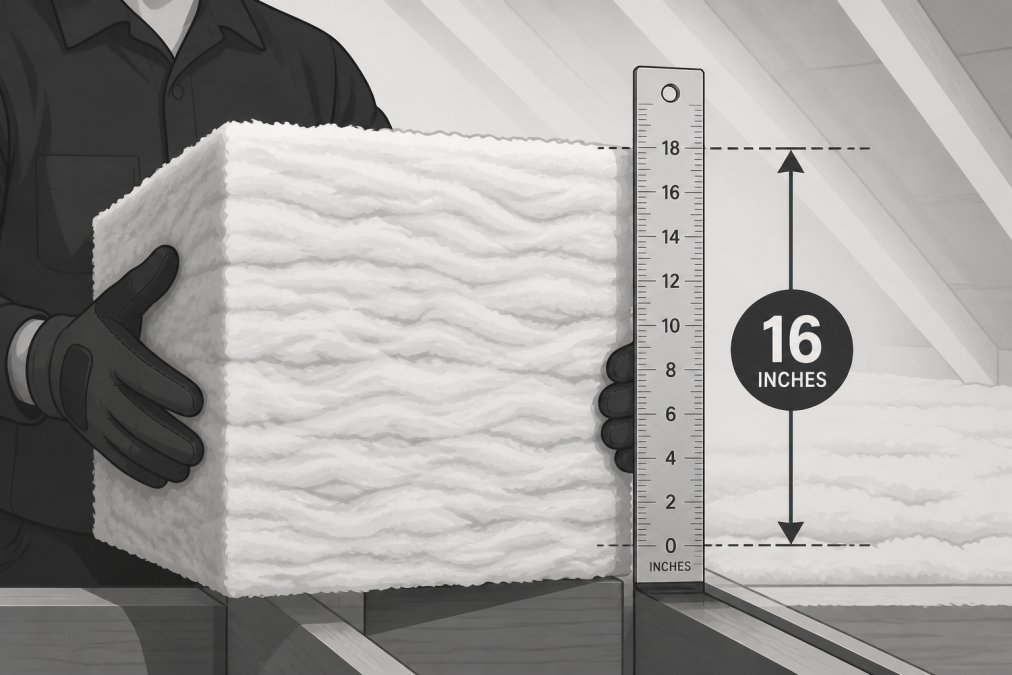
Thermal resistance works bidirectionally. In winter, high R-value insulation keeps heated air from escaping through the attic. In summer, it blocks solar heat gain from warming your home's interior.
The thermal envelope, the sealed boundary between conditioned space and unconditioned attic space, depends on both insulation thickness and air sealing. Insulation alone won't maximize savings if air leaks bypass it. A common mistake is adding insulation without addressing air sealing first. You can have R-60 insulation, but if warm or cool air leaks through gaps around ductwork, electrical penetrations, or attic bypasses, you're wasting much of that investment.
Recommended R-Value for Attic Insulation by Climate Zone
The Department of Energy provides R-value guidance based on climate severity. Colder climates require higher R-values; moderate climates require less.
For most climates, recommendations fall into these ranges:
- Cold climates (northern zones): R-38 to R-60
- Moderate climates (middle zones): R-30 to R-38
- Warm climates (southern zones): R-19 to R-30
A homeowner in a cold climate upgrading from R-19 to R-49 will see more dramatic energy savings than someone in a warm climate making the same upgrade, because the temperature differential between inside and outside is larger for more of the year.
Energy audits performed by professionals can pinpoint your exact climate zone and current insulation shortfalls. Many utility companies offer free or subsidized audits that measure your home's thermal performance and recommend specific R-value targets based on your local climate.
The Role of Air Sealing in Maximizing Energy Savings
Insulation alone doesn't determine your energy savings, air sealing does.
An attic bypass is a gap or hole that allows conditioned air to escape directly into the attic, bypassing your insulation entirely. Common bypasses include gaps around ductwork, electrical wiring holes, plumbing vents, and interior wall top plates. If your attic has significant bypasses, adding insulation won't deliver full savings potential.
Air sealing + insulation together maximize your thermal envelope's effectiveness. Air sealing addresses heat loss from air movement; insulation addresses heat loss from conduction. You need both.
A professional energy audit will identify attic bypasses using thermal imaging or blower door testing. Once sealed with caulk, spray foam, or weatherstripping, your insulation can work at its rated R-value. The cost is usually modest compared to the insulation upgrade itself, but the impact on energy savings can be substantial.
Cost to Insulate Attic Per Square Foot and ROI Timeline
Attic insulation costs and ROI vary by material type, climate zone, and current insulation level.
Insulation Material Costs and Performance Trade-offs
Three primary materials dominate residential attic insulation:
Fiberglass batts cost $0.50-$1.50 per square foot installed, with an R-value of R-3.2 to R-3.8 per inch. They're the most affordable option and easiest for DIY installation, but require careful air sealing around penetrations to avoid bypasses.
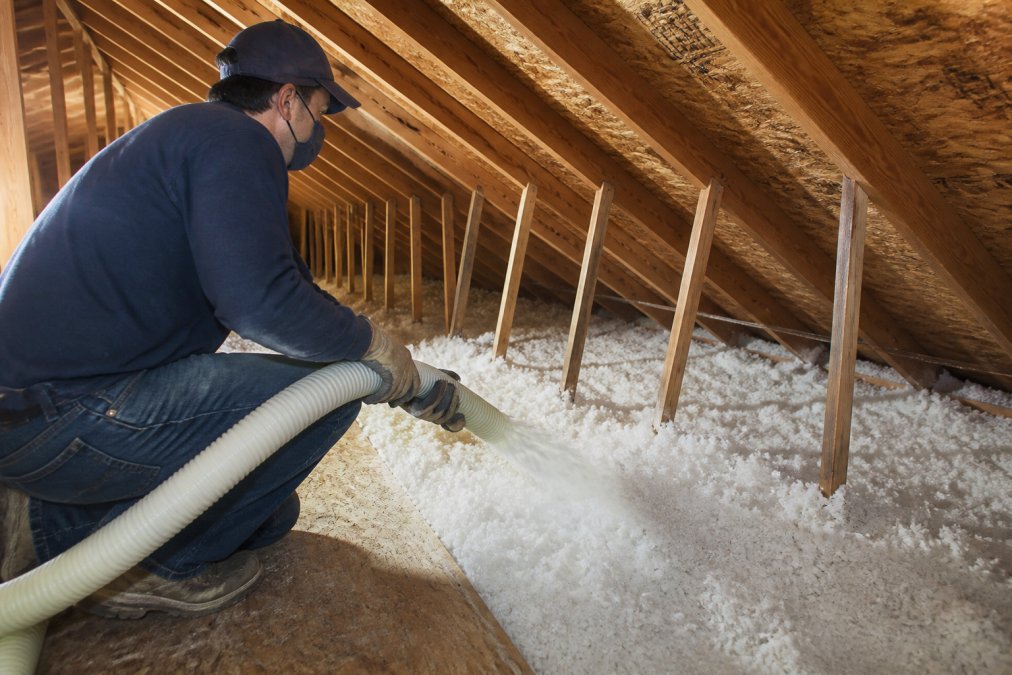
Blown-in cellulose costs $1.00-$2.00 per square foot installed and delivers R-3.5 per inch. Cellulose is denser than fiberglass, filling irregular spaces more completely and resisting air movement better. It's made from recycled paper, making it environmentally attractive. The trade-off: it requires professional equipment to install.
Spray foam (open-cell) costs $2.50-$4.00 per square foot and provides R-3.6 per inch, plus it seals air leaks simultaneously during installation. Closed-cell spray foam costs $4.00-$7.00 per square foot with R-6 to R-7 per inch, offering superior performance in extreme climates. Spray foam's main drawback is higher upfront expense, though its air-sealing benefit often justifies the premium for homes with significant bypass issues.
For most homeowners, blown-in cellulose or fiberglass batts offer the best cost-to-performance ratio.
Climate-Zone ROI Examples
Cold climate example (Zone 5-6: Northern regions) A 1,500-square-foot home upgrading from R-19 to R-49 using blown-in cellulose at $1.50/sq ft costs approximately $2,250. This typically reduces annual heating and cooling costs by 15-20%, or roughly $1,200-$1,600 per year. ROI timeline: 18 months to 2 years. Lifetime savings over 20 years: $24,000-$32,000.
Moderate climate example (Zone 3-4: Mid-Atlantic, Midwest) Upgrading from R-19 to R-38 at $1.50/sq ft costs $1,800. Annual savings are typically 10-15%, or $600-$900 per year. ROI timeline: 2-3 years. Lifetime savings: $12,000-$18,000.
Warm climate example (Zone 1-2: Southern regions) Upgrading from R-19 to R-30 at $1.50/sq ft costs $1,650. Annual savings are typically 8-12%, or $400-$600 per year. ROI timeline: 3-4 years. Lifetime savings: $8,000-$12,000.
These examples assume air sealing is completed first. If significant attic bypasses exist, add $500-$1,500 for professional air sealing.
Factors That Accelerate or Slow Your ROI
Accelerators: Above-average utility rates improve ROI. Federal tax credits (up to $3,200 under the Inflation Reduction Act) or utility rebates (typically $200-$800) cut ROI timelines by 20-30%. Homes with existing insulation below R-19 see faster payback.
Delays: Difficult attic access or complex geometry increases labor costs. Moderate climates with already-adequate insulation (R-30+) see smaller marginal savings, lengthening payback to 5+ years.
A professional energy audit can model your specific home's savings using your actual utility bills, climate zone, and current insulation level.
Attic Insulation Tax Credit 2024 and Rebate Opportunities
Federal tax incentives and utility rebates can offset 20-40% of your attic insulation project cost, dramatically improving ROI.
Call (702) 707-4242 for a free estimate →
Federal Tax Credits Under the Inflation Reduction Act
The Inflation Reduction Act expanded the Energy Efficient Home Improvement Credit (IRC Section 25C) to provide substantial incentives for attic insulation and air sealing through 2032.
Credit amount: You can claim up to $3,200 per year for qualifying energy efficiency improvements, including attic insulation. The credit is 30% of the cost of materials and labor, capped at $3,200 annually across all qualifying improvements.
Eligibility requirements:
- Your home must be a principal residence
- The insulation must meet Department of Energy performance standards for your climate zone
- Work must be performed by a qualified contractor (as defined by the IRS)
- You must retain receipts and documentation proving the R-value achieved and contractor credentials
Example: If your attic insulation project costs $3,000, you can claim a $900 credit (30% of $3,000). If your total tax liability is $1,500, the credit reduces it to $600. Unused credits carry forward to future tax years.
State and Utility Rebate Programs
Many utility companies and state energy offices offer rebates that stack on top of the tax credit.
Utility rebates typically range from $200-$800 depending on your insulation upgrade and local utility rates. Common structures include:
- Per-R-value rebate: $0.50-$1.50 per R-value point added
- Flat rebate: $300-$500 for completing an approved upgrade
- Tiered rebate: Higher rebates for reaching higher R-values
State incentives vary widely. Some states offer additional tax credits or grants for energy efficiency improvements.
How to Access These Incentives
Step 1: Verify your contractor's qualifications. The IRS requires that work be performed by a "qualified contractor," typically holding relevant certifications such as Building Performance Institute certification. Ask your contractor for proof before signing.
Step 2: Check your utility company's rebate program. Visit your utility's website or call their energy efficiency department. Many utilities have online portals for eligibility checks and rebate applications.
Step 3: Document everything. Keep all receipts, invoices, photos, and proof of the R-value achieved. The contractor should provide a certificate of completion.
Step 4: Claim the federal credit on your tax return. File Form 5695 (Residential Energy Credits) with your tax return for the year the work was completed.
Step 5: Submit utility rebate applications. Follow your utility's process, typically submitting receipts and proof of installation within 30-60 days of completion.
Real-World Impact on Your ROI
Combining federal and utility incentives can cut your net project cost by 30-50%:
- Without incentives: $2,250 project cost, $1,400/year savings = 1.6-year ROI
- With federal credit (30%): $2,250 − $675 = $1,575 net cost, same $1,400/year savings = 1.1-year ROI
- With federal credit + $400 utility rebate: $2,250 − $675 − $400 = $1,175 net cost, same $1,400/year savings = 10-month ROI
Start by contacting your utility company and checking the Database of State Incentives for Renewables & Efficiency (DSIRE) at dsireusa.org for a complete list of programs in your area.
Signs Your Attic Needs More Insulation
Several clear indicators suggest your attic insulation is inadequate and needs upgrading.
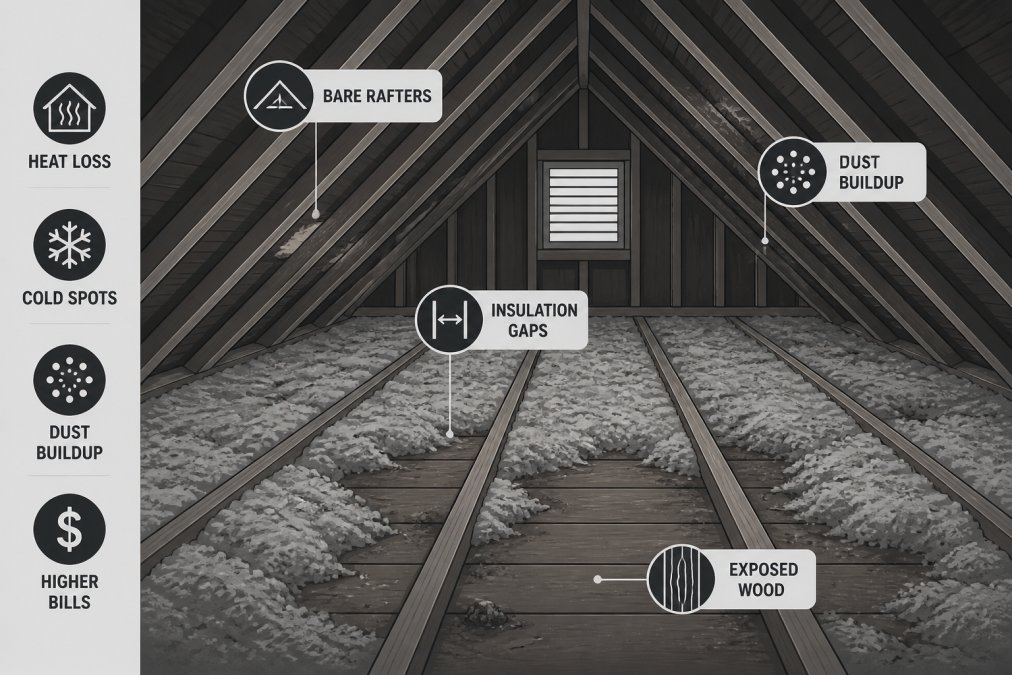
High heating and cooling costs are the most obvious sign. If your utility bills are climbing year-over-year despite consistent usage, poor attic insulation is often the culprit.
Uneven temperatures throughout your home indicate thermal envelope problems. If upstairs bedrooms are significantly warmer in summer or colder in winter than downstairs areas, inadequate attic insulation is preventing proper heat distribution.
Ice dams in winter are a specific sign of heat loss through your attic. When warm air escapes into the attic, it melts snow on your roof. That meltwater runs down to cold eaves and refreezes into ice dams, damaging gutters and causing water intrusion. Proper attic insulation and air sealing prevent this.
Visible insulation that's thin, compressed, or deteriorated indicates you need more. If you can see wood framing through your insulation, you're below recommended R-values.
Moisture or mold in the attic suggests both insulation and ventilation problems. Inadequate insulation combined with poor ventilation creates condensation, leading to mold growth and wood rot.
A professional energy audit is the most reliable way to determine whether your attic needs more insulation.
Conclusion
How much can attic insulation save on energy bills? The answer depends on your climate zone, current insulation level, and home sealing. Most homeowners see meaningful reductions in annual heating and cooling costs after upgrading to recommended R-values and sealing air leaks.
The investment in proper attic insulation pays for itself through lower utility bills while improving comfort throughout your home. RTS Comfort Cooling & Heating offers comprehensive energy efficiency services, including professional energy audits, attic insulation installation, and air sealing to maximize your thermal envelope's performance. Our team can assess your specific situation, recommend the right insulation material and R-value for your climate, and help you access available tax credits and rebates. Call (702) 707-4242 for a free estimate and discover how much you can actually save.
Frequently Asked Questions
How much will attic insulation reduce my heating bill?
Attic insulation can reduce heating costs by 10-20% depending on your current insulation level, climate zone, and air sealing quality. Homes in colder climates see higher savings because more heat escapes through an uninsulated attic. However, these savings only materialize if air sealing is done first, attic bypasses can eliminate 30% of insulation effectiveness. Your actual savings depend on your thermal envelope condition and local energy rates.
What is the recommended R-value for attic insulation?
The EPA recommends R-38 to R-60 for most attics, depending on your climate zone. Homes in the northern United States should aim for R-49 to R-60, while southern regions typically need R-30 to R-38. Your specific recommendation depends on local heating and cooling demands. An energy audit can determine your home's exact needs and whether your current insulation meets current standards.
Is there a tax credit for insulating your attic?
Yes. The Energy Efficient Home Improvement Credit allows homeowners to claim up to $3,200 annually for qualifying home energy improvements, including attic insulation. Attic insulation must meet DOE thermal performance standards to qualify. The credit is 30% of the cost, with a lifetime limit of $3,200. Check the IRS website for current eligibility requirements and ensure your insulation contractor provides proper documentation for tax purposes.
How long does it take for attic insulation to pay for itself?
Payback periods typically range from 3-8 years, depending on energy costs, climate zone, and insulation thickness added. Homes in high-cost energy markets or those upgrading from minimal insulation see faster returns. When combined with air sealing and tax credits, the ROI improves significantly. Your actual payback timeline depends on your current utility rates and how much your heating and cooling costs drop after installation.
This article was written using GrandRanker