 ultimate-guide
Cost of AC Repair in Las Vegas: 2026 Price Guide
Table of Contents
- What AC Repair Cost in Las Vegas Looks Like in 2026
- AC Repair Price Table by Fault and System Type
- AC Diagnostic Fee, Service Call, and Labor Breakdown
- Emergency AC Repair Cost: After-Hours and Same-Day Rates
- AC Compressor Replacement Cost and Other Major Repairs
- AC Repair vs Replacement: A Decision Framework
- How to Avoid Surprise Charges and Vet a Contractor
- Frequently Asked Questions
Last Updated: October 6, 2026
What AC Repair Cost in Las Vegas Looks Like in 2026
Understanding the cost of AC repair in Las Vegas starts with one reality: this is not a mild-climate market. According to U.S. Department of Energy cooling guidance, air conditioners in hot, dry climates like ours run far more annual hours than units in temperate regions, and that runtime is what drives both breakdown frequency and repair pricing.
Repair pricing here is shaped by three forces: extreme heat, a compressed peak season, and systems failing on the hottest days when technician demand peaks. A repair that's routine in April becomes urgent in July, and urgency carries a premium.
This guide breaks down what drives the cost of AC repair in Las Vegas, from a failed capacitor to a full compressor replacement, so you can walk into any estimate knowing what you're paying for.
Why Desert Heat Pushes Repair Costs Higher
Desert heat doesn't just make your AC work harder. It shortens the life of every component inside the unit.
A capacitor that lasts years in a coastal climate can fail in one brutal summer here. Compressors run longer cycles, refrigerant lines expand and contract more, and dust clogs coils faster, meaning more frequent repairs and shorter gaps between them.
Seasonality matters just as much. Past 110°F, every HVAC company in the valley is slammed: emergency calls spike, parts run short, and after-hours rates apply.
AC Repair Price Table by Fault and System Type
The cost of any AC repair comes down to two things: the part that failed and the labor to reach it.
| Fault | Typical Part | Typical Part Cost | Typical Labor Cost | Typical Total Installed |
|---|---|---|---|---|
| Failed run capacitor (single or dual) | Capacitor | $15-$60 | $75-$175 | $90-$235 |
| Failed contactor | Contactor | $20-$80 | $75-$175 | $95-$255 |
| Blower motor (PSC) | Blower motor | $100-$300 | $200-$450 | $300-$750 |
| Blower motor (ECM/variable-speed) | ECM motor module | $300-$700 | $250-$500 | $550-$1,200 |
| Refrigerant leak, detection and repair | Line or coil repair kit | $50-$250 | $250-$700 | $300-$950 |
| Refrigerant recharge (R-410A, per lb) | Refrigerant | $8-$20 per lb | Included in service | $150-$600 depending on charge lost |
| Evaporator coil replacement | Coil assembly | $400-$1,200 | $500-$1,200 | $900-$2,400 |
| Condenser fan motor | Fan motor | $100-$350 | $150-$400 | $250-$750 |
| Compressor replacement | Compressor | $500-$1,500 | $700-$1,500 | $1,200-$3,000+ |
| Thermostat replacement (standard to smart) | Thermostat | $30-$300 | $75-$250 | $105-$550 |
Two patterns matter when you read this table.
First, small electrical parts are cheap and quick. Capacitors and contactors are common failures and the least expensive to fix.
Second, anything touching the sealed refrigerant system jumps in cost. Leak detection, coil work, and compressor replacement all require refrigerant recovery, vacuum, and recharge. That's why a "cheap" sealed-system quote should make you suspicious.
How System Type Changes the Number
The table above assumes a standard split system with the air handler in a closet, garage, or attic. Two variations shift the range:
- Package units (roof or slab): Access is usually easier, so labor on capacitors, contactors, and fan motors can land at the low end. Compressor work is comparable.
- Mini-split and ductless systems: Parts are often proprietary, so a failed control board or inverter module can cost more than the equivalent part on a standard split system.
- Two-stage and variable-speed systems: ECM blower motors and inverter-driven compressors cost more than their single-stage counterparts, but they also fail less often under heavy cycling.
Common Faults: Capacitors, Contactors, and Blower Motors
Capacitors are a common failure. A single-run capacitor starts the compressor; a dual-run handles both compressor and fan motor. When one fails, the unit hums but won't start, or the fan won't spin.
Contactors are the relays that send power to the compressor and fan. They pit and burn out over time, especially under heavy cycling, a low-cost part with low labor.
Blower motors sit in the middle: the motor costs more and reaching it takes longer, so parts and labor climb.
Refrigerant Leaks and Coil Repairs
Refrigerant leaks are where costs jump. A system low on refrigerant has a leak somewhere, and recharging without finding it is a temporary fix at best.
Leak detection takes time, and coil repairs take more because the evaporator coil is buried inside the air handler. A proper repair means finding the source, fixing it, and recharging to the correct level.
AC Diagnostic Fee, Service Call, and Labor Breakdown
A diagnostic fee is what a technician charges to come out, inspect your system, and identify the problem. It's separate from the repair, but companies bundle, waive, or rename these charges, so two quotes for the same repair can look wildly different on paper. Here's how to read them.
Typical Fee Ranges
| Charge | Typical Range | What It Covers |
|---|---|---|
| Service call / trip fee | $0-$99 | Travel to your home; sometimes waived if you approve the repair |
| Diagnostic fee | $49-$150 | Time spent testing and pinpointing the fault |
| Standard labor rate | $75-$150 per hour | On-site repair time, billed hourly or as a flat rate |
| After-hours labor premium | 1.5x-2x standard rate | Nights, weekends, and holidays |
| Refrigerant handling | $50-$150 | Recovery, vacuum, and recharge setup on sealed-system work |
Some companies waive the diagnostic fee if you approve the repair; others charge it regardless. Always ask which policy applies before you book, and whether the fee is credited toward the repair.
An Itemized Estimate Checklist
Before you approve any repair, ask the contractor to put each of these lines in writing. If a line is missing, ask why.
- Service call or trip fee, flat, waived, or credited?
- Diagnostic fee, separate from labor, or rolled in?
- Parts, listed by name and part number, with a price per part
- Labor, hourly rate or flat rate, and estimated hours
- Refrigerant, price per pound, and how many pounds are expected
- Permit or inspection fees, if the job requires them
- Disposal or haul-away fee for old parts
- After-hours or weekend surcharge, if applicable
- Warranty on parts and on labor, stated in writing
- Whether the diagnostic fee is credited if you decline the repair
A quote that lists one lump sum with no breakdown is not a quote you can compare. Ask for the itemization before you sign anything.
Why Two Quotes for the "Same" Repair Differ
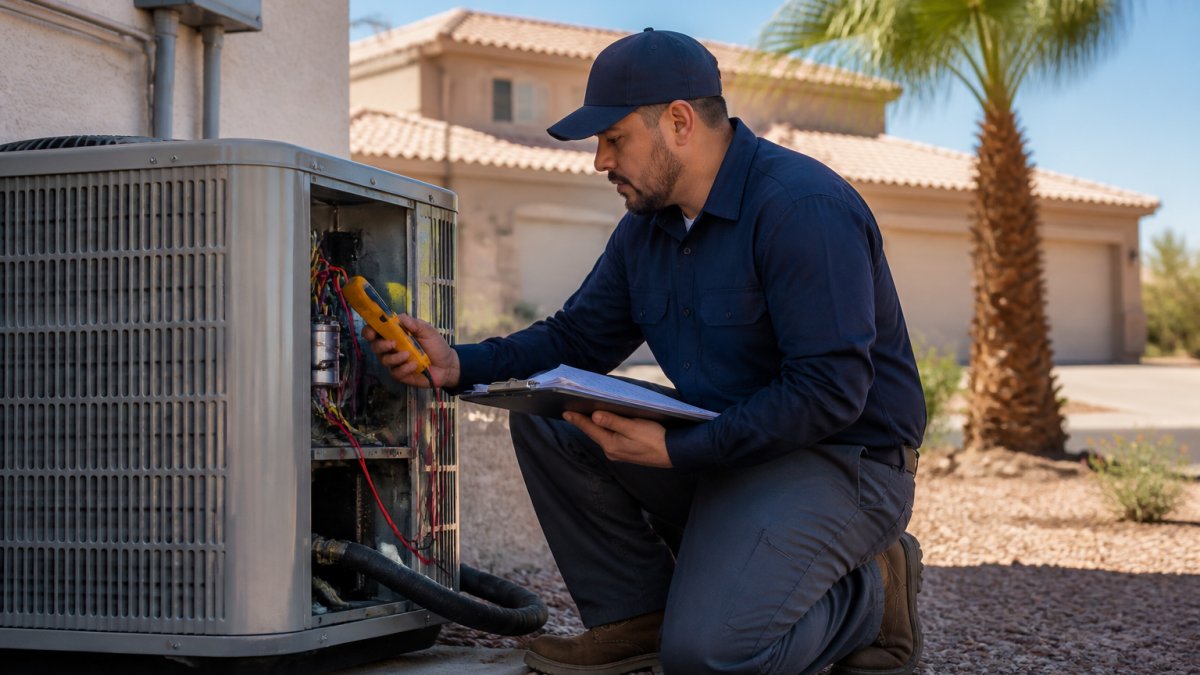
Labor rates vary by company, season, and time of day. A capacitor swap might take under an hour; a compressor replacement can take most of a day. That's why two quotes for the "same" repair differ: one bundles labor into a flat rate, the other itemizes it; one includes refrigerant handling, the other bills it separately; one credits the diagnostic fee, the other may not.
Call (702) 707-4242 for a free estimate →
Compare total installed cost, parts, labor, refrigerant, fees, and surcharges, not the advertised headline number. A lower headline price with add-on fees can cost more than a higher flat-rate quote.
Emergency AC Repair Cost: After-Hours and Same-Day Rates
Emergency AC repair costs more than a scheduled visit. That's not a scam; it's the economics of keeping technicians on call overnight and on weekends.
When you call at 2 a.m. during a heat wave, you're paying for after-hours labor premiums, overtime wages, and priority dispatch so you're not waiting behind a full daytime queue.
Same-day service during normal hours usually costs less than a true after-hours call.
The flip side: in extreme heat, waiting isn't always safe. RTS Comfort Cooling & Heating runs 24/7 emergency service for exactly this reason: a Las Vegas summer breakdown is a safety issue, not just an inconvenience.
AC Compressor Replacement Cost and Other Major Repairs
AC compressor replacement cost is the highest single line item in residential cooling repair.
Because of that, a compressor failure forces a real decision: repair or replace the whole unit?
Other major repairs fall into the same "big ticket" category: evaporator or condenser coil replacement, refrigerant line repair after a major leak, and blower motor replacement on older, hard-to-access units.
On a system near the end of its life, spending big on one of these repairs rarely makes sense. On a newer system, it usually does.
AC Repair vs Replacement: A Decision Framework
AC repair vs replacement is the decision that matters most, and it comes down to three factors: age, repair cost relative to replacement, and efficiency.
Use this framework:
- Under 8 years old, single failed part: Repair. The system has life left.
- 8-12 years old, moderate repair: Weigh it. If the repair is a small fraction of replacement cost, repair; if it's a large fraction, lean toward replacing.
- Over 12-15 years old, major repair (compressor or coil): Replace. You're likely to face another failure soon.
- Any age, repeated failures: Replace. A system that breaks every summer is telling you something.
There's also an efficiency angle. Newer, energy-efficient air conditioners use less power, and federal incentives like ENERGY STAR tax credit guidance can offset part of the upfront cost for qualifying equipment. If your old unit is a power hog, replacement can pay back over time through lower bills.
How to Avoid Surprise Charges and Vet a Contractor
The best defense against surprise charges is a written, itemized estimate before any work begins, with parts, labor, and fees listed separately.
Be wary of quotes dramatically lower than everyone else's.
If you want a straight answer on what your repair should cost, call (702) 707-4242 for a free estimate.
A failed AC in a Las Vegas summer is stressful, and the last thing you need is a vague bill on top of it.
Frequently Asked Questions
How much does AC repair typically cost in Las Vegas?
AC repair cost in Las Vegas varies by the fault, the system type, and whether the call is routine or after hours. Minor fixes like a capacitor or contactor swap sit at the low end, while compressor or coil work sits at the high end. Because pricing depends on parts availability, system age, and the specific diagnosis, RTS Comfort Cooling & Heating provides a written estimate before any work begins. Call (702) 707-4242 for a free estimate.
What is the average cost to fix an air conditioner?
Most single-fault repairs land in a moderate range once you combine the diagnostic fee, labor, and the replacement part. The final figure depends on whether the technician needs a single-run or dual-run capacitor, whether refrigerant must be recovered and recharged, and whether the unit is a standard split system or a packaged rooftop model common on older Las Vegas homes. Ask for an itemized quote that separates parts from labor.
Does emergency AC repair cost more than a scheduled visit?
Yes. Emergency AC repair cost is higher because after-hours, weekend, and holiday calls carry a premium on top of the standard service call and diagnostic fee. In a Las Vegas summer, a 2 AM failure during a heat wave is a genuine safety issue, so the premium is often worth paying. Confirm the after-hours rate on the phone before you authorize the dispatch.
Is it cheaper to repair or replace an air conditioner?
The repair vs replacement call usually comes down to system age, repair frequency, and the size of the current bill. A single inexpensive fix on a unit under 10 years old almost always favors repair. A compressor or evaporator coil failure on a system past 12 to 15 years, especially one that has needed multiple visits in two summers, usually favors replacement. Factor in federal tax credits and utility rebates for qualifying high-efficiency equipment before deciding.