 ultimate-guide
How to Find the Common Causes of AC Refrigerant Leaks
Last Updated: November 4, 2026
Quick Summary
The most common causes of AC refrigerant leaks in Las Vegas are worn flare fittings and service ports, cracked copper lines, pinhole leaks in coils, and loose Schrader valves. Desert heat and long cooling seasons put constant pressure on these points, and corrosion, vibration, and installation defects speed up the damage.
- Leaks most often occur at flare fittings and service ports where lines connect to the units.
- Copper lines passing through walls or resting on metal brackets are a frequent leak source.
- Constant thermal expansion and contraction fatigues metal at bends and joints over time.
- Warm supply air, ice on the lines, and hissing near the units are key warning signs.
- Never add refrigerant without finding and fixing the leak, since that only postpones failure.
Table of Contents
- Common Refrigerant Leak Locations in Your AC System
- Corrosion, Vibration, and Wear: The Slow Causes of Leaks
- Installation Defects and Physical Damage That Cause Leaks
- AC Refrigerant Leak Signs to Watch For at Home
- How HVAC Technicians Find Refrigerant Leaks and Confirm the Cause
- How to Prevent AC Refrigerant Leaks and Schedule Your Next Service Visit
- Frequently Asked Questions
If your air conditioner is blowing warm air or struggling to keep up on a 110-degree afternoon, a refrigerant leak is one of the most common culprits. The causes of these problems are more predictable than most homeowners expect. Refrigerant is the working fluid that absorbs heat from your indoor air and releases it outside. Our guide to why refrigerant leaks are dangerous explains the risks before you decide how urgently to act. When that charge drops, the system cannot move heat effectively, and the compressor works harder to compensate.
Desert conditions make the problem worse. Las Vegas systems run for long stretches at high outdoor temperatures, which puts sustained pressure on every joint, coil and line in the refrigerant circuit. Heat cycles expand and contract metal, and small weaknesses that might never fail in a milder climate can start to seep under constant load. Our advice is simple: treat a suspected leak as a repair issue, not a refill job, because adding refrigerant without fixing the leak only postpones the next failure.
Refrigerant is also not something to handle casually. Refrigerant handling is subject to federal regulation, so confirming a leak and repairing it is work for a qualified professional.
Common Refrigerant Leak Locations in Your AC System
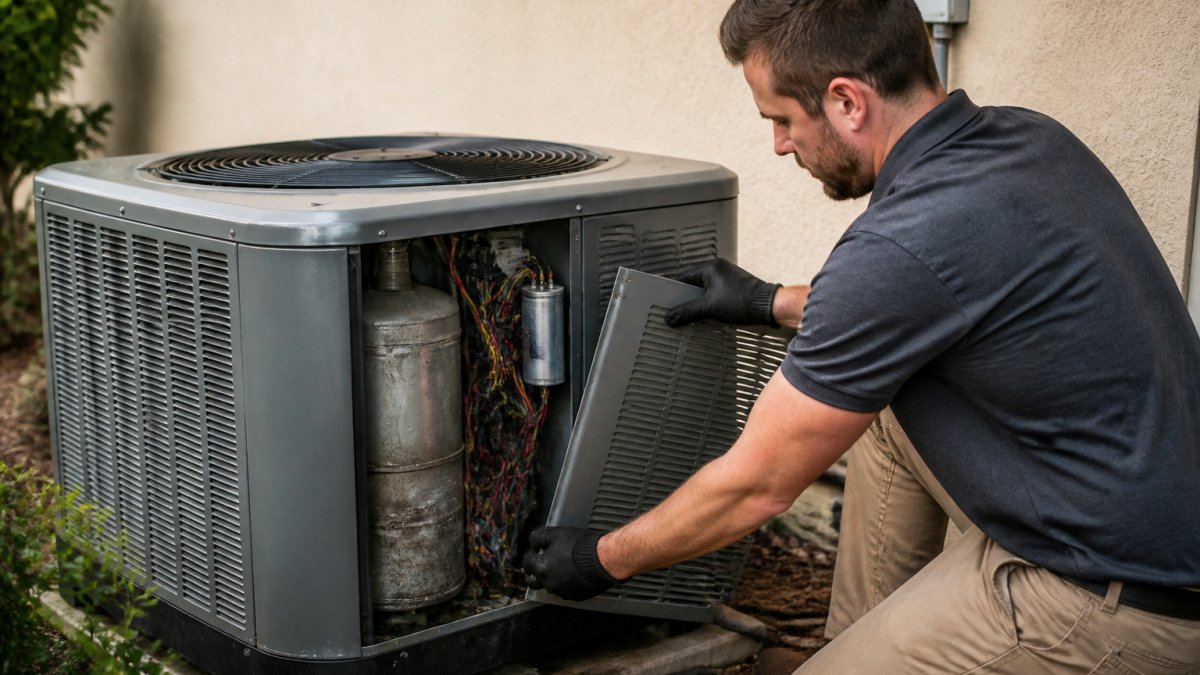
Leaks cluster in a few predictable places. The most common are the flare fittings and service ports where lines connect to the indoor evaporator coil and outdoor condenser. The copper refrigerant lines running between the two units are another frequent source, especially where they pass through walls or rest against metal brackets. Evaporator and condenser coils themselves can develop pinhole leaks, and the Schrader valves on service ports can seep when the core loosens or the cap is missing.
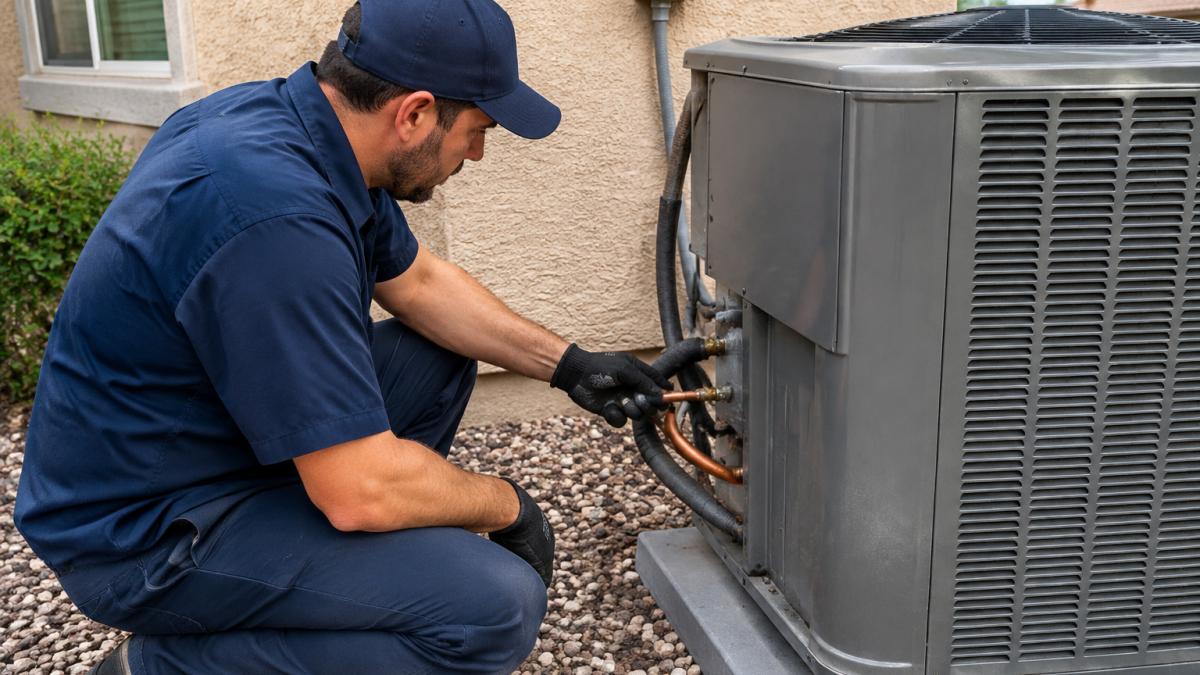
Knowing where to look helps you describe symptoms accurately when you call for service. A technician will check these points first with electronic detection equipment before moving on to deeper diagnosis.
Leaks cluster in a few predictable places, so knowing where to look helps you describe symptoms accurately.
| Leak location | Where it occurs | Typical source |
|---|---|---|
| Flare fittings and service ports | Where lines connect to the indoor and outdoor units | Connection points |
| Copper refrigerant lines | Between indoor and outdoor units | Walls and metal brackets |
| Evaporator and condenser coils | Within the coil units | Pinhole leaks |
| Schrader valves | On service ports | Loose core or missing cap |
Corrosion, Vibration, and Wear: The Slow Causes of Leaks
Not every leak comes from a single event. Corrosion is a gradual process: moisture and acids that form inside a system, or dissolved contaminants from poor cleaning practices, can eat through copper tubing and coil fins over years. Vibration from the compressor and fan motor loosens connections, while daily thermal expansion and contraction fatigues metal at bends and joints. Over a long service life, these forces work together.
System age matters. A unit that has run through many Las Vegas summers has accumulated more cycles of stress than one installed recently, so older equipment deserves closer inspection.
Installation Defects and Physical Damage That Cause Leaks
Some leaks start on day one. Poorly brazed joints, flare connections that were not torqued correctly, or lines that were not properly supported can fail early. Physical damage is another common cause: a lawn mower, a shifted fence or a careless contractor can kink or puncture a refrigerant line outdoors. Even a small dent in an exposed copper line can develop into a leak over time.
If your system was recently installed or repaired and starts losing cooling, ask the company to check their workmanship first.
AC Refrigerant Leak Signs to Watch For at Home
The most obvious sign is air from vents that feels less cold than usual, even when the thermostat is set low. Other signals include ice forming on the refrigerant line or evaporator coil, a hissing or bubbling sound near the indoor or outdoor unit, and a system that runs constantly without reaching the set temperature. Higher utility bills can also point to a charge problem, because the system takes longer to cool your home.
Refrigerant does not evaporate away on its own. If your system appears low, the charge has leaked out somewhere, and the leak should be found and fixed.
How HVAC Technicians Find Refrigerant Leaks and Confirm the Cause
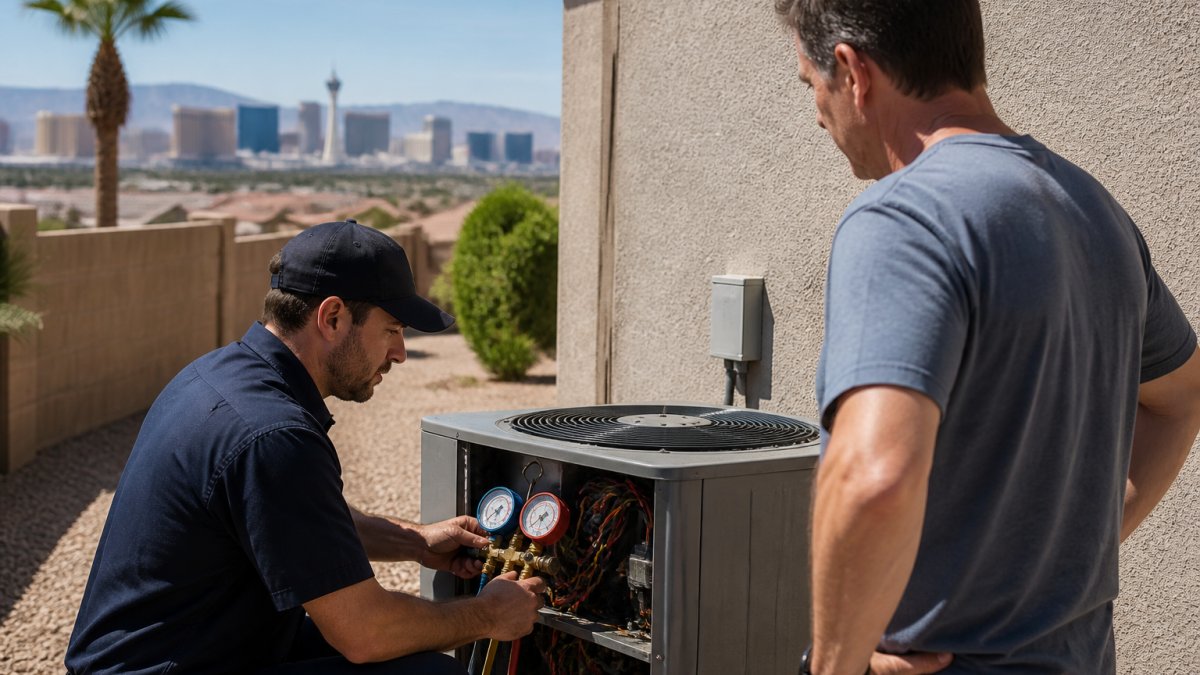
A refrigerant leak is easy to suspect and harder to prove. A technician's first job is to separate a charge problem from an airflow or electrical problem, because adding refrigerant to a system with a blocked coil or a weak blower will not restore cooling and can overcharge the system. Get emergency AC diagnosis from Las Vegas HVAC experts for a fast on-site check.
Call (702) 707-4242 for a free estimate →
A general diagnostic sequence for refrigerant leaks looks like this:
- Verify airflow and electrical operation first. Check the filter, inspect the evaporator coil for dust matting, confirm the blower is running at the correct speed, and test the capacitor and contactor. A system moving too little air will show low suction pressure and can frost a coil even with a full charge.
- Measure operating pressures and temperatures. Compare suction and liquid-line pressures against the manufacturer's target for the outdoor temperature, then calculate superheat and subcooling. Low superheat with low suction pressure points toward an overfeed or mechanical issue; high superheat with low suction pressure is the classic low-charge signature. Subcooling below target on a TXV system is another charge indicator.
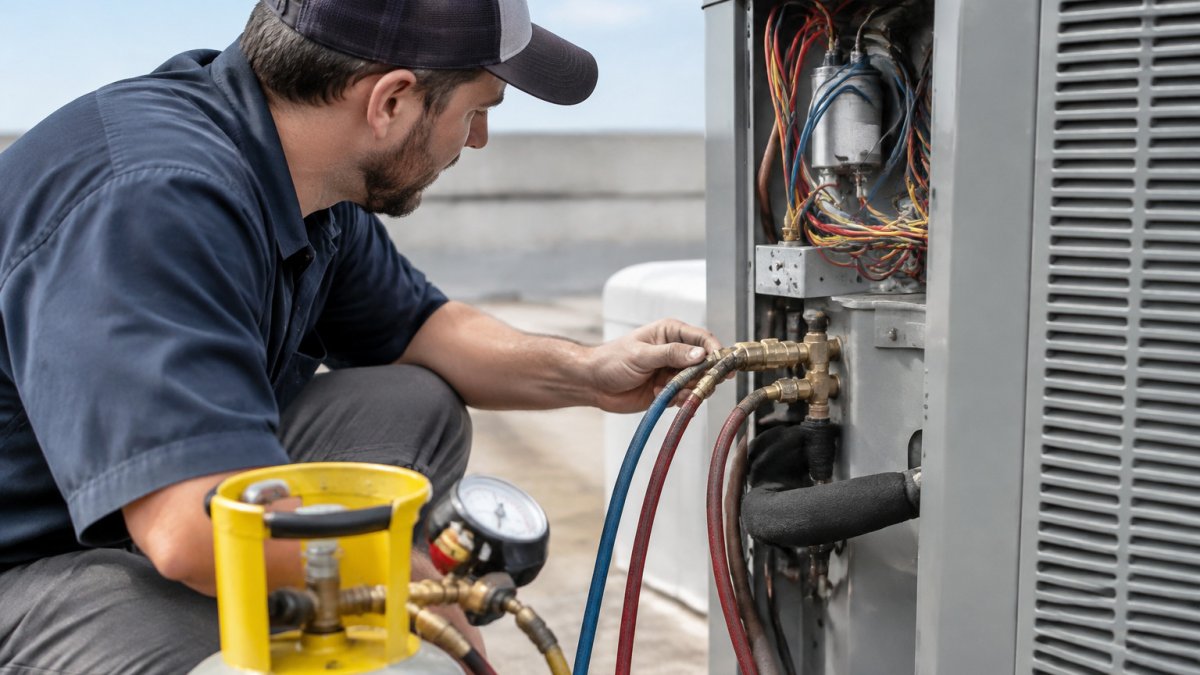
- Confirm the leak with a detector, not a guess. Electronic leak detectors sniff joints, service ports, and coil faces and are sensitive to the halogenated refrigerants used in most residential systems. Ultraviolet dye injected into the circuit shows up at the leak site under a UV lamp after the system runs. Bubble solution on a suspected joint is the simplest confirmation. Nitrogen pressure testing isolates a circuit that will not hold pressure and is the standard method when a leak is suspected but not located.
- Isolate the location. A leak at a flare fitting or Schrader valve is a fitting repair. A pinhole in an evaporator coil face, a rubbed copper line behind a wall, or a failed braze in the condenser is a different scope of work. The location drives both the labor and the parts.
Watch out: a system that is low on charge but shows no detectable leak on the first pass may have a leak in a location the detector cannot reach, such as inside a wall chase or under attic insulation. A second visit with dye or a pressure test is often needed before a repair is authorized.
Repair versus replacement. A single leaking Schrader core, a flare fitting, or a short accessible section of line is usually a straightforward repair. Replacement becomes the better economic choice when the leak is in an evaporator coil that is difficult to access, when the equipment is near the end of its expected service life, when the system has a history of repeat leaks, or when the compressor has already been stressed by running low on charge. Age, repair history, refrigerant type, and the cost of the repair relative to the cost of new equipment are the factors a technician should walk through with you.
How to Prevent AC Refrigerant Leaks and Schedule Your Next Service Visit
Prevention is mostly about reducing the stress that opens joints and wears through copper. You can schedule maintenance or consider a new installation with Las Vegas HVAC experts to keep the circuit sound. In this climate, systems run for many annual cooling hours, and the outdoor unit sits through high afternoon temperatures and wide day-night temperature swings. Each of those cycles expands and contracts the refrigerant lines and works the fittings.
What to do yourself:
- Change the air filter every one to three months. A clogged filter drops airflow, which lowers suction pressure and can frost the evaporator coil. Homeowners sometimes mistake a frosted coil for a refrigerant leak when the real cause is restricted airflow.
- Keep the outdoor unit clear. Remove leaves, dirt, and debris from the cabinet and keep at least two feet of clearance around it. A condenser that cannot reject heat runs hotter and at higher head pressure, which adds stress to every joint in the circuit.
- Do not stack or lean objects against the refrigerant lines. Vibration against a bracket or a wall is one of the slow causes of rubbed-through copper.
- Watch the drain and the pad. A clogged condensate drain can cause water damage and ice, and a settling pad can put strain on the line set.
What not to touch: Do not attempt to add refrigerant, tighten flare fittings on a live system, or open service ports yourself. Refrigerant handling is regulated under federal law, and the EPA requires certified technicians to service the circuit (the EPA). A homeowner who adds refrigerant without finding the leak is simply postponing the next failure and may overcharge the system.
What a professional tune-up should include: A spring inspection should cover operating pressures and temperatures, superheat and subcooling, a visual check of the line set and fittings for oil residue (a common leak indicator), an electronic leak scan of the service ports and coil faces, condenser coil cleaning, capacitor and contactor testing, and a condensate drain flush.
A practical schedule:
- Monthly: check or replace the filter.
- Quarterly: clear debris from around the outdoor unit and look for oil staining on the line set.
- Annually, before the cooling season: professional inspection and tune-up.
- Any time cooling drops, you hear hissing or bubbling, or ice appears on the lines: call for service rather than waiting for the next scheduled visit. If a leak may have damaged your system, you can book a repair with a Las Vegas HVAC technician.
Watch out: a system that needed refrigerant added last season and needs it again this season has an unresolved leak. Recharging without a leak search is the most common way homeowners end up paying for the same repair twice.
For a diagnosis or leak repair, call RTS Comfort Cooling & Heating at (702) 707-4242 for a free estimate. RTS Comfort Cooling & Heating offers 24/7 emergency service.
Frequently Asked Questions
What are the most common causes of AC refrigerant leaks?
The most common causes are corrosion of copper lines and coils, wear and vibration over years of operation, poorly brazed or flared joints from improper installation, and physical damage to exposed refrigerant lines. In Las Vegas, long cooling seasons and high summer heat put extra stress on these components, so systems often show problems sooner than in milder climates. Routine inspections help catch small issues before they become full leaks.
Where is the most common place for an AC refrigerant leak?
Leaks most often occur at brazed joints, flare connections, and the evaporator and condenser coils. The indoor evaporator coil and the outdoor condenser coil are exposed to moisture and temperature swings, which makes them prone to corrosion. Service valves and the line set connecting the indoor and outdoor units are also common leak points, especially where vibration or physical contact has stressed the copper.
How can I tell if my air conditioner has a refrigerant leak?
Common signs include warm air from vents, weak cooling even when the thermostat is set low, ice forming on the refrigerant line or evaporator coil, a hissing or bubbling sound near the lines, and rising energy bills from the system running longer. Some of these symptoms overlap with other problems such as a dirty air filter, so a technician should confirm the cause with pressure testing and leak detection.
Is it expensive to repair an AC refrigerant leak?
Pricing depends on where the leak is, how accessible it is, how much refrigerant must be recharged, and whether the system needs additional components replaced. Contact RTS Comfort Cooling & Heating at (702) 707-4242 for a free estimate.