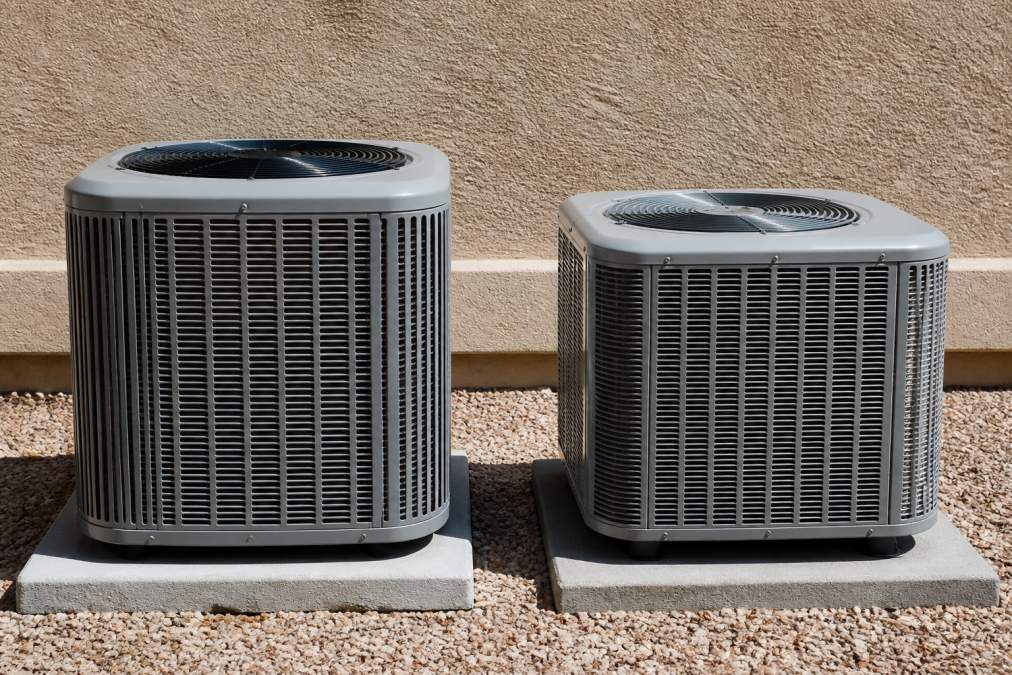
 comparison
Variable-Speed AC vs Single-Stage: Desert Climate Guide
Table of Contents
- Variable-Speed AC vs Single-Stage: Quick Comparison Table
- How Variable-Speed and Single-Stage Systems Work in Extreme Heat
- SEER2 Ratings for Desert Climates: What Actually Matters
- Cost of Variable Speed AC Installation vs Single-Stage
- Smart Thermostat Compatibility with Variable Speed Systems
- Desert-Specific Thermal Load and Humidity Control
- Maintenance, Repairability, and ROI in Remote Desert Areas
- Conclusion
- Frequently Asked Questions
Last Updated: September 16, 2026
Variable-Speed AC vs Single-Stage: Quick Comparison Table
Choosing between a variable-speed AC unit and a single-stage system in a desert climate comes down to one trade-off: higher upfront cost for steadier comfort and lower energy consumption, or a lower purchase price for a system that runs flat-out and cycles constantly. This guide from RTS Comfort Cooling & Heating breaks down how both behave above 100°F.
| Feature | Single-Stage | Variable-Speed |
|---|---|---|
| Compressor operation | Full on or full off | Modulates in small increments |
| Temperature swings | Noticeable, 2-4°F | Minimal, under 1°F |
| Humidity control | Limited | Strong, runs longer at low output |
| SEER2 ceiling | Lower | Highest available |
| Upfront cost | Lowest | Highest |
| Repair simplicity | Simple parts, easy diagnosis | More electronics, needs trained tech |
| Best for | Tight budgets, mild loads | Extreme heat, long runtimes |
How Variable-Speed and Single-Stage Systems Work in Extreme Heat
A single-stage AC runs at 100% capacity whenever the thermostat calls for cooling, then shuts off once the setpoint is reached. A variable-speed system adjusts compressor output continuously, matching capacity to the actual heat load. That difference matters more in the desert than almost anywhere else, because the heat load never really drops.
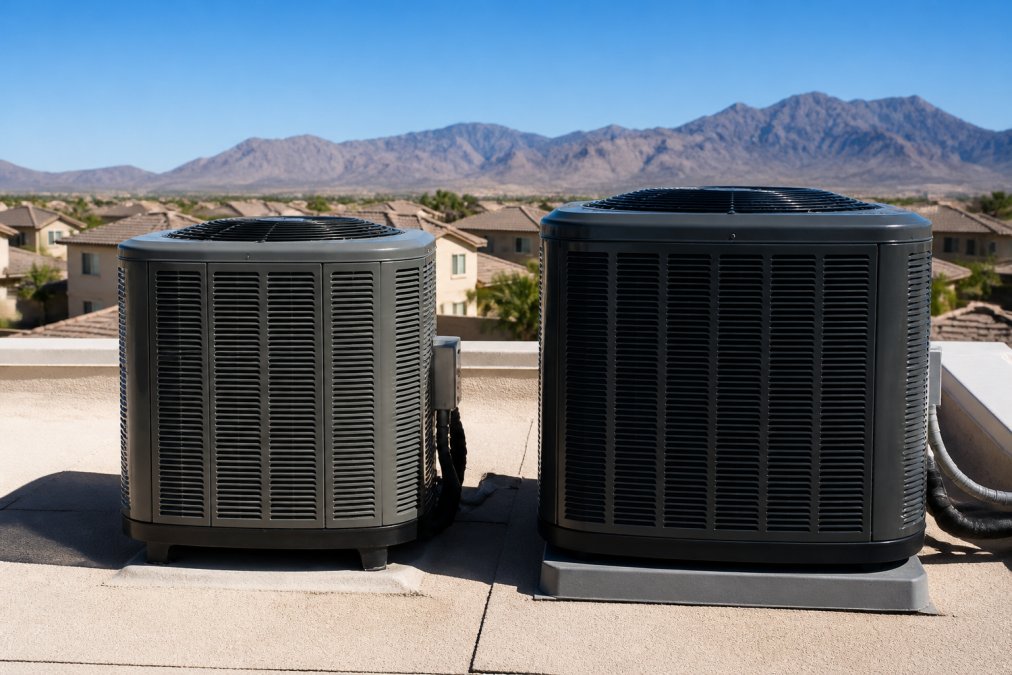
Single-Stage Operation
Single-stage systems are the simplest design in residential cooling: the compressor has one speed, on. In moderate climates, that cycle might run 15 minutes every hour. In a desert summer above 105°F, the system may run nearly continuously and still struggle to hold setpoint, short cycling during milder hours and marathon runtimes at peak load, both of which wear the compressor and drive up power consumption.
Variable-Speed Inverter Technology
Variable-speed systems use an inverter-driven compressor that ramps output up and down in fine increments rather than jumping between zero and full. Variable-speed systems adjust in small increments, letting the system hold a setpoint instead of chasing it. Running longer at lower output removes more moisture per hour and avoids the hard starts that shorten equipment life. The trade-off is complexity: more electronics and a technician who understands inverter diagnostics.
SEER2 Ratings for Desert Climates: What Actually Matters
SEER2 is a seasonal efficiency rating, and "seasonal" is doing a lot of work in a desert climate. The rating is a weighted mix of test conditions that includes mild part-load hours, the 80°F spring and fall afternoons that barely exist in a desert summer. When your system spends June through September near the top of its operating range, the headline SEER2 number describes a season you don't have.
The Three Numbers That Predict Desert Performance
Instead of shopping the seasonal rating alone, look at these specifications on the product data sheet:
- EER2 at full load: The efficiency number at peak capacity. Because desert systems run at or near full load for far more hours than the seasonal average assumes, EER2 tracks your real utility bill more closely than SEER2.
- High-ambient capacity: How many BTUs the unit delivers at elevated outdoor temperatures. Standard ratings are published at 95°F, but desert afternoons run well above that. A unit that loses a large share of rated capacity as ambient climbs will struggle to hold setpoint at 4 p.m. even though it looked properly sized on paper.
- Turndown ratio (minimum modulation): The lowest capacity the compressor can reach. A wide turndown lets the system run continuously at low output overnight and still ramp to full capacity at peak. A narrow turndown forces on/off cycling, erasing most of the efficiency and humidity benefit you paid for.
Why the Regional Standard Doesn't Settle the Question
The DOE energy efficiency standards for central air conditioners set minimum SEER2 levels by region, and the hottest region carries the highest floor. That floor keeps the least efficient equipment off the market, which is genuinely useful, but it's a minimum, not a ranking. Every unit you're comparing already clears the bar. The standard tells you nothing about which qualifying unit holds capacity best at 112°F, which one modulates lowest, or which one recovers fastest after a thermostat setback.
The Part-Load Trap
Here's the counterintuitive part: in a desert climate, a high-SEER2 single-stage unit can post a better seasonal number than a modest variable-speed unit and still cost more to run. Single-stage equipment earns its rating by cycling, running full-out, shutting off, repeating. Each cycle is efficient in isolation, but the repeated hard starts draw a current surge, stress the compressor, and leave the house swinging through temperature and humidity.
Cost of Variable Speed AC Installation vs Single-Stage
Variable-speed AC installation costs more than single-stage, and the gap is real. The equipment is more expensive, the installation is more involved, and the diagnostic tools required to commission the system add labor time. For instance, some variable-speed systems use communicating technology that requires the indoor and outdoor units to be matched and configured as a system, not just connected.
- Upfront investment: Variable-speed systems carry a higher equipment and labor cost. Single-stage is the cheapest option to install.
- Energy consumption: Variable-speed systems run longer at lower output, which cuts power consumption during part-load hours. Single-stage units cycle on and off at full draw.
- Repair costs: Single-stage systems use simpler, cheaper parts. Variable-speed systems use inverter boards and communicating controls that cost more to replace.
- System longevity: Single-stage units typically last 12-15 years. Variable-speed systems avoid hard starts, which extends compressor life.
Smart Thermostat Compatibility with Variable Speed Systems
Smart thermostat compatibility with variable speed systems depends on whether the thermostat supports communicating or multi-stage control. A basic smart thermostat designed for single-stage equipment often can't modulate a variable-speed compressor properly, so the system defaults to on/off operation and you lose the efficiency you paid for.
The compatibility question comes down to three things:
- Communicating vs. conventional wiring: Some variable-speed systems use proprietary communicating protocols. The thermostat has to speak that protocol or the system falls back to staged operation.
- Number of stages supported: A thermostat rated for two stages won't control a system with dozens of modulation steps.
- Dehumidification control: In a desert climate, the thermostat needs to command lower airflow for better dehumidification, which requires specific terminal connections.
ENERGY STAR guidance on smart thermostats and HVAC compatibility
Call (702) 707-4242 for a free estimate →
Desert-Specific Thermal Load and Humidity Control
Most buying guides treat "desert climate" as a label rather than a load profile. That's the gap worth closing, because the desert load profile is what separates a variable-speed system from a single-stage one, and where the ROI math lives.
What Makes Desert Thermal Load Different
Three forces drive cooling load in arid climates, and they don't behave the way mild-climate rules of thumb assume:
- Sustained high ambient temperature. In a mild climate, outdoor temperature peaks for a few afternoon hours and falls off. In a desert summer, ambient can sit above 100°F for much of the day and stay warm into the evening. The compressor never gets a cooldown window, so runtime is long and continuous rather than short and intermittent.
- Intense solar gain. Radiant heat through west- and south-facing glass and attic surfaces adds a large, predictable load spike in the late afternoon, right when ambient is highest. This is the hour that sizes the system, even though it's a small fraction of total cooling hours.
- Large daily temperature swing. Desert nights can drop dramatically from the afternoon peak. A system sized for the afternoon peak is oversized for the overnight low, which is exactly the condition that causes short cycling and poor moisture removal.
Why This Load Profile Favors Modulation
Put those three together and you get a system that needs to run many hours at part load, with a few hours of near-full load in the late afternoon. That's the operating envelope a variable-speed compressor is built for and a single-stage compressor is not.
Humidity Control Is the Underrated Desert Issue
Desert air is dry, so homeowners assume humidity is a non-issue. In a tightly built house it isn't. Showers, cooking, laundry, and occupants add moisture, and a tight envelope traps it. The problem isn't outdoor humidity, it's indoor moisture that never gets removed.
The ROI Angle Most Guides Skip
The desert load profile is also what makes the payback math work, or not. Because the system runs so many part-load hours, the efficiency advantage of modulation applies across a large share of total runtime, not just a few peak afternoons. The downside is that the same extreme conditions that create the savings also stress the equipment and, in remote areas, complicate repairs.
Maintenance, Repairability, and ROI in Remote Desert Areas
Repairability is where variable-speed systems get complicated. In remote desert areas, parts availability can add days to a repair. A single-stage system uses common components most supply houses stock. A variable-speed system may need a specific inverter board or communicating control module that has to be ordered, a multi-day wait in the middle of summer.
- Estimate your current annual cooling cost from your utility bills
- Get quotes for both a single-stage and a variable-speed replacement
- Divide the price difference by your estimated annual savings to get a payback period
Conclusion
The hardest part of this decision isn't the technology, it's the uncertainty about whether the higher upfront investment will pay off in your specific home. A proper load calculation, a realistic look at your utility bills, and a contractor who will show you the math turn that uncertainty into a clear answer. RTS Comfort Cooling & Heating provides free estimates, 24/7 emergency service, and full smart thermostat installation so your system is commissioned as a matched set.
Frequently Asked Questions
Why is variable-speed AC better for high-heat environments?
Variable-speed AC units adjust compressor speed in small increments, so they run longer at lower capacity instead of blasting on and off. In extreme heat, this reduces temperature swings and keeps the system from short-cycling. It also lowers peak load strain on the compressor, which can extend system longevity. For desert homes, the result is steadier cooling and less energy waste during the hottest part of the day.
Does a variable-speed AC unit help with humidity control?
Yes. Variable-speed systems run longer at lower speeds, which allows the evaporator coil to stay cold and pull more moisture from the air. Single-stage units cycle on and off quickly, so they remove less humidity. In desert climates where monsoon season can bring short bursts of humidity, this dehumidification advantage can make a noticeable difference in indoor comfort.
How much energy can I save with a variable-speed AC compared to single-stage?
Savings depend on your home's insulation, ductwork, thermostat settings, and local utility rates. Variable-speed units often have higher SEER2 ratings than single-stage models, which means less energy consumption per unit of cooling. Because they avoid hard starts and run at lower speeds, they can reduce power consumption during peak hours. A professional load calculation and energy audit can give you a more accurate estimate for your specific home.
Do variable-speed AC units require more frequent maintenance?
Variable-speed systems have more electronic components, including inverter boards and communicating controls, so they can require specialized diagnostics when something fails. However, routine preventative maintenance, such as filter changes, coil cleaning, and refrigerant checks, is similar to single-stage units. The key difference is finding a technician trained on inverter technology. Regular service helps avoid system cycling issues and keeps the unit running efficiently in extreme heat.
What is the lifespan difference between variable-speed and single-stage systems?
Single-stage AC units typically last 12 to 15 years, while variable-speed systems often last longer because they avoid the hard starts and stops that wear out compressors. In desert climates, where systems run almost continuously for months, the reduced mechanical stress of variable-speed operation can add years to the equipment's life. Proper installation and annual maintenance are the biggest factors in achieving that longevity.