 comparison
Repair vs Replace AC Unit: 2026 Decision Guide
Table of Contents
- Repair vs Replace AC Unit: The Short Answer
- Repair vs Replace Comparison Table
- AC Repair vs Replacement Cost: What Each Path Really Costs
- Signs You Need a New Air Conditioner
- AC Unit Lifespan: How Age Changes the Decision
- Energy-Efficient Air Conditioner Replacement: When Efficiency Pays Off
- Warranty, Rebates, Tax Incentives, and Financing
- Repair Quality, Diagnosis, and Second Opinions
- Frequently Asked Questions
Last Updated: October 17, 2026
Repair vs Replace AC Unit: The Short Answer
The repair vs replace AC decision usually comes down to three numbers: the unit's age, the repair quote, and how often it has broken down.
We run this same checklist on emergency calls across the Las Vegas Valley, where a failed condenser in July is not a comfort problem but a safety one.
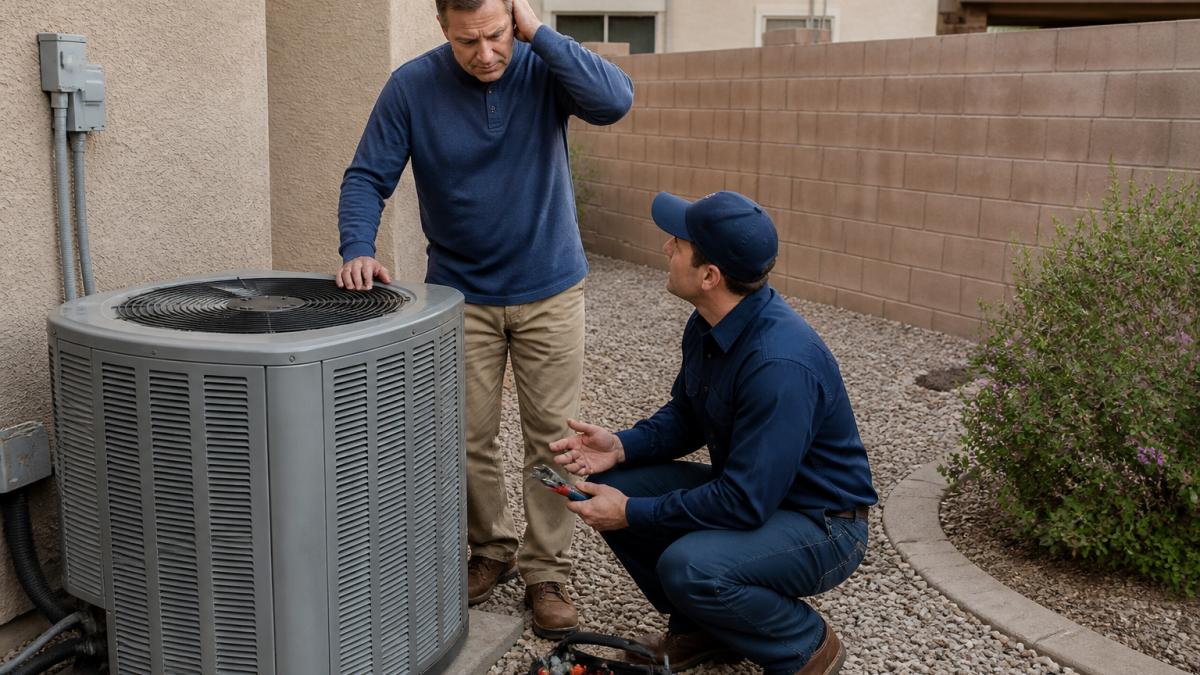
Repair vs Replace Comparison Table
Here is how the two paths stack up on the factors that actually drive the decision:
| Factor | Repair | Replace |
|---|---|---|
| Best for | Units under 10 years, one-off faults | Units 12+ years or repeat failures |
| Upfront cost | Lower, varies by part | Higher, varies by system size |
| Disruption | Hours | One to two days |
| Efficiency | Unchanged | Higher SEER2 rating |
| Warranty | Part only, often short | Full equipment and labor coverage |
| Lifespan gained | Months to a few years | 10-15 years |
| Refrigerant risk | Recurring if lines leak | New system, current refrigerant |
Neither column wins outright. The right answer depends on where your specific unit sits on age, repair history, and efficiency.
AC Repair vs Replacement Cost: What Each Path Really Costs
AC repair vs replacement cost is the question homeowners ask first, and the honest answer is that pricing depends on the diagnosis, system size, and parts required.
What we can tell you is how the math works, and how to run it yourself. Compare the repair estimate against a replacement estimate, not against zero. A repair that costs a third of a new system buys time.
What a Repair Quote Should Include
Before you compare anything, make sure the repair quote is complete. A usable quote lists the failed component, the diagnostic finding that led to it (pressures, electrical draw, airflow readings), the parts and labor separately, the refrigerant charge if lines are being opened, and whether the repair is covered by any remaining parts or labor warranty. A quote that says only "compressor replacement" is not a number you can weigh against a new system.
The 50% Repair-Cost Rule
The 50% rule is a simple threshold: if the repair quote exceeds half the cost of installing a new system, replacement usually wins.
Apply it with judgment. On a 6-year-old system, a repair at 55% of replacement cost can still be the smarter call, since you keep a decade of service life. On a 15-year-old system, the same ratio points clearly to replacement.
Lifetime Cost Comparison: A Worked Example
Picture a 13-year-old system with a failing compressor. The repair quote lands at roughly half of what a new system would cost to install.
Add the two paths over five years. Repairs tend to arrive in clusters on old equipment, so the "cheaper" option often closes the gap fast. That is the comparison most quotes never show you.
To make it concrete, build a five-year ledger with four lines for each option:
- Upfront cost, the repair quote for Option A, the installed price for Option B.
- Energy cost, estimate annual cooling cost from the unit's SEER or SEER2 rating and your local electric rate, then multiply by five. An older 10 SEER unit can draw roughly twice the electricity of a modern high-efficiency system for the same cooling.
- Maintenance and likely repairs, budget for at least annual service on both paths, and add a realistic allowance for one additional repair on the aging unit over five years.
When homeowners run this ledger honestly, the pattern is consistent: the repair looks cheaper in year one, the two paths converge around years three to four, and the replacement usually pulls ahead after that, especially when the old unit is past 12 years or already on its second major repair.
A Quick Decision Check
If you want a fast read before the full ledger, score four inputs: system age, repair quote as a share of replacement cost, number of repairs in the last two years, and the efficiency gap between your unit and current equipment. Two or more inputs pointing toward replacement is a strong signal to get a replacement estimate alongside the repair quote, not instead of it.
Signs You Need a New Air Conditioner
The clearest signs you need a new air conditioner are age past 12 years, three or more repairs in two years, rising energy bills with no usage change, and cooling that no longer keeps up. Any two of those together justify a replacement estimate.
Frequent Breakdowns and Repeat Repairs
Three service calls in 24 months is our replacement trigger. Each breakdown costs money and comfort, and the pattern signals that components are failing in sequence rather than in isolation. A system on its third summer of repairs is telling you something.
Uneven Cooling and Temperature Control
Rooms that never quite cool, or a system that runs constantly without reaching the thermostat setting, point to a unit losing capacity. Sometimes that is a duct or airflow issue worth fixing. Sometimes it is a compressor on its way out. A professional inspection separates the two before you spend.
AC Unit Lifespan: How Age Changes the Decision
AC unit lifespan runs 10-15 years for most systems, and the decision shifts as a unit approaches that ceiling. Under 10 years, repair is usually the default.
Age alone is a starting point, not a verdict. Two 12-year-old systems can be in very different condition depending on how hard they have run, whether they received annual maintenance, and what refrigerant they use.
Call (702) 707-4242 for a free estimate →
What Actually Shortens or Extends Lifespan
The biggest lifespan factors are run time, maintenance history, and installation quality. A system that runs nearly continuously in summer wears faster than one that cycles normally. Annual service, coil cleaning, refrigerant charge checks, electrical inspections, measurably extends life. Poor installation, undersized ductwork, or restricted airflow forces the compressor to work harder and shortens the service life of even a good unit.
Refrigerant Type and Repairability
Refrigerant type now shapes repairability, and it is where the age decision gets more nuanced than a simple rule.
- R-22 systems. Older equipment charged with R-22 faces scarce, costly supply because production and import for new equipment have been phased out under federal rules. A small leak on an R-22 system can sometimes be repaired and recharged, but the refrigerant cost alone can be significant, and a large leak or a failed compressor often makes repair uneconomical. If your technician flags an R-22 system with a significant leak, weigh replacement seriously.
- R-410A systems. The current transitional refrigerant remains available, so leaks and component failures on these systems are generally repairable. Repairability here depends more on the cost of the failed part and the unit's age than on refrigerant availability.
- Newer refrigerant systems. Equipment using the latest refrigerants is still under warranty in most cases, and parts are readily available, which favors repair for isolated faults.
A leak is not automatically a replacement sentence. The decision turns on leak severity, whether the leak is in an accessible line or buried in a coil, the cost of the refrigerant, and how much life the rest of the system has left.
How to Use Age in the Decision
Treat age as a weight, not a switch. Under 10 years, lean repair unless the repair quote is unusually high or the unit has a history of failures. Between 10 and 15 years, let the repair quote, refrigerant situation, and breakdown history decide. Past 15 years, plan for replacement and treat any repair as a short bridge rather than a long-term fix.
Energy-Efficient Air Conditioner Replacement: When Efficiency Pays Off
Energy-efficient air conditioner replacement pays off when your old unit's efficiency has fallen well behind current equipment. Every dollar of repair on an inefficient system buys more of the same high operating cost.
SEER Ratings and Older Equipment
SEER rating measures cooling efficiency, and older units sit far below today's standard. A system rated at 10 SEER uses roughly twice the electricity of a modern 20 SEER unit for the same cooling. Repairing that old unit locks in the higher bills. Replacing it cuts operating costs every month for the next decade.
U.S. Department of Energy guidance on central air conditioning efficiency
Warranty, Rebates, Tax Incentives, and Financing
Warranty coverage changes the math more than most homeowners expect. A repair on a system still under parts warranty costs less out of pocket, which can justify fixing a newer unit.
Replacement opens funding options repairs do not. Manufacturer warranties reset, utility rebates for high-efficiency equipment may apply, and federal tax incentives for qualifying heat pump and cooling systems change periodically.
ENERGY STAR rebate and tax credit locator
Repair Quality, Diagnosis, and Second Opinions
Repair quality starts with diagnosis. A technician who reads pressures, checks electrical draw, and inspects airflow finds the actual fault. One who guesses at the most common part sells you a repair that may not last.
Second opinions are worth the call on any major quote. Ask what failed, why, and what the repair includes. If the diagnosis is vague, get another set of eyes.
Frequently Asked Questions
When should I replace my AC instead of repairing it?
Replace when the unit is 10 to 15 years old, when a repair quote exceeds half the cost of a new system, or when you have had three or more service calls in 24 months. Frequent breakdowns, rising energy bills, and refrigerant leaks on older equipment all point toward replacement. If your system is under 10 years old and the problem is a single failed part like a capacitor, repair usually makes more sense.
How much should an AC repair cost before replacement makes more sense?
The 50% rule is the common benchmark: if the repair estimate is more than half of what a new system would cost, put the money toward replacement instead. A repair that costs a few hundred dollars on a 7-year-old unit is worth doing. A repair that runs into the thousands on a 14-year-old system rarely pays back, especially when that money could go toward a more efficient replacement.
Is it worth repairing an AC unit that is more than 10 years old?
It depends on the repair. A minor fix like a capacitor, contactor, or thermostat on an otherwise healthy 11-year-old system can be worth it. But once you pass 10 years, AC unit lifespan is working against you: parts get harder to find, refrigerant costs rise, and breakdowns become more frequent. If the repair is a major component like a compressor, replacement is usually the better long-term value.
Can replacing an air conditioner lower energy bills?
Yes. Older systems lose efficiency as they age, and an energy-efficient air conditioner replacement with a higher SEER rating can cut cooling costs noticeably. The savings depend on how inefficient your current unit is, how well your home is sealed and insulated, and how you set your thermostat. Duct cleaning, attic insulation, and a smart thermostat can add to the savings from a new system.
What are the signs you need a new air conditioner?
Watch for frequent breakdowns, repairs that keep coming back, warm air or uneven cooling, unusual noises, refrigerant leaks, and energy bills that climb without a change in usage. A unit that is 10 to 15 years old and needs repeated repairs is a strong candidate for replacement. A professional inspection can confirm whether the problem is a simple fix or a sign the system is near the end.
A failing system in peak summer heat leaves you choosing between emergency repairs and a rushed replacement. RTS Comfort Cooling & Heating handles both, with 24/7 emergency service, expert cooling installation, and smart thermostat setup that keeps temperature control steady and energy bills down. Call (702) 707-4242 for a free estimate and get a clear repair-or-replace recommendation before the next breakdown.