 how-to
Why Is My AC Not Cooling? 8 Common Causes Fixed
Table of Contents
- Why Your AC Is Not Cooling: Quick Diagnosis First
- How to Clean Your AC Air Filter (And Why It Matters)
- AC Thermostat Troubleshooting: Settings, Calibration, and Smart Thermostats
- Signs of Low Refrigerant in Your AC System
- Condenser Coil, Electrical, and Airflow Problems That Stop Cooling
- DIY Fixes vs. When to Call an HVAC Technician
- Preventative Maintenance Checklist to Keep Your AC Cooling
- AC Not Cooling in Las Vegas? Here's Your Next Step
Last Updated: August 9, 2026
Why Your AC Is Not Cooling: Quick Diagnosis First
Your AC not cooling properly is one of the most stressful problems a Las Vegas homeowner can face, especially when temperatures climb past 110°F. At RTS Comfort Cooling & Heating, we field dozens of calls every summer from homeowners whose systems are running but producing warm or barely cool air. Many failures trace back to a handful of predictable causes.
Before calling anyone, run through this quick self-diagnosis. It takes five minutes and can save you a service call.
Quick Diagnostic Checklist:
- Is the thermostat set to COOL mode and below the current room temperature?
- Is the outdoor condenser unit running? (Listen for the fan and compressor)
- Are any supply vents blowing warm air, or is airflow weak throughout the house?
- Has the system been running non-stop without reaching the set temperature?
- When did you last replace the air filter?
The eight causes below cover the vast majority of ac not cooling complaints. Work through them in order from simplest to most complex.
| Problem | Likely Symptom | Fix Type |
|---|---|---|
| Dirty air filter | Weak airflow, warm air | DIY |
| Thermostat misconfigured | System won't cycle on | DIY |
| Low refrigerant | Warm air, ice on lines | Professional |
| Dirty condenser coil | Reduced cooling capacity | DIY / Professional |
| Capacitor failure | Outdoor unit won't start | Professional |
| Tripped circuit breaker | No power to unit | DIY check, then Professional |
| Blocked vents / duct leaks | Uneven cooling | DIY / Professional |
| Improper unit sizing | Never reaches set temp | Professional |
How to Clean Your AC Air Filter (And Why It Matters)
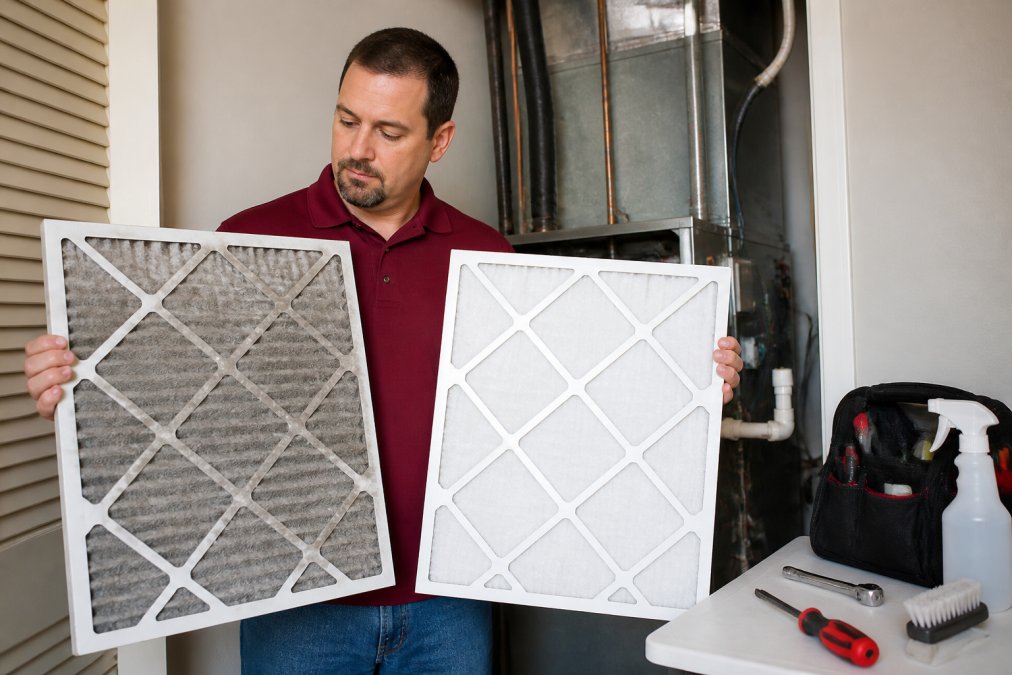
A clogged air filter is the single most common reason an AC stops cooling effectively. When blocked with dust, pet dander, and debris, airflow across the evaporator coil drops sharply. The coil can't absorb heat from your home's air, and the entire cooling cycle breaks down.
In Las Vegas, where dust storms and desert particulates are a year-round reality, filters clog faster than in most other climates. The U.S. Department of Energy guidance on air filter maintenance recommends checking filters monthly in high-use periods and replacing them at least every 90 days under normal conditions.
Step-by-Step Filter Cleaning or Replacement
- Turn off the system at the thermostat before touching anything.
- Locate the filter. Most residential systems have the filter at the return air grille on a wall or ceiling, or inside the air handler cabinet itself.
- Remove the filter carefully to avoid shaking loose debris into the ductwork.
- Inspect the filter. Hold it up to a light source. If you can't see light through it, it needs replacing.
- For reusable filters: Rinse with lukewarm water, let dry completely (at least an hour), and reinstall. Never reinstall a damp filter.
- For disposable filters: Note the size printed on the frame (e.g., 16x25x1), purchase the correct replacement, and insert it with the airflow arrow pointing toward the air handler.
- Restart the system and check airflow at a nearby vent within five minutes.
AC Thermostat Troubleshooting: Settings, Calibration, and Smart Thermostats
Thermostat misconfiguration is responsible for more "my AC isn't working" calls than most people expect. Confirm the system is set to COOL (not FAN ONLY, which circulates air without activating the compressor). Set the target temperature at least 3-4 degrees below the current room reading.
Thermostat calibration verifies that the temperature displayed matches the actual room temperature. A miscalibrated thermostat can read 72°F when the room is actually 78°F, causing the system to cycle off prematurely. To test this, place a reliable thermometer near the thermostat for 15 minutes and compare readings. A difference of more than 2°F warrants recalibration or replacement. Also check the thermostat's location, direct sunlight, proximity to lamps, or placement near a supply vent can cause false readings.
Smart Thermostat Issues Specific to Las Vegas Heat
Smart thermostats require a C-wire (common wire) for stable power. Without it, many smart models enter low-power mode causing erratic behavior and failure to call for cooling during peak demand. Las Vegas homes with older HVAC systems frequently lack C-wire wiring. If your smart thermostat was self-installed and the system worked fine before, check the wiring configuration first.
Other smart thermostat issues to check:
- Wi-Fi connectivity loss: Some models require a live internet connection for scheduling features.
- Software updates: Pending firmware updates can temporarily affect system response.
- Geofencing errors: Location permission changes on your phone can cause indefinite setback temperatures.
RTS Comfort Cooling & Heating installs and configures smart thermostats professionally, including C-wire installation where needed.
Signs of Low Refrigerant in Your AC System
Low refrigerant is one of the more serious causes of ac not cooling, and it's one you cannot fix yourself. Refrigerant doesn't "run out" like gasoline. If the level is low, there's a leak somewhere in the system.
Refrigerant is the chemical compound that circulates through the HVAC system's cooling cycle, absorbing heat from indoor air at the evaporator coil and releasing it outside at the condenser coil. When refrigerant levels drop, the system loses cooling capacity and efficiency.
Signs of low refrigerant include:
- Ice forming on the refrigerant lines or evaporator coil from the coil temperature dropping below freezing.
- Warm air from supply vents even when the compressor is running.
- Hissing or bubbling sounds near the indoor air handler or outdoor unit.
- Higher-than-normal energy bills with reduced cooling output.
- Short cycling: The system turns on and off rapidly without completing a full cooling cycle.
According to the EPA's guidance on refrigerant handling and Section 608 of the Clean Air Act, only certified HVAC technicians are legally permitted to purchase, handle, and recharge refrigerant. If you suspect low refrigerant, call a licensed HVAC technician who can locate and repair the leak before recharging the system.
Condenser Coil, Electrical, and Airflow Problems That Stop Cooling
Several mechanical and electrical failures can bring an otherwise healthy HVAC system to a complete stop.
Dirty or Blocked Condenser Coils
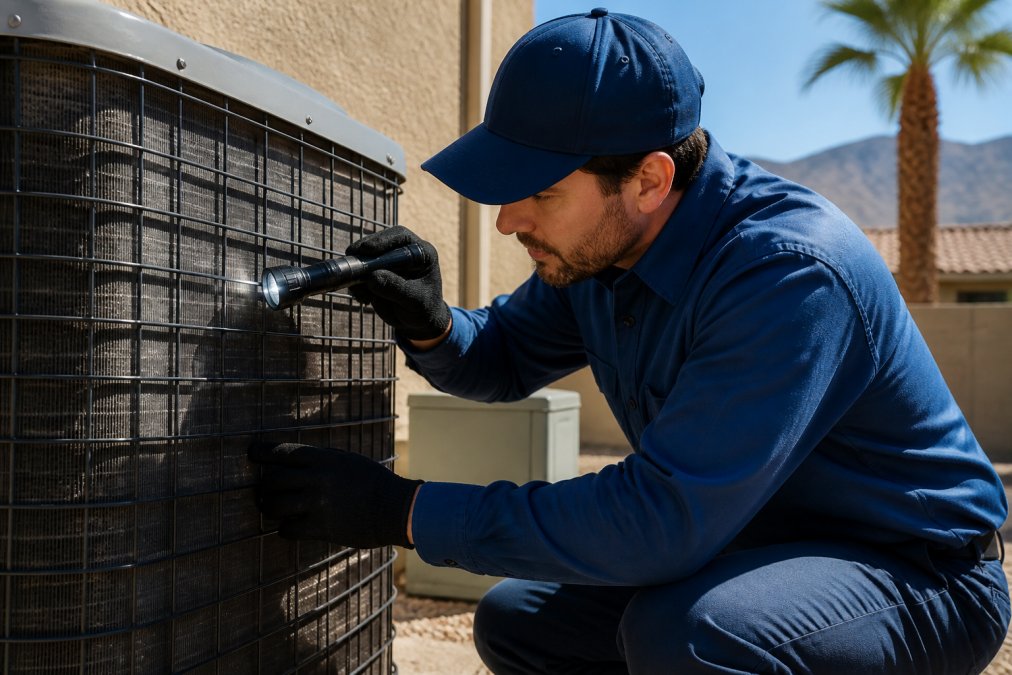
The outdoor condenser unit expels heat from your home into the outside air. When the condenser coil fins are clogged with dirt, cottonwood seed, or debris, heat transfer becomes severely restricted. The compressor works harder, the system loses cooling capacity, and in extreme cases the unit shuts down on thermal overload.
In Las Vegas, condenser coils face an unusually harsh environment: desert dust, high ambient temperatures, and cottonwood season all contribute to faster fouling. You can gently clean the coil fins from the outside with a garden hose on a low-pressure setting. Spray from the inside out to push debris outward. Never use a pressure washer, the aluminum fins bend easily and restrict airflow permanently. Clear at least two feet of space around the condenser unit.
Capacitor Failure, Tripped Circuit Breakers, and Electrical Faults
Capacitors are small cylindrical components that provide the electrical jolt needed to start the compressor and fan motors. Capacitor failure is one of the most common HVAC repairs in hot climates. When a capacitor fails, the outdoor unit may hum but fail to start.
A tripped circuit breaker is worth checking before assuming a major electrical fault. Locate your home's electrical panel and look for the breaker labeled for the AC or air handler. A tripped breaker sits in a middle position between ON and OFF. Reset it by switching it fully to OFF first, then back to ON. If it trips again immediately, stop. A repeatedly tripping breaker indicates a deeper electrical fault, short circuit, failed compressor, or wiring issue requiring a licensed electrician or HVAC technician.
Blocked Vents, Ductwork Leaks, and Improper Unit Sizing
Blocked supply or return vents reduce the volume of air moving through the system, causing the evaporator coil to freeze. Walk through your home and confirm every vent is fully open and unobstructed.
Ductwork leaks are a subtler problem. According to the U.S. Department of Energy's duct sealing guidance, leaky ducts in unconditioned spaces like attics can cause significant cooling losses. In Las Vegas, where attic temperatures regularly exceed 150°F in summer, duct leaks actively pump superheated air into your living spaces.
Improper unit sizing is the hardest problem to diagnose without professional help. An undersized system runs continuously without reaching the set temperature. An oversized system short-cycles, shutting off before adequately dehumidifying the air. Proper sizing requires a Manual J load calculation performed by a qualified HVAC technician.
DIY Fixes vs. When to Call an HVAC Technician
Most homeowners can safely handle a handful of ac not cooling issues without professional help. Knowing the boundary between DIY and professional territory protects both your safety and your equipment warranty.
Safe for homeowners to handle:
- Replacing or cleaning the air filter
- Checking and resetting thermostat settings
- Clearing debris from around the outdoor condenser unit
- Checking and resetting a tripped circuit breaker (once only)
- Clearing blocked supply and return vents
- Rinsing condenser coil fins with a low-pressure garden hose
Call a licensed HVAC technician for:
- Any refrigerant-related work (leak detection, repair, recharge)
- Capacitor, contactor, or electrical component replacement
- Compressor or blower motor diagnostics and repair
- Ductwork leak sealing and rebalancing
- Manual J load calculations for sizing questions
- Smart thermostat wiring issues involving the C-wire or multi-stage systems
- Any situation where the circuit breaker trips more than once
If the fix involves opening electrical panels beyond the breaker box, handling refrigerant lines, or working inside the air handler cabinet, it belongs in a technician's hands.
Preventative Maintenance Checklist to Keep Your AC Cooling
The most effective way to avoid an ac not cooling emergency is a consistent maintenance schedule. Las Vegas HVAC systems work harder than almost any in the country, and that workload accelerates wear on every component.
The Air Conditioning Contractors of America's maintenance standards outline what a comprehensive annual tune-up should include. Use this checklist to stay ahead of failures:
Monthly (homeowner):
- Check and replace air filter if needed
- Clear debris from around the outdoor condenser unit
- Confirm all supply and return vents are open and unobstructed
- Check the condensate drain line for standing water or algae buildup
Seasonally, Before Summer (homeowner + professional):
- Rinse condenser coil fins with low-pressure water
- Test thermostat calibration with a separate thermometer
- Inspect refrigerant lines for ice, frost, or visible damage
- Check circuit breaker labels and confirm correct amperage ratings
- Schedule professional tune-up before peak heat season
Annual Professional Maintenance:
- Refrigerant level check and leak inspection
- Capacitor and contactor voltage testing
- Blower motor and fan blade inspection
- Evaporator coil cleaning
- Ductwork inspection for leaks or disconnected sections
- Condensate pump and drain line flush
- SEER rating efficiency assessment
- Electrical continuity testing on all control wiring
AC Not Cooling in Las Vegas? Here's Your Next Step
Diagnosing why your ac is not cooling follows a logical sequence: start with the filter, confirm the thermostat, check the outdoor unit, and work inward toward more complex mechanical and electrical systems. Most homeowners can resolve simple issues themselves within an hour. Refrigerant leaks, electrical faults, ductwork failures, and sizing issues require professional diagnostics and licensed repair.
Las Vegas summers don't give you much margin for error. A system that's struggling in June will likely fail completely in July.
Frequently Asked Questions
Why would my AC be running but not cooling the house?
When an AC runs but produces no cold air, the most common culprits are a clogged air filter blocking airflow, low refrigerant from a leak, a frozen evaporator coil, or a failed capacitor preventing the compressor from doing its job. In Las Vegas summers, an undersized unit struggling against extreme ambient temperatures is also a frequent cause. Start with the filter and thermostat settings before calling a technician, then move to the outdoor condenser unit.
Can a dirty air filter really cause my AC to stop cooling?
Yes. A heavily clogged filter restricts airflow across the evaporator coil so severely that the coil can freeze solid, completely halting the cooling cycle. Even a moderately dirty filter forces the blower motor to work harder, reducing cooling capacity and raising energy bills. Replacing or cleaning the filter is the single easiest fix a homeowner can do, and it should be the first step in any AC not cooling troubleshooting checklist.
Should I turn my AC off if it's not cooling?
If the system is running but producing warm air, turn it off and let it sit for 30 minutes. This allows a frozen evaporator coil to thaw and prevents the compressor from overheating or short cycling, which causes expensive damage. After the thaw, replace the air filter and restart. If the problem returns within an hour, shut the unit down and contact an HVAC technician rather than running the system continuously.
When should I call an HVAC professional instead of fixing it myself?
Call a licensed HVAC technician for any issue involving refrigerant, electrical components like capacitors or the compressor, or ductwork inside walls. Refrigerant handling requires EPA Section 608 certification, and working on high-voltage components without proper training risks serious injury. If the AC is short cycling, making grinding or hissing noises, tripping the circuit breaker repeatedly, or the evaporator coil keeps freezing after a filter change, those are clear signals to stop DIY attempts and get professional diagnostics.
If your AC isn't cooling and the basic checks haven't resolved it, the problem almost certainly requires professional diagnosis. RTS Comfort Cooling & Heating provides 24/7 emergency HVAC service throughout the Las Vegas area, with experienced technicians equipped to handle everything from refrigerant leaks and capacitor failures to ductwork repair and smart thermostat installation. Call (702) 707-4242 for a free estimate and same-day service when available.
This article was written using GrandRanker