 how-to
How to Get Emergency HVAC Repair Covered by Home Insurance
Last Updated: November 9, 2026
Quick Summary
Most standard homeowners policies do not cover emergency HVAC repair when the cause is mechanical failure; they cover the system only when a listed peril such as fire, lightning, storm, or power surge damages it. Mechanical breakdown from age or wear is typically excluded, so check whether your policy names the peril and consider equipment breakdown coverage.
- A lightning strike is the cleanest HVAC claim because the cause is sudden, accidental, and easy to document.
- The resulting damage rule may pay for what a cause destroyed even when the cause itself is excluded.
- Equipment breakdown coverage is an add-on that pays for sudden electrical or mechanical failure of home systems.
- A home warranty is a service contract covering breakdown from normal use, not insurance for sudden events.
- Photograph the failure in place and get the technician's written diagnosis naming the cause before filing.
Table of Contents
- What Homeowners Insurance Actually Covers for Emergency HVAC Repair
- Wear and Tear vs. Sudden and Accidental Damage: Why Mechanical Breakdown Is Usually Excluded
- Does Homeowners Insurance Cover HVAC Replacement?
- How to Get Home Insurance to Pay for Air Conditioner Repairs
- Is HVAC Covered by Home Warranty? How Service Contracts Differ from Insurance
- HVAC Repair Insurance Claim Documentation: What to Collect Before You File
- When Your AC Fails Tonight: Booking Emergency Service and Protecting Your Claim
- Frequently Asked Questions
What Homeowners Insurance Actually Covers for Emergency HVAC Repair
Most standard homeowners policies do not cover emergency HVAC repair when the cause is mechanical failure. They cover the system only when a listed peril damages it. That distinction decides most claims before an adjuster ever opens the file.
A compressor dies at 11 p.m. in triple-digit heat, and the homeowner assumes insurance will help. Usually it won't, and knowing why saves you a wasted claim.
Homeowners insurance is a policy that pays to repair or replace your home and belongings after a sudden, accidental event listed in the policy. Damage from a covered event is eligible. Breakdown from age or wear is not.
Covered Perils: Fire, Lightning, Storm, and Power Surge
A covered peril is a specific event named in your policy. When one of these damages your HVAC system, the repair or replacement typically qualifies:
- Fire: flames, smoke, or heat damage to the unit or ductwork
- Lightning: a direct strike that fries controls or the compressor
- Storm: wind, hail, or falling debris that crushes or punctures the outdoor unit
- Power surge: a utility spike that burns out a circuit board, when the policy lists surge as a peril
A lightning strike is the cleanest claim you can file. The cause is sudden, accidental, and easy to document. A power surge sits closer to the line, so check whether your policy names it. If you suspect a surge killed your compressor, how to tell if a power outage damaged your AC compressor walks through the warning signs.
The Resulting Damage Distinction Most Homeowners Miss
Here is the gap that sinks claims. Your policy may exclude the cause but still pay for what the cause destroyed. That is the resulting damage rule.
Say a pipe bursts and water soaks your furnace's control board. The pipe failure might sit outside coverage. The water damage to the equipment often does not. Read your exclusions closely, because the same event can be half covered.
The Insurance Information Institute's guide to homeowners policies explains how named perils and exclusions interact. Understanding that structure is the difference between a paid claim and a denial.
Wear and Tear vs. Sudden and Accidental Damage: Why Mechanical Breakdown Is Usually Excluded
Mechanical breakdown is usually excluded because insurers treat it as maintenance, not catastrophe. A part that wears out over years is expected. Insurance exists for the unexpected.
Sudden and accidental damage means a single event you could not predict: a strike, a surge, a falling limb. Wear and tear means gradual deterioration from normal use.
A common mistake is filing a claim for a unit that simply aged out. The adjuster will ask for maintenance records, find none, and deny it. That denial stays on your claims history.
- Covered: a hailstorm dents the condenser coil
- Not covered: the condenser fails after twelve summers of service
- Covered: a surge burns the board
- Not covered: the board corrodes from years of moisture
If your system is older and failing, repair versus replacement becomes the real question. Our repair vs replace AC unit guide helps you decide before you call anyone.
Does Homeowners Insurance Cover HVAC Replacement?
Homeowners insurance covers HVAC replacement only when a covered peril destroyed the system. Age, wear, and mechanical failure do not trigger replacement coverage, no matter how expensive the new unit is.
When a covered event does total the system, the payout depends on your policy's valuation method:
| Valuation Method | How It Pays | Best For |
|---|---|---|
| Actual cash value | Replacement cost minus depreciation | Lower premiums, older systems |
| Replacement cost | Full cost of a new unit, no depreciation | Newer systems, fuller recovery |
Your deductible and policy limits also cap the payout. A high deductible can exceed a small repair, making a claim pointless.
One more trap: many policies cap outdoor equipment at a sub-limit well below the dwelling coverage. Check that number before you assume full replacement is covered.
How to Get Home Insurance to Pay for Air Conditioner Repairs
Getting insurance to pay for air conditioner repairs starts with proving a covered cause. The claim rises or falls on documentation, not on how hot the house is.
Follow this sequence:
- Stop and document. Photograph the damage before anyone touches the unit.
- Identify the cause. A licensed technician's written diagnosis carries weight with adjusters.
- Call your insurer. File promptly and get a claim number.
- Keep the damaged parts. Do not let anyone haul them away before inspection.
- Submit the estimate. A detailed, itemized repair estimate beats a verbal quote.
The National Association of Insurance Commissioners consumer resources outline how to file a property claim and what records adjusters expect. Follow that framework and you remove the easy reasons for denial.
Policy Endorsements That Fill the Mechanical Breakdown Gap
A policy endorsement is an add-on that broadens coverage for an extra premium. If you want protection for mechanical failure, this is where to look.
- Equipment breakdown coverage: pays for sudden electrical or mechanical failure of home systems, including HVAC
- Service line coverage: handles buried utility lines, not the unit itself
- Scheduled personal property riders: rarely useful for HVAC
Equipment breakdown coverage is the closest thing to real mechanical protection. Ask your agent specifically for it, because it is not standard.
Is HVAC Covered by Home Warranty? How Service Contracts Differ from Insurance
HVAC is covered by a home warranty only if you buy a service contract, and that contract is not insurance. A home warranty is a service contract that covers repair or replacement of systems that fail from normal wear, for a service fee per visit.
That is the opposite of insurance. Insurance handles sudden events. A warranty handles the breakdowns insurance excludes.
- Homeowners insurance: covers damage from named perils
- Home warranty: covers breakdown from normal use
- Both: can leave gaps if you read neither
Watch the fine print. Many contracts exclude systems past a certain age, cap payouts, and require proof of maintenance. A denied warranty claim usually traces to skipped service records.
HVAC Repair Insurance Claim Documentation: What to Collect Before You File
Strong documentation is what separates a paid claim from a denial. Gather everything before you call the insurer, not after, because the adjuster's first question is always the same: was this sudden, or was it coming for years?
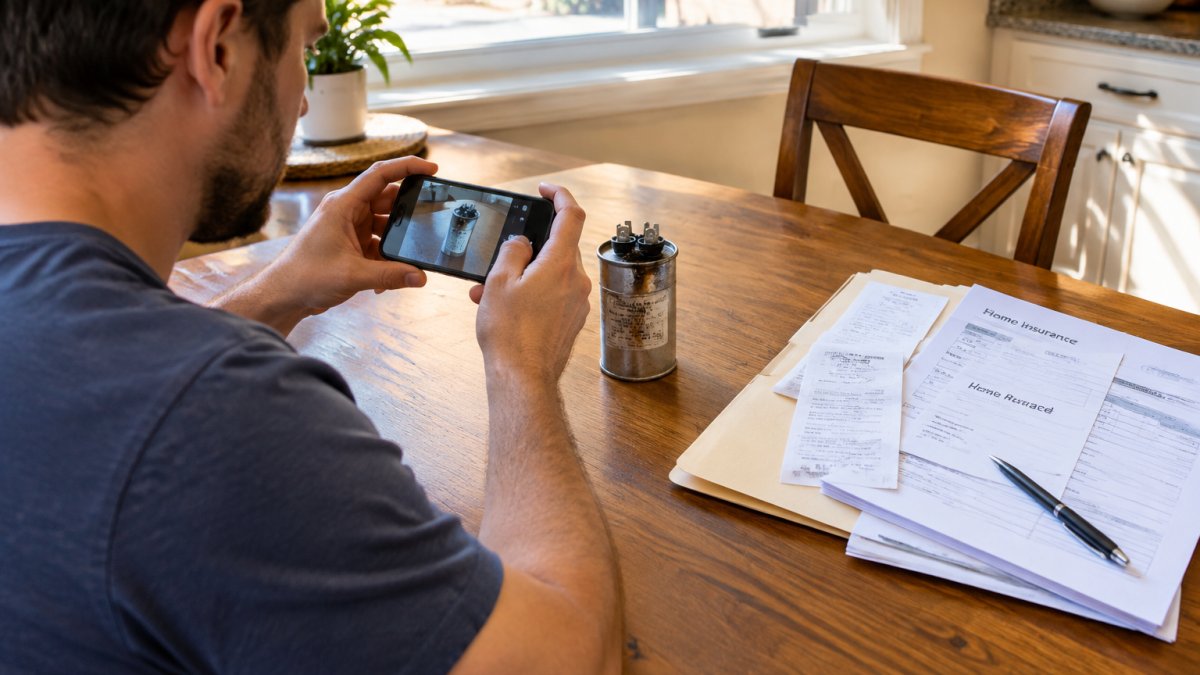
Use this checklist:
- Photos and video of the damage from multiple angles
- The technician's written diagnosis naming the cause
- Itemized repair estimate with part numbers
- Maintenance records showing regular service
- Proof of the triggering event, such as a storm report or utility surge notice
- Your policy number and claim number
- Receipts for any emergency work already done
How to Prove a 'Sudden' Event to an Adjuster
The checklist is the easy part. The hard part is building a record that answers the adjuster's real question: what changed, and when?
Get the technician's diagnosis in writing, with the cause named. A work order that says "compressor failed" is weak.
Preserve the failed part. Adjusters and carriers sometimes want to inspect the component. Do not let anyone haul it away before the claim is reviewed.
Show the maintenance history. Maintenance records do not prove a sudden event, but they remove the wear-and-tear argument.
Watch out: do not authorize permanent repairs before the adjuster has seen the damage, unless the repair is necessary to prevent further loss.
What a Claim-Ready Estimate Should Include
A vague invoice invites questions. A claim-ready estimate answers them before they are asked:
- Line-item pricing for parts and labor, not a single lump sum
- Part numbers and model numbers for the failed components and the proposed replacement
- The cause of failure restated in the contractor's own words
- The unit's age and serial number, so the adjuster can apply depreciation
- Photos attached to the estimate, not just referenced
- A separate line for emergency or after-hours charges, if any
Choosing the right contractor matters here too. Our guide on how to choose an HVAC contractor covers what a claim-ready estimate should include and how to spot an invoice that will slow your claim down.
Keep a Claim File From Day One
A simple folder, paper or digital, keeps the file coherent. Put the policy declarations page, the claim number, every photo, the technician's diagnosis, the estimate, and every receipt in one place. If the claim is denied and you appeal, that file is your case. If the claim is paid, the same file documents your loss for tax or warranty purposes.
When Your AC Fails Tonight: Booking Emergency Service and Protecting Your Claim
When your AC fails tonight, book emergency service immediately and document everything while the details are fresh. Heat is a health risk, and delay makes damage worse.
Call a 24/7 provider and ask two questions: what the after-hours rate is, and whether they will put the diagnosis in writing. Get both answers before you agree.
RTS Comfort Cooling & Heating offers 24/7 emergency HVAC service. We also provide duct cleaning, attic insulation, indoor air quality services, and smart thermostat installation.
You can book 24/7 emergency HVAC repair through our homeowner's guide, or reach our team directly to schedule service.
A failed AC in a heat wave is stressful enough without a denied claim on top of it.
Frequently Asked Questions
Can I use my homeowners insurance to replace my HVAC system?
Only if the replacement is tied to a covered peril such as a fire, lightning strike, or falling tree, not to age or wear. Most policies pay to repair or replace the HVAC system when sudden and accidental damage is the cause, and they pay actual cash value or replacement cost depending on your policy limits and deductible. A system that simply stopped working after 15 years is a maintenance issue, not a claim. Check your declarations page and ask your adjuster before scheduling work.
What is the $5,000 rule for HVAC?
The $5,000 rule is a common industry guideline: if a repair costs more than roughly $5,000, or more than half the cost of a new unit, replacement often makes more financial sense than repair. It is not an insurance rule and it does not trigger coverage. Insurers still look at cause, age, and policy limits. Use the figure as a decision tool when comparing a repair estimate against a furnace or AC replacement quote, and confirm the actual numbers with your contractor.
Does homeowners insurance cover HVAC repairs caused by normal wear and tear?
No. Wear and tear, gradual deterioration, and mechanical breakdown are standard policy exclusions. A compressor that fails from years of use, a rusted heat exchanger, or a blower motor worn out from age will not be paid. Coverage applies when a listed peril, such as fire, hail, lightning, or a power surge, damages the system suddenly. That is why maintenance records matter: they show the system was cared for and help separate a sudden event from long-term neglect.
What should I do before filing an HVAC insurance claim?
Stop using the system, photograph and video the damage, and keep the failed part until the adjuster inspects it. Call a licensed HVAC technician for a written diagnosis that names the cause, and gather maintenance records, purchase receipts, and your policy number. Report the claim promptly, since most policies require notice within a reasonable time. Do not authorize permanent repairs before the adjuster approves them, or the insurer may reduce the payout.