 how-to
Wildfire Smoke and Indoor Air: A Homeowner's Guide
Last Updated: November 6, 2026
Quick Summary
To manage indoor air pollution during wildfire smoke, first seal your home by closing windows, doors, and gaps, then run a MERV 13 or higher HVAC filter and a HEPA purifier sized to the room. Build one sealed clean-air room and track indoor PM2.5 with a monitor to confirm filtration is working.
- Close every window, shut exterior doors, and seal gaps around frames before running any filter.
- Choose a pleated HVAC filter rated MERV 13 or higher if your system handles the airflow.
- Pick a portable HEPA purifier sized by CADR for smoke, not marketing square footage.
- Set central air to circulate so air keeps passing through the filter.
- Skip candles and incense, and vacuum with a HEPA vacuum during smoke events.
Table of Contents
- How Wildfire Smoke Changes Your Indoor Air
- How to Keep Wildfire Smoke Out of House
- Choosing an HVAC Filter for Wildfire Smoke
- Picking a Wildfire Smoke Air Purifier and Sizing It Right
- Running Central Air and Cutting Indoor Particle Sources
- How to Test Air Quality After a Fire
- Renters and Homes Without Central HVAC: A Practical Plan
- Book an Indoor Air Quality Assessment Before Smoke Season
- Frequently Asked Questions
How Wildfire Smoke Changes Your Indoor Air
Wildfire smoke doesn't stay outside. Fine particulate matter, the tiny particles that make smoke dangerous, seeps through gaps you can't see and settles into your home within hours of a smoke event.
The particle that matters most is PM2.5, meaning particles small enough to travel deep into the lungs. According to the U.S. Environmental Protection Agency's particle pollution guidance, these particles are the main health concern in wildfire smoke because they bypass the body's usual defenses.
What PM2.5 Does Inside a Sealed Home
A sealed home slows smoke down. It does not stop it. PM2.5 particles are small enough to pass through window frames, door sweeps, and attic vents. Once inside, they linger in the air and settle into carpets, furniture, and ductwork.
The result: particle concentration builds up over hours, not minutes. You may not smell smoke, but the particles are still there.
Why Las Vegas Homes Are Not Automatically Safe
Desert homes are built to keep heat out, not smoke. Many rely on evaporative cooling or older ductwork with gaps. Both let particles in fast. Add wind-driven smoke from regional fires, and indoor air quality can drop even with the windows shut.
That's the part most guides skip. Sealing and filtering work together, and neither works alone.
How to Keep Wildfire Smoke Out of House
The fastest way to keep wildfire smoke out of house is source control: close the building envelope before you run any filter. Filtration cleans the air already inside. Sealing stops new smoke from entering.
Start with these steps:
- Close every window, even the ones you usually crack for airflow.
- Shut exterior doors and check the weatherstripping.
- Seal gaps around window frames with weatherstripping or caulk.
- Block the pet door if you have one.
- Turn off whole-house fans and any system that pulls outside air.
Sealing Gaps, Doors, and Windows
Walk your home with a flashlight at night while a helper runs an exhaust fan. Light shows through gaps you'd never spot by day. That trick finds the worst leaks in minutes.
Before you seal, it helps to know how to identify air leaks in your home with a simple room-by-room method. Fix the big gaps first. Small ones can wait.
Managing Heat While Staying Sealed
Here's the tension nobody warns you about. Sealing a home in extreme heat turns it into an oven. Indoor temperature climbs fast, and heat risk can outweigh smoke risk for older adults.
So run the air conditioner. Keep the fan set to circulate, not "on," so it recirculates indoor air instead of pulling in outside air. If the AC fails during a smoke event, that's an emergency, not an inconvenience.
Choosing an HVAC Filter for Wildfire Smoke
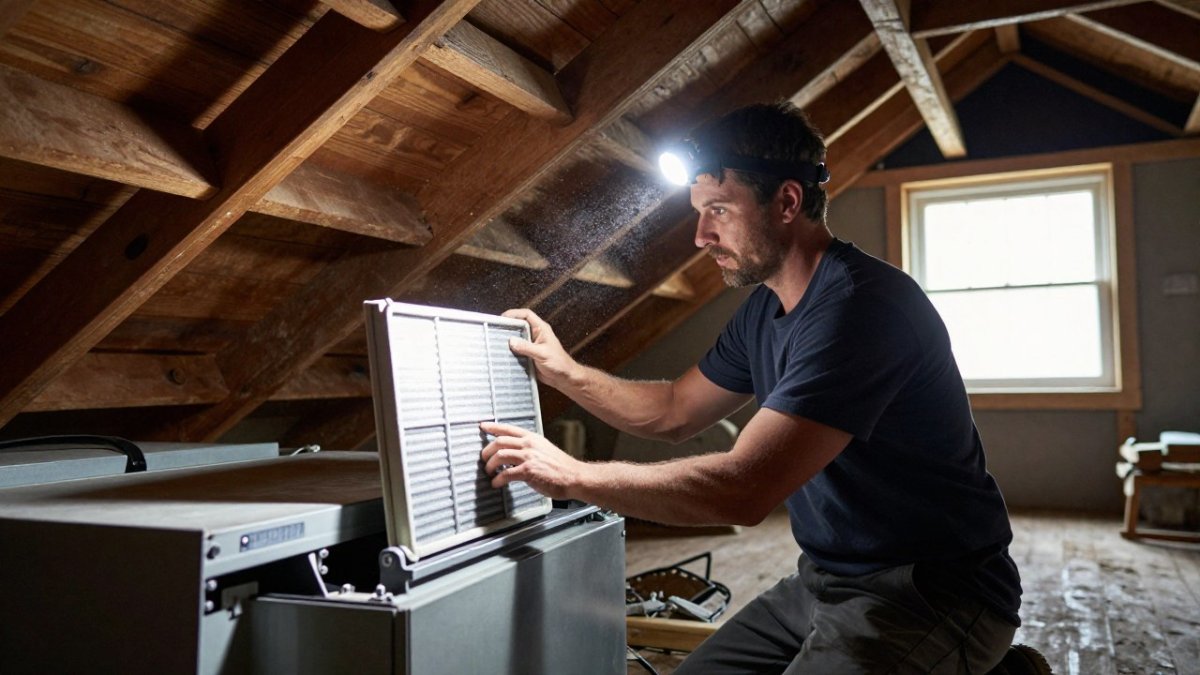
The best HVAC filter for wildfire smoke is a pleated filter rated MERV 13 or higher, if your system can handle the airflow.
Check three things before you buy:
- MERV rating: 13 is the practical sweet spot for smoke.
- Filter depth: match the slot exactly. A loose filter leaks air around the edges.
- Pressure drop: thicker filters (4 to 5 inches) handle high MERV better than thin ones.
Change the filter when it looks gray and loaded, and always keep a spare on hand during smoke season.
For a deeper look at ratings and compatibility, our guide to HVAC filters for dust and allergens breaks down which MERV levels fit common systems.
Picking a Wildfire Smoke Air Purifier and Sizing It Right
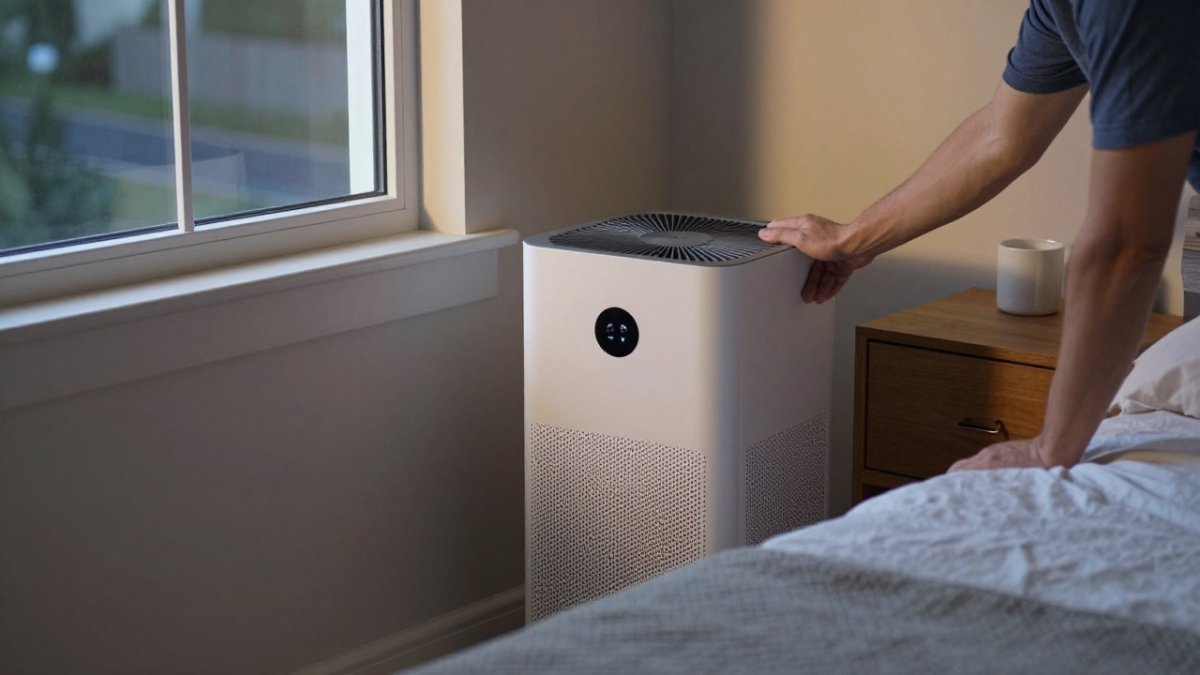
The right wildfire smoke air purifier is a portable unit with a true HEPA filter, sized to the room's clean-air delivery rate (CADR) rather than its marketing square footage.
The Sizing Math Most Buyers Skip
CADR is measured in cubic feet per minute (cfm) and is usually printed on the box or in the spec sheet, often listed separately for smoke, dust, and pollen. Use the smoke number.
Watch out: CADR ratings are taken at maximum fan speed, which is also the loudest setting. A unit that's technically large enough but too noisy to run on high overnight isn't doing the job.
Placement, Airflow, and the Clean-Air Room
A clean-air room is one sealed room where you concentrate filtration so you have a safe place to sleep and breathe. Pick a bedroom, close the door, and run a HEPA purifier continuously.
Placement rules that matter:
- Put the purifier near where you sit or sleep, not tucked against a wall or behind furniture.
- Keep at least a few feet of clearance on the intake and exhaust sides so air can actually circulate.
- Close the door to keep the cleaned air in; an open doorway to a smoky hallway undoes much of the work.
- Run it on high during smoke events, and drop to a lower speed at night only if noise keeps you awake.
For model comparisons, our roundup of the best air purifiers for wildfire smoke covers sizing and placement in detail.
Running Central Air and Cutting Indoor Particle Sources
Your central air system is a filtration tool, not just a cooling tool. Set the fan to circulate so air keeps passing through the filter even when the AC cycles off.
Then cut the sources you control:
- Skip candles and incense during smoke events.
- Cook with the range hood on, or use the microwave.
- Don't smoke indoors.
- Vacuum with a HEPA vacuum, or hold off until air clears.
- Wipe dust with a damp cloth instead of dry sweeping.
Ductwork also matters. Particles settle in ducts and recirculate every time the system runs. If your ducts haven't been cleaned in years, professional duct cleaning removes that built-up load before smoke season.
How to Test Air Quality After a Fire
To test air quality after a fire, check the local Air Quality Index (AQI) and use an indoor air monitor to read PM2.5 levels inside your home. The AQI is a 0 to 500 scale where higher numbers mean more pollution. Outdoor AQI tells you when to seal up. Indoor readings tell you whether your filtration is actually working.
Reading AQI and Monitor Numbers
Here's what the numbers mean for your decisions:
| AQI Level | What It Means | What to Do |
|---|---|---|
| 0-50 | Good air quality | Ventilate normally |
| 51-100 | Moderate | Sensitive groups should limit outdoor time |
| 101-150 | Unhealthy for sensitive groups | Seal up, run filtration |
| 151-200 | Unhealthy | Stay indoors, clean-air room on |
| 201+ | Very unhealthy to hazardous | Stay inside, run all filtration |
An indoor PM2.5 monitor shows whether particles are dropping while your purifier runs. If indoor numbers stay high, check your seals and filter. The AirNow fire and smoke map shows current conditions so you can time your sealing and cleaning.
For respiratory health, the Centers for Disease Control and Prevention's wildfire guidance recommends staying indoors and limiting outdoor activity when smoke is heavy.
What Consumer PM2.5 Sensors Can and Can't Tell You
This is the part most guides skip. Low-cost indoor monitors use optical sensors that estimate particle mass from scattered light. They're useful for spotting trends, not for lab-grade accuracy. A few practical limits:
- They drift. Readings can wander over weeks and need periodic recalibration or comparison against a known reference.
- Humidity skews them. High indoor humidity, common when you're running a swamp cooler, can inflate readings.
- They measure one spot. A monitor in the hallway says little about the bedroom where you sleep.
Use the monitor to answer one question: are indoor particles falling while filtration runs?
Where to Place a Monitor and How to Use It
Place the monitor in the room you actually occupy, at breathing height, away from the purifier's direct exhaust and away from cooking or candle sources. Take a baseline reading before you seal up, then watch the trend over an hour or two rather than reacting to a single number.
Watch out: don't chase a specific indoor PM2.5 target. Outdoor AQI can swing by the hour during a fire, and a consumer sensor's absolute number is less reliable than the direction it's moving. Compare indoor and outdoor readings side by side, and treat a sustained gap in your favor as confirmation that sealing and filtration are working.
Renters and Homes Without Central HVAC: A Practical Plan
No central system? You can still build clean air with portable units and smart habits. Renters have fewer options for sealing and ductwork, but the core plan works anywhere.
- Pick one room as your clean-air room and seal it with removable weatherstripping.
- Run a HEPA purifier sized to that room, on high during smoke.
- Use a window AC unit only if it recirculates and seals tightly around the frame.
- Keep a box fan with a high-efficiency filter as a backup for small spaces.
- Track indoor PM2.5 with a plug-in monitor.
Sensitive groups, including children, older adults, and people with heart or lung conditions, should talk with a doctor about an individualized plan.
Book an Indoor Air Quality Assessment Before Smoke Season
Smoke season rewards preparation. Sealing gaps, sizing filters, and setting up a clean-air room before smoke arrives makes a difference.
At RTS Comfort Cooling & Heating, we help homeowners get ahead of it. We can also schedule a professional assessment so you know exactly where your home leaks and which filter fits your equipment.
Get started with RTS Comfort Cooling & Heating and breathe easier before the next smoke event. Call (702) 707-4242 for a free estimate.
Smoke season doesn't wait for a convenient moment. Build your clean-air plan now, and call RTS Comfort Cooling & Heating when you need duct cleaning, filtration help, or emergency HVAC service.
Frequently Asked Questions
Do indoor air purifiers actually help with wildfire smoke?
Yes, when they use a true HEPA filter and are sized for the room. HEPA filters capture fine particulate matter, including the PM2.5 that makes wildfire smoke harmful. Match the purifier's clean-air delivery rate to the room's square footage, run it on high during heavy smoke, and keep windows and doors closed. A single small unit will not clean a whole house, so focus on the rooms where you sleep and spend the most time.
Should I run my HVAC system during wildfire smoke?
Run it with the fan set to circulate and the outdoor-air intake closed or minimized. A central system with a high-efficiency filter for wildfire smoke can filter indoor air continuously, but a standard low-MERV filter will not capture fine particles well. Check that your filter fits the slot correctly and change it more often during a smoke event. If the system is struggling or you smell smoke indoors, call an HVAC technician to inspect it.
How do I keep wildfire smoke out of my house without central air?
Seal gaps around doors and windows with weatherstripping or towels, keep everything closed, and use one or more portable HEPA purifiers in the rooms you use most. Set up a clean-air room with a purifier sized for that space. Avoid cooking, candles, and smoking indoors during the event. A box fan with a properly fitted filter can add filtration in a pinch, but a HEPA unit is more effective for fine particulate matter.
How do I test air quality after a fire?
Use a portable indoor air quality monitor that reports PM2.5, or check a local AQI source for outdoor conditions before you reopen windows. Compare indoor readings before and after ventilation to confirm levels are dropping. If odors or visible ash remain, clean surfaces with a damp cloth and vacuum with a HEPA-filtered vacuum. For persistent concerns, an HVAC professional can inspect ductwork and recommend filtration or duct cleaning.