 listicle
Why Switch to a Smart Thermostat: A Practical Guide
Table of Contents
- The Real Case for Switching to a Smart Thermostat
- Smart Thermostat Energy Savings: What You Can Actually Expect
- Smart Thermostat Compatibility: Will It Work With Your HVAC System?
- Smart Thermostat Installation Cost and What's Involved
- Remote Access and Automated Scheduling: Control From Anywhere
- Data Privacy, Security, and System Longevity Considerations
- Incentives, Rebates, and Finding Money to Help Pay for Installation
- Conclusion: Is a Smart Thermostat Worth It for Your Home?
Last Updated: August 18, 2026
The Real Case for Switching to a Smart Thermostat
Most homeowners think about upgrading their thermostat only when the old one stops working. That's a mistake. A smart thermostat isn't just a replacement, it's a fundamentally different approach to managing your home's climate. At RTS Comfort Cooling & Heating, we've installed smart thermostat systems and watched homeowners realize they were leaving money on the table with manual controls.
The shift from a traditional thermostat to a smart thermostat changes how your HVAC system operates. Instead of you manually adjusting temperatures throughout the day, the system learns your patterns, anticipates your needs, and makes adjustments automatically. This isn't theoretical, it's how modern homes manage energy consumption efficiently.
Here's what separates a smart thermostat from what you've probably been using: remote access means you control your heating and cooling from anywhere, automated scheduling eliminates the guesswork, and learning algorithms adapt to your actual behavior rather than forcing you into a preset schedule. The combination of these features addresses the core inefficiency in how most people use their HVAC systems, inconsistent manual adjustments that waste energy during periods when nobody's paying attention.
The question isn't really whether you should switch. It's whether you're willing to keep paying more than necessary to heat and cool your home.
Smart Thermostat Energy Savings: What You Can Actually Expect
Energy savings from a smart thermostat depend entirely on your current habits and your HVAC system's condition. If you're already disciplined about adjusting your thermostat manually, the savings will be modest. If you tend to leave your system running at the same temperature regardless of whether anyone's home, the improvements can be significant.
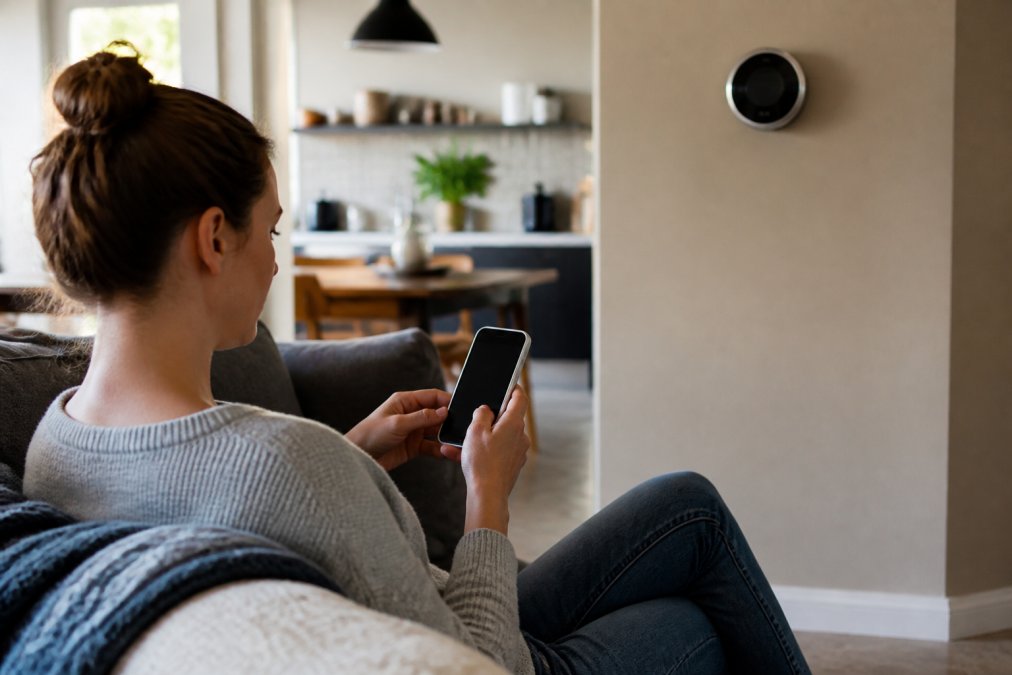
The Ecobee Smart Thermostat Premium, for example, is Energy Star certified and can deliver up to 26% in annual energy cost reductions. The Emerson Sensi Touch offers potential savings around 23% on HVAC energy consumption. These figures represent the upper range, actual results depend on several factors. Your climate zone matters. A home in a mild climate sees smaller absolute savings than one in an extreme climate. Your existing thermostat's age matters too. If you're upgrading from a 20-year-old manual unit, the difference will be more dramatic than replacing a programmable thermostat from five years ago.
The mechanics are straightforward: automated scheduling prevents your system from conditioning empty spaces. Geofencing features detect when you've left home and adjust temperatures accordingly. Learning algorithms identify your preferences and optimize heating and cooling cycles to match your actual schedule rather than a generic program. Over a heating and cooling season, these adjustments compound.
Real-world energy savings also depend on whether your HVAC system itself is in good working condition. A smart thermostat controlling an inefficient or poorly maintained system won't deliver the same results as one paired with a well-tuned unit. This is where professional installation matters. RTS Comfort Cooling & Heating ensures your entire system, thermostat, ductwork, and HVAC equipment, works together efficiently, which maximizes the energy benefits you'll actually see.
Smart Thermostat Compatibility: Will It Work With Your HVAC System?
Not every smart thermostat works with every HVAC system. This is the question that stops most people from upgrading, and it's legitimate. Compatibility depends on three main factors: your system type, your thermostat wiring, and whether a C-wire is present.
Most homes have either a heat pump system or a traditional split system with separate heating and cooling. Smart thermostats generally work with both. The real constraint is usually the C-wire, the common wire that provides continuous power to the thermostat. Older homes often lack this wire, which means the smart thermostat either won't work or requires an adapter.
Here's the practical breakdown. If your current thermostat has four wires (typically labeled R, W, Y, and G), you likely have no C-wire. Some smart thermostats handle this with built-in adapters or power-stealing technology. The Honeywell Home T9 Smart Thermostat includes a C-wire adapter if you need one. The Wyze Thermostat may require a separate adapter. The Emerson Sensi Touch requires a C-wire for all systems, which eliminates it as an option for some older homes without professional rewiring.
The Google Nest Learning Thermostat and Google Nest Thermostat both work with most systems, but the Nest Learning model can operate without a C-wire in some configurations. The Ecobee Smart Thermostat Premium and Ecobee Smart Thermostat Enhanced are similarly flexible.
Before purchasing any smart thermostat, take a photo of your existing thermostat's wiring or note which wires are connected. Match that against the compatibility requirements of the model you're considering. If you're uncertain or if your wiring is unusual, professional installation removes the guesswork entirely. RTS Comfort Cooling & Heating evaluates your specific system and installs the smart thermostat that actually works with what you have, rather than what you hope will work.
Smart Thermostat Installation Cost and What's Involved
Installation complexity ranges from straightforward to moderately involved, depending on your home's wiring. A basic installation, where the C-wire already exists and your system is standard, typically takes an hour or two. The thermostat mounts on the wall, wires connect to the corresponding terminals, and the system is configured through the mobile app.
Complications arise when a C-wire is absent or when your ductwork layout is unusual. Adding a C-wire means running new wire from your HVAC equipment to the thermostat location, which can require fishing wire through walls or drilling holes. This is the primary reason some homeowners hesitate, not because smart thermostats are expensive, but because installation might be.
The cost of installation varies significantly based on your home's layout and whether a C-wire needs to be added. Rather than guessing at a price, contact RTS Comfort Cooling & Heating for a free estimate. The team will assess your specific situation and explain exactly what's involved before any work begins. This transparency eliminates the surprise that comes with calling an unfamiliar contractor at 2 AM during an emergency.
The device itself ranges from budget-friendly options like the Wyze Thermostat (starting at $79.98) to premium models like the Ecobee Smart Thermostat Premium (starting at $259.99). The Google Nest Learning Thermostat costs $249, while the Honeywell Home T9 starts at $179.99 with a sensor. Installation labor is a separate consideration that depends on your home's requirements.
One detail most guides skip: a professional installation often includes configuration assistance, ensuring your smart thermostat is set up correctly for your habits and preferences from day one. This prevents the frustration of buying a sophisticated device and then settling for basic settings because the setup process was confusing.
Remote Access and Automated Scheduling: Control From Anywhere
The ability to adjust your thermostat from anywhere is the feature that changes daily life. You're stuck in traffic on a hot day, lower the temperature remotely so your home is comfortable when you arrive. You're at work and realize you left the heat on, turn it down from your phone. You're traveling and want to ensure your home maintains a minimum temperature to prevent freezing pipes, adjust it without calling a neighbor.
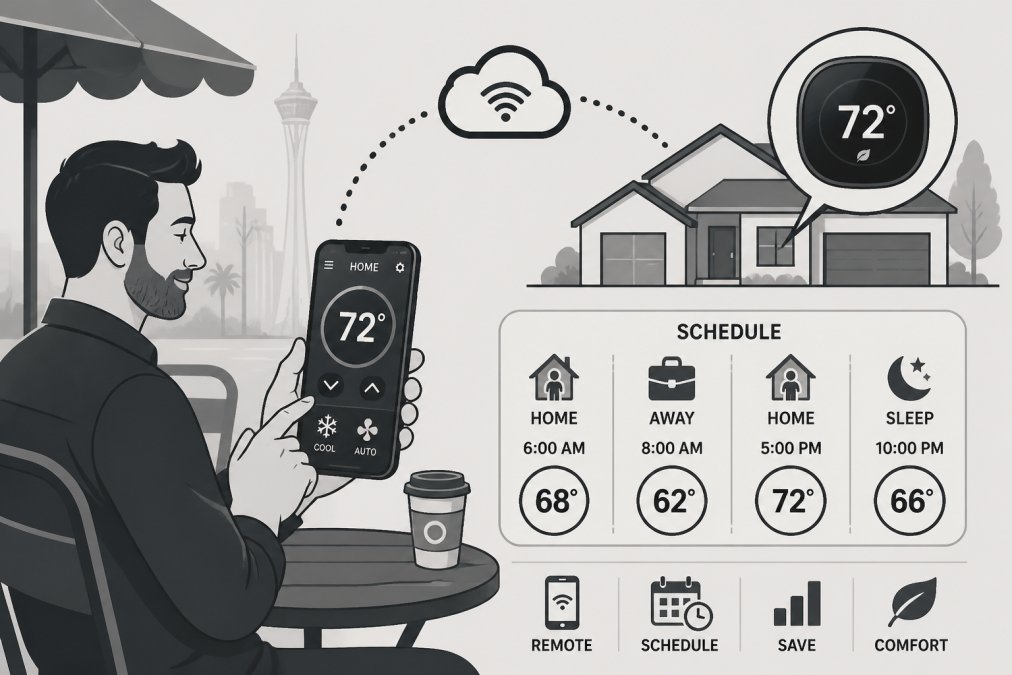
Every smart thermostat mentioned here, Google Nest, Ecobee, Honeywell, Emerson, Wyze, Amazon, and Lux, offers remote access through a mobile app. The interface varies slightly, but the core functionality is identical: view your current temperature, set a new target, and confirm the change from anywhere with internet access.
Automated scheduling is where the real efficiency gains happen. Rather than adjusting your thermostat manually each morning, evening, and night, you program a schedule once. Your system follows it automatically. Most models allow four or more time periods per day, so you can set different temperatures for early morning, daytime, evening, and night. The system switches automatically without any input from you.
Geofencing takes this further. Your smart thermostat can detect when everyone has left home using GPS from your phone, then automatically shift to an away temperature. When you're heading home, it can pre-condition your house so it's comfortable when you arrive. The Honeywell Home T9 and Lux Kono Smart Thermostat both emphasize geofencing as a core feature. This prevents the common scenario where someone forgets to adjust the thermostat before leaving, letting the system cool or heat an empty house all day.
The combination of remote access and automated scheduling means your HVAC system is no longer running on a fixed schedule or on your memory. It responds to actual occupancy patterns and your real-time needs.
Data Privacy, Security, and System Longevity Considerations
Every smart thermostat collects data about your home's temperature patterns and occupancy. This is how the learning algorithms work and how geofencing functions. The legitimate concern is what happens to that data.
Most manufacturers, Google, Ecobee, Honeywell, Amazon, state clearly in their privacy policies that they don't sell personal data to third parties. They use it to improve their services and, in some cases, to provide you with energy reports. That said, data collection is a real aspect of using any connected device. If privacy is a primary concern, review the specific manufacturer's privacy policy before purchasing. The information is public and detailed.
A secondary consideration is security. Your smart thermostat is connected to your home Wi-Fi network. A poorly secured system could theoretically be compromised. In practice, the risk is low if you follow basic security practices: use a strong Wi-Fi password, keep your thermostat's firmware updated, and enable two-factor authentication on your mobile app account if the manufacturer offers it.
System longevity is a topic most guides ignore entirely. Installing a smart thermostat doesn't harm your HVAC equipment, it actually tends to extend its lifespan. Because a smart thermostat optimizes heating and cooling cycles, your system runs more efficiently and experiences less strain. Fewer unnecessary cycles means less wear on compressors, motors, and other components. The system itself, if properly maintained, should operate reliably for 15-20 years or longer.
What does change over time is the smart thermostat device itself. Like any electronic device, it has a lifespan of 10-15 years before components begin to degrade. This is substantially longer than a traditional thermostat, but it's not indefinite. Plan for eventual replacement, though most owners find that the energy savings over a decade easily justify the initial investment.
Incentives, Rebates, and Finding Money to Help Pay for Installation
Many utility companies offer rebates or incentives for installing energy-efficient smart thermostats. These programs vary by location and utility provider. Some offer $50-$200 rebates simply for purchasing an Energy Star certified model. Others provide larger incentives if you use their preferred installer.
The first step is to contact your local utility company directly. Ask specifically whether they have a smart thermostat rebate program. Some utilities have dedicated energy efficiency programs with online portals where you can check your eligibility and apply for rebates. The application process typically requires proof of purchase and sometimes proof of installation.
Federal tax credits for energy-efficient home improvements may also apply, though the specifics change year to year. Check the IRS website or consult a tax professional to determine whether your smart thermostat installation qualifies for any current credits.
Some manufacturers also run promotions. Google, Ecobee, and Honeywell periodically offer discounts or bundle deals. Checking their websites directly, especially during seasonal transitions (spring and fall), can reveal temporary price reductions.
The practical approach: calculate the total cost (device plus installation), identify any available rebates from your utility, and subtract that from your out-of-pocket expense. Then consider the energy savings you'll likely see over five years. For most homeowners, the math works out, the device pays for itself through reduced utility bills before it reaches the end of its useful life.
RTS Comfort Cooling & Heating can advise you on available rebates in your area and help you navigate the application process. Having a professional handle the installation also ensures your system qualifies for any rebates that require professional installation.
Conclusion: Is a Smart Thermostat Worth It for Your Home?
A smart thermostat is worth installing if you want to reduce your utility bills, gain remote control over your home's climate, and ensure your HVAC system operates efficiently. The device itself is affordable, installation is straightforward in most homes, and the energy savings accumulate over time.
The real question is whether your current setup, manual adjustments, fixed schedules, or an aging thermostat, is costing you more than it should. If you're paying for heating or cooling when nobody's home, or if you frequently adjust your thermostat manually without a consistent pattern, a smart thermostat will deliver measurable improvements.
RTS Comfort Cooling & Heating provides professional smart thermostat installation with full system evaluation, ensuring your thermostat works seamlessly with your existing HVAC equipment and is configured for your specific home and habits. Call (702) 707-4242 for a free estimate and let our team explain exactly what's involved for your situation.
Frequently Asked Questions
How much energy can a smart thermostat actually save?
Energy savings depend on your current thermostat, climate, and how actively you adjust temperatures. Most smart thermostats are Energy Star certified and can reduce HVAC energy consumption by 10-26% annually. Learning algorithms and automated scheduling help eliminate waste from heating or cooling empty homes. Actual savings vary by usage patterns and local utility rates, so request a personalized estimate from a professional installer.
What happens if your Wi-Fi goes out with a smart thermostat?
Your smart thermostat continues to operate normally using its last programmed settings. You won't have remote access through your mobile app until Wi-Fi reconnects, but the device maintains temperature control locally. Most smart thermostats have backup battery power and store schedules in memory, so a temporary internet outage won't leave you without heat or cooling.
Can you replace a traditional thermostat with a smart thermostat yourself?
Installation difficulty depends on your HVAC system's wiring. If your system has a C-wire (common wire), installation is straightforward for confident DIYers. Without a C-wire, you may need an adapter or professional installation. Compatibility issues with older HVAC systems can create unexpected problems. Professional installation ensures proper setup, system compatibility, and warranty coverage, contact RTS Comfort Cooling & Heating at (702) 707-4242 for a free estimate.
Are there downsides to smart thermostats I should know about?
Smart thermostats require Wi-Fi connectivity and internet-connected devices introduce security considerations. Some models require a C-wire, adding installation complexity. Initial cost is higher than traditional thermostats, though energy savings often offset this over time. Learning algorithms may take weeks to optimize, and data privacy depends on the manufacturer's practices. Weigh these against long-term energy savings and convenience benefits for your specific situation.
The choice isn't between a traditional thermostat and a smart one. It's between paying more than necessary to heat and cool your home, or investing in a system that learns your patterns, responds to your actual needs, and reduces energy waste automatically. The smart thermostat wins that comparison every time.
This article was written using GrandRanker