 blog
Best HVAC Filters for Desert Dust and Allergens in 2026
Last Updated: October 23, 2026
Quick Summary
The best HVAC filters for desert dust and allergens are pleated filters rated MERV 9 through MERV 13, sized to fit your cabinet without gaps, and changed on a dust-driven schedule rather than a calendar. That combination captures fine particles without choking airflow in a system built for a milder climate.
- For most homes, MERV 8 to MERV 13 is the practical range, with MERV 11 to MERV 13 the better target when airflow allows.
- A four-inch MERV 13 has roughly four times the media surface of a one-inch MERV 13, holding far more dust.
- Measure the actual filter, since a 20x25x1 often measures closer to 19.5 x 24.5 x 0.75 inches.
- During dusty months, inspect the filter every 30 days and replace it if you cannot see light through it.
- A true HEPA filter is not built for a standard residential HVAC system because of its pressure drop.
Table of Contents
- Why Desert Dust Demands a Different HVAC Filter
- Best MERV Rating for Dust and Allergies: Finding the Sweet Spot
- Pleated, Electrostatic, or Disposable: Which Filter Type Handles Desert Dust
- HVAC Filter Size Guide: Fit, Bypass Leakage, and Cabinet Sizing
- HEPA Filter vs. HVAC Filter: What Your System Can Actually Handle
- HVAC Filter Replacement Frequency in Dusty Climates
- Balancing Filtration With Airflow and System Compatibility
- Frequently Asked Questions
Why Desert Dust Demands a Different HVAC Filter
The best HVAC filters for desert dust and allergens are pleated filters rated MERV 9 through MERV 13, sized to fit your cabinet without gaps, and changed on a dust-driven schedule rather than a calendar. That combination captures fine particles without choking airflow in a system built for a milder climate.
Desert dust is not pollen in a wet climate. It arrives in volume, stays airborne longer because indoor air is dry, and includes fine particles that slip past cheap fiberglass panels.
The tension most guides ignore: a filter dense enough to catch fine dust restricts airflow, while one loose enough to protect airflow lets dust through. Everything below is about balancing that for your system.
Best MERV Rating for Dust and Allergies: Finding the Sweet Spot
For most homes fighting dust and allergies, MERV 8 to MERV 13 is the practical range, with MERV 11 to MERV 13 the better target where the system can handle the added resistance.
The U.S. Environmental Protection Agency's guide to indoor air quality and filtration is a useful starting point for understanding what different efficiency levels actually remove. Higher MERV means finer capture, but it also means more resistance to airflow.
MERV 8 vs. MERV 13: What Each Captures
MERV 8 handles the basics: a solid share of pollen, mold spores, and larger dust, with little airflow penalty. For households without allergy sufferers and systems that struggle to move air, it is a reasonable floor.
MERV 13 is the step up that matters for allergy season, capturing far more fine particles, including the fraction that stays suspended and reaches deep into the lungs.
| Filter Rating | Best For | Airflow Impact | Change Interval in Dust |
|---|---|---|---|
| MERV 8 | Basic dust control, older systems | Low | 60-90 days |
| MERV 11 | Allergy households, moderate dust | Moderate | 45-60 days |
| MERV 13 | Fine particles, heavy allergy sufferers | Higher | 30-45 days |
Pleated, Electrostatic, or Disposable: Which Filter Type Handles Desert Dust
Pleated filters are the best default for desert dust because folded media packs more surface area into the same cabinet footprint, allowing a higher MERV without the airflow penalty of a flat panel. The angle most guides skip: fine mineral dust behaves differently from pollen or pet dander, which changes which filter type holds up.
Desert dust is dominated by silt- and clay-sized mineral particles, much in the 2.5 to 10 micron range, plus ultrafines that stay suspended for hours in dry indoor air. Wind events, haboobs, dust storms, spring gusts, push a spike into return air within hours, so a filter fine on a mild week can load solid during one event. That is why media capacity, not just rating, matters.
Pleated media: depth beats rating
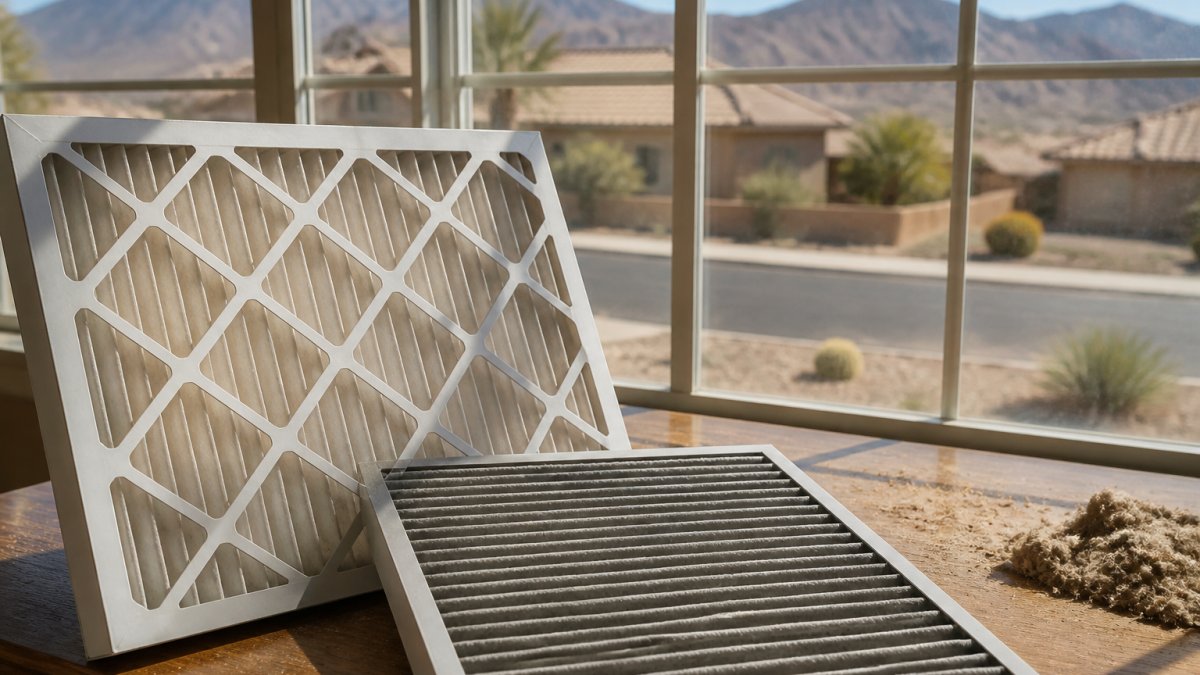
Pleated filters come in one-, two-, four-, and five-inch depths. In a dusty climate, the deeper pleat separates a filter that lasts from one that blinds over.
Watch pleat count and media construction, too. Tightly packed, shallow pleats load faster and bridge over with dust, forcing air to find paths of least resistance; fewer, deeper pleats hold capacity longer in heavy dust.
Electrostatic filters: convenience with a catch
Electrostatic filters use charged fibers, self-charging media or an externally charged washable frame, to attract particles. They capture fine dust well when new, but efficiency fades as the charge dissipates and collected dust masks the fibers, and in a desert home that fade happens faster. Washable versions need short cleaning cycles; a loaded, neglected washable filter is worse than a fresh disposable one because it restricts airflow and re-releases dust.
Disposable fiberglass panels: a stopgap, not a solution
Fiberglass panel filters are cheap and nearly transparent to airflow, exactly the problem. They catch large lint and debris but let the fine mineral dust that drives allergies and coats your coil pass straight through. In a desert home, that is essentially no filtration for the particles that matter. Use them only as a temporary placeholder while a proper filter is on order.
The desert-specific trade-off
The core tension is capacity versus resistance. Fine desert dust loads media quickly, and a loaded filter raises pressure drop regardless of MERV. A deep pleated filter buys more dust-holding capacity; a thin high-MERV filter captures fine particles well when new but can become an airflow problem within weeks during dust season. Match filter type to cabinet depth first, then choose the highest MERV that depth supports without excessive pressure drop.
HVAC Filter Size Guide: Fit, Bypass Leakage, and Cabinet Sizing
Filter size is where filtration plans quietly fail. A filter even a quarter inch too small lets air slip around the edges, bypass leakage, carrying dust straight past the media and onto your coil.
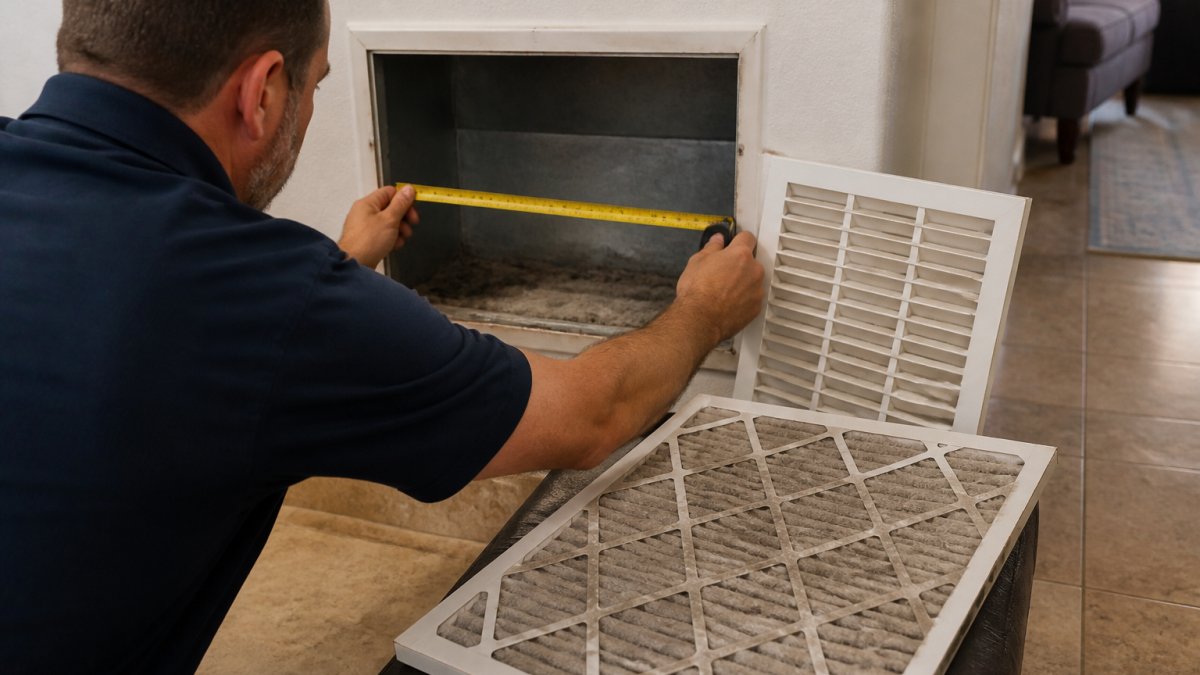
Measure the actual filter, not the nominal label: a "20x25x1" often measures closer to 19.5 x 24.5 x 0.75 inches. Bring the old filter's exact dimensions and the cabinet opening measurement when you buy.
Cabinet depth matters just as much: a one-inch slot cannot accept a four-inch filter no matter how much you want the extra media. If your cabinet is shallow and your ducts older or oddly routed, an upgrade may need ductwork attention first.
Call (702) 707-4242 for a free estimate →
HEPA Filter vs. HVAC Filter: What Your System Can Actually Handle
A true HEPA filter is not built for a standard residential HVAC system. HEPA media captures an extremely high share of fine particles but with a pressure drop most residential blowers cannot overcome.
That does not mean HEPA is useless. Alongside a MERV 13 furnace filter, a portable unit gives whole-house dust control plus targeted fine-particle removal where you sleep or spend the day. Air purifier options can complement your HVAC filter choice.
For whole-house filtration, the practical ceiling is a high-MERV pleated filter in a deep cabinet, or a media cabinet designed for the job. If you want to talk through what your system can actually support, our team handles indoor air quality improvement and duct cleaning and can tell you honestly whether an upgrade makes sense.
HVAC Filter Replacement Frequency in Dusty Climates
In a dusty climate, calendar intervals are a starting point, not a rule. A one-inch filter may need changing every 30 days during a dust-storm month and last 60 in a calm one. Go condition-based: inspect on a schedule, replace when the filter tells you it is loaded, and let seasonal dust drive the cadence.
Why desert dust breaks the calendar
Desert dust arrives in events, not a steady trickle. A spring wind event or summer haboob can push weeks' worth of particulate into return air in a day, so a filter fine on the first of the month can be visibly gray by the tenth. Dry indoor air also keeps fine particles suspended longer, so more reach the filter rather than settling out.
A condition-based inspection schedule
Use this as a desert-dust maintenance cadence:
- During dusty months (typically spring and summer wind season): inspect the filter every 30 days. Hold it up to light, if you cannot see through it, replace it. Check more often after a visible dust event.
- After a major dust storm or wind event: inspect within a few days. A single event can load a one-inch filter significantly.
- During calm months: inspect every 60 days and adjust based on what you see.
The visual and airflow tests
Two field checks beat any calendar:
- The light test. Hold the filter up to a bright light. If light passes freely, it has life left. If it is opaque, it is loaded.
- The airflow check. Notice whether rooms are cooling more slowly, the blower sounds louder, or registers feel weak. A loaded filter raises pressure drop, and that shows up as comfort loss before it shows up as a breakdown.
What else drives the interval
Dust load is not the only variable. Pet hair, nearby construction, a wood-burning fireplace, and runtime all shorten filter life; two dogs and a system running continuously in summer load a filter faster than a vacation-empty house. High-MERV filters load faster than lower-MERV in the same dust because they capture more of the fine fraction. And a poorly fitting filter with bypass gaps lets dust past the media, so it looks less loaded while your coil collects the dust.
Beyond the filter
Dust does not stay in the filter; it settles in ducts, on the blower wheel, and on the evaporator coil. A condition-based schedule should include an annual coil inspection and duct cleaning when registers show visible buildup. To have inspections and changes tracked for you, consider setting up a maintenance plan so the cadence follows your home's dust load rather than a generic reminder.
Balancing Filtration With Airflow and System Compatibility
The most common filtration mistake is chasing a higher MERV without checking whether the system can move air through it.
Three checks keep you out of trouble:
- Cabinet depth: match the filter to the slot, not the other way around
- Pressure drop: one-inch high-MERV filters resist more than four-inch versions of the same rating
- System age and blower capacity: older systems have less margin for added resistance
The U.S. Department of Energy's guidance on heating and cooling systems is worth reading on how airflow and equipment efficiency interact. Restricted airflow shows up on your utility bill before it shows up as a breakdown.
If your system is already struggling, added filtration resistance makes it worse, get airflow right first.
Frequently Asked Questions
What is the best MERV rating for desert dust and allergens?
MERV 8 to MERV 13 is the practical range for most homes dealing with desert dust and allergens. MERV 8 captures pollen, dust mites, and larger dust particles while keeping airflow high. MERV 13 adds fine-particle capture, including many mold spores and pet dander, but creates more pressure drop. Homes with standard 1-inch filter slots should stay at MERV 8 to MERV 11; systems with 4- to 5-inch media cabinets can usually run MERV 13 without straining the blower.
How often should I change my HVAC filter in a dusty climate?
In a dusty climate, check the filter every 30 days and plan to replace 1-inch filters every 30 to 60 days during peak dust season. Thicker 4- to 5-inch media filters can often last 6 to 12 months, but inspect them monthly during windy periods. If you see a visible gray coating, notice reduced airflow, or your energy bill climbs, replace it sooner. Homes with pets or heavy carpet should follow the shorter end of every range.
Will a higher-MERV filter make my HVAC system work harder?
Yes, a higher-MERV filter increases resistance to airflow, which raises pressure drop across the system. Whether that matters depends on your blower and duct design. A MERV 13 filter in a narrow 1-inch slot can restrict airflow enough to reduce cooling capacity and stress the blower motor. A MERV 13 filter in a deep media cabinet has far more surface area and much lower pressure drop. Match the rating to your cabinet depth, not just the label.
Should I use a HEPA filter in my home HVAC system?
A true HEPA filter is not designed for most residential HVAC systems. HEPA media is dense enough to create pressure drop that standard blowers cannot overcome, which can reduce airflow, freeze the coil, or shorten motor life. If you want HEPA-level filtration, use a standalone HEPA air purifier in the room where you spend the most time, and keep a MERV 8 to MERV 13 filter in the HVAC system. Whole-house HEPA setups exist but require a system designed for the added resistance.
Desert dust and allergies are a solvable combination, but only with a filter that matches your cabinet, your system's airflow, and the actual dust load in your home. RTS Comfort Cooling & Heating helps homeowners get that balance right with 24/7 emergency HVAC service, comprehensive duct cleaning, indoor air quality services, and smart thermostat installation that keeps filtration running on schedule. Call (702) 707-4242 for a free estimate and stop guessing which filter your system can handle.