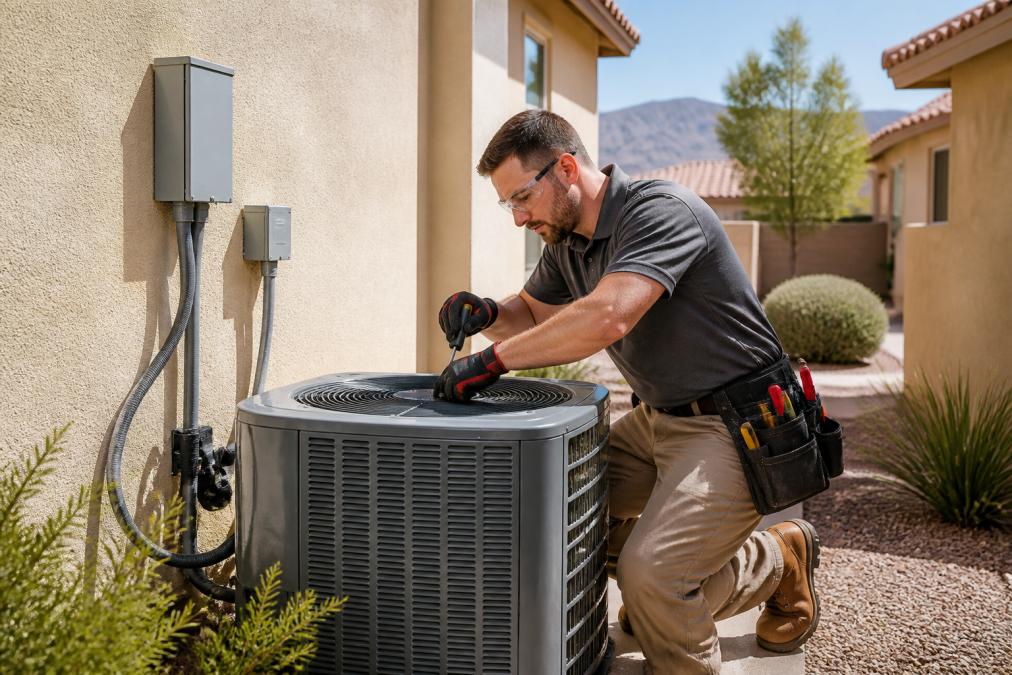
 comparison
Average Cost to Install Central Air in Las Vegas
Table of Contents
- What the Average Cost to Install a Central Air Conditioner in Las Vegas Looks Like
- Factors Affecting Central Air Installation Price
- The Hidden Cost of Ductwork Repair in Older Las Vegas Homes
- How to Choose a Reliable HVAC Contractor in Las Vegas
- Heating and Cooling in Las Vegas: Why Your System Choice Matters
- Rebates and Financing Options for Central Air Installation
- Frequently Asked Questions
Last Updated: September 10, 2026
What the Average Cost to Install a Central Air Conditioner in Las Vegas Looks Like
The average cost to install central air conditioner Las Vegas homeowners face depends on system size, efficiency rating, and whether your ductwork can handle the new unit. Because every project is quoted individually, a single number cannot be published here, but the cost buckets that make up a real installation quote can be shown.
Central air installation is the process of adding or replacing a split-system cooling setup: an outdoor condenser, an indoor air handler or coil, refrigerant lines, a thermostat, and the electrical and duct connections that tie it all together. Most quotes you receive will separate equipment from labor, permits, and any ductwork changes.
That split matters more than the total. A low equipment price with vague labor terms is how homeowners end up surprised mid-project.
Equipment Cost by System Type
Equipment is typically the largest line item, and it scales with tonnage and efficiency. A builder-grade single-stage unit costs far less than a variable speed system with a higher SEER2 rating. Two-stage cooling sits in the middle and is a common upgrade for homeowners who want steadier temperatures without the top-tier price.
Labor, Permits, and Other Fixed Costs
Labor covers removal of the old unit, line-set work, electrical hookups, and startup. Permitting fees and inspection costs vary by jurisdiction, and a licensed HVAC contractor will build them into the quote rather than surprise you later. Ask for these as separate line items so you can compare quotes fairly.
| Cost Component | What It Covers | Varies With |
|---|---|---|
| Equipment | Condenser, coil, air handler, thermostat | Tonnage, SEER2 rating, brand tier |
| Labor | Removal, install, electrical, startup | System complexity, attic access |
| Permits and inspection | Local sign-off on the install | Jurisdiction, scope of work |
| Ductwork | Repair, sealing, or replacement | Age and condition of existing ducts |
Factors Affecting Central Air Installation Price
Several variables move the number more than any other. Home size determines the tonnage you need, and in this climate, undersizing a system is a costly mistake that shows up as a unit that runs constantly and still can't keep up in July.
Home Size, Tonnage, and Climate-Specific Sizing
Tonnage is a measure of cooling capacity, not weight, and each ton equals roughly 12,000 BTU of cooling (energy.gov). A proper load calculation accounts for square footage, window orientation, insulation, and the extreme summer design temperatures here, which push capacity requirements above what a same-sized home would need in a milder climate. A contractor who sizes by square footage alone is guessing.
SEER2 Rating and Efficiency Upgrades
SEER2 is the current efficiency standard for cooling equipment, and higher ratings generally mean higher upfront cost with lower operating cost over the unit's lifespan (energy.gov). Because cooling season runs long here, the efficiency premium pays back faster than it would in a short-season market. A smart thermostat adds a smaller cost and gives you more control over runtime.
The Hidden Cost of Ductwork Repair in Older Las Vegas Homes
Ductwork is the line item that blows up budgets, and it's the one most quotes gloss over. Older homes often have undersized, leaking, or oddly routed ducts that can't handle a modern high-efficiency system without modification. This is the content gap most national guides skip entirely: they price the box on the pad and ignore the delivery system attached to it.
Here's the trap: a new condenser matched to failing ducts will underperform and can freeze up. Contractors who skip a duct inspection are setting you up for a callback. A thorough quote includes a duct assessment, and if repairs are needed, you'll see them priced before work starts rather than after the equipment is already in.
How Ducts Actually Fail in This Climate
Attic ductwork here lives in one of the harshest environments in the country: summer attic temperatures routinely climb well above 140°F, and the temperature swing between a 110°F afternoon and a 75°F night flexes the materials daily. Over 10 to 20 years, that cycling degrades the inner liner, dries out mastic and tape, and opens seams. Common failure modes include:
- Disconnected or crushed flex runs where a joist, plumber, or previous installer pinched the duct.
- Failed mastic and foil tape at plenum and boot connections, which leak conditioned air straight into the attic.
- Undersized return ducts that starve a modern high-static system and cause coil freeze-up.
- R-4 or R-6 insulation on older flex, which is far below what a high-efficiency system needs to hit its rated capacity.
How a Contractor Should Test Your Ducts
A real duct assessment is not a visual glance. Ask whether the quote includes:
- A static pressure test at the return and supply plenums. High static pressure is the single most common reason a correctly sized system underperforms.
- A duct leakage test (often a blower-door-assisted or duct-blaster measurement) to quantify how much air is escaping before any repairs are quoted.
- A visual inspection of accessible runs for crushed, disconnected, or uninsulated sections.
If a contractor quotes a replacement without any of these, the ductwork line on the quote is a guess.
Repair vs. Seal vs. Replace
Not every duct problem requires a full rebuild. The decision usually follows a simple pattern:
| Situation | Typical Fix | Why |
|---|---|---|
| Isolated leaks at boots and plenums | Seal with mastic and mesh tape | Cheapest fix, restores most lost capacity |
| Crushed or disconnected flex runs | Replace individual runs | A pinched duct can't be un-crushed |
| Undersized returns or trunk lines | Partial redesign and resizing | Required to support the new system's airflow |
| Aging R-4 flex throughout the attic | Full replacement with R-8 flex or rigid duct | Old insulation can't meet modern efficiency targets |
If your ducts need sealing, repair, or partial replacement, that cost lands on top of the equipment and labor figures. It's not optional if you want the system to actually deliver its rated capacity. A common pattern is for the ductwork line to rival or exceed the labor line on an older home, which is exactly why it belongs in the quote before you sign, not as a change order after the condenser is set.
How to Choose a Reliable HVAC Contractor in Las Vegas
Choosing a reliable HVAC contractor comes down to verification, not advertising. Ask for the license number, confirm insurance, and request references from jobs similar to yours. A contractor who hesitates on any of those is telling you something.
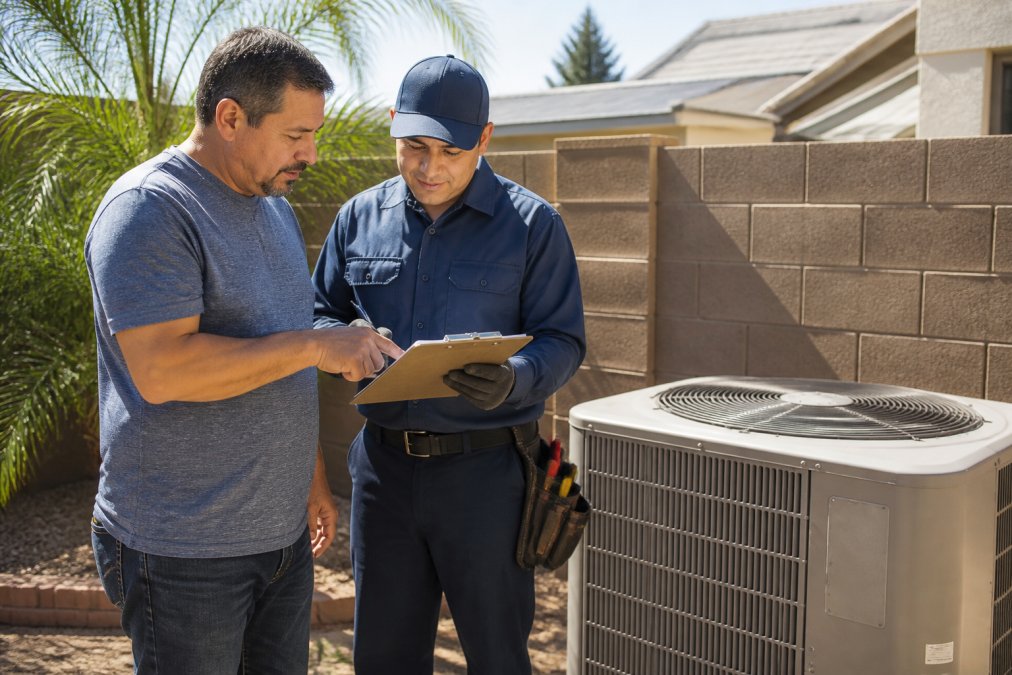
Get at least three written quotes with itemized equipment, labor, permits, and ductwork. Compare the scope, not just the total. The cheapest quote often excludes the work that matters most.
- License and insurance verified in writing
- Load calculation provided
- Duct inspection included
- Permits listed as a line item
- Warranty coverage stated in the contract
- Written quote with itemized pricing
We walk homeowners through each of these before any work begins, and our 24/7 emergency service means a failed system doesn't leave you waiting in the heat.
Heating and Cooling in Las Vegas: Why Your System Choice Matters
Heating and cooling here is a year-round load, not a seasonal one. A system that's merely adequate in a mild climate gets pushed hard through a long cooling season, and that's why efficiency and correct sizing matter more than they would elsewhere.
This is also where financing and rebates change the math. Utility rebate programs in the area can offset part of the cost of qualifying high-efficiency equipment, and manufacturer or contractor financing can spread the remainder into monthly payments. Ask your contractor which rebates your chosen system qualifies for and whether they handle the paperwork.
Rebates and Financing Options for Central Air Installation
Rebates and financing can meaningfully change what you pay out of pocket, but they're easy to miss if you don't ask. This is the section where most national guides stop at 'check with your utility', and it's the biggest local gap on the page. Here's how the mechanics actually work.
Utility Rebates: How the Math Works
Utility rebate programs typically reward higher-efficiency equipment, so the system you choose affects eligibility. The general structure is consistent across most utility programs:
- Efficiency tiers. A base-tier unit may qualify for a modest credit, while a higher-SEER2, variable-speed system qualifies for a larger one. The rebate is usually paid as a post-install credit, not a discount at the point of sale.
- Qualifying equipment lists. Utilities publish a list of eligible model numbers. A contractor who installs a unit that isn't on the list means no rebate, even if the SEER2 rating looks high enough.
- Paperwork and timing. Rebates generally require an invoice, a permit record, and sometimes a post-install verification. Missing the filing window forfeits the credit.
- Federal tax credits. Separately from utility rebates, federal tax credits for high-efficiency heat pumps and air conditioners have been available under recent energy legislation. These are claimed on your tax return, not at the point of sale, and eligibility depends on meeting specific efficiency thresholds.
Because program details and amounts change, confirm current terms directly with your utility and a qualified tax professional before you buy. The U.S. Department of Energy guidance on home cooling is a solid starting point for understanding efficiency ratings before you shop.
Financing: What Each Option Actually Costs You
Financing options usually fall into a few categories, and the differences matter more than the labels:
| Option | How It Works | Watch For |
|---|---|---|
| Manufacturer promotional financing | 0% or low-rate terms through the equipment brand, often 12-60 months | Deferred-interest offers that retro-charge interest if not paid in full by the deadline |
| Contractor payment plans | Monthly payments arranged at the point of sale | Whether the rate is fixed or variable, and whether there's a prepayment penalty |
| Utility rebates | Post-install credit for eligible equipment | Filing deadlines and model-number eligibility |
| Home improvement loans | Third-party lending, often unsecured | Origination fees and whether the loan is secured against your home |
| Home equity line of credit | Borrows against home equity at a lower rate | Closing costs and the risk of using your home as collateral |
How to Stack Rebates and Financing
The order of operations matters. A typical sequence that maximizes savings:
- Choose qualifying equipment first. Pick a model that appears on your utility's eligible list and meets federal tax credit thresholds.
- Get the itemized quote. The rebate paperwork usually requires a breakdown of equipment and labor.
- Confirm the permit is pulled. Many rebate programs require a permit record as proof of a code-compliant install.
- File the rebate promptly. Post-install credits often have a short window after the invoice date.
- Finance only the net cost. If you're financing, ask whether the lender will wait for the rebate to post so you're not borrowing against money you'll get back.
Frequently Asked Questions
How much does a new AC unit cost for a 2,000 sq ft home?
For a 2,000 sq ft home, central air installation pricing depends on the SEER2 rating, brand, labor, permits, and any ductwork repairs. Request an estimate to get an exact figure for your home's layout and existing duct system.
What are the primary factors affecting central air installation price?
The biggest factors are system capacity (tonnage), SEER2 efficiency rating, and whether your existing ductwork and electrical panel can handle the new unit. Labor costs, permitting fees, and the condition of your attic or crawlspace also play a role. In Las Vegas, proper sizing for extreme summer heat is critical. A qualified HVAC contractor will evaluate all of these before quoting a price.
Are there energy-efficiency rebates available for new AC installations?
Yes, several utilities and programs offer rebates for high-efficiency cooling equipment. These rebates often require a minimum SEER2 rating and professional installation by a licensed contractor. The exact amount and eligibility rules change annually. Ask your HVAC contractor to confirm which rebates your system qualifies for and to provide the paperwork you need to claim them.
What should I look for when comparing HVAC contractor quotes?
Compare more than the bottom line. Check that each quote includes equipment model numbers, SEER2 rating, tonnage, labor, permit fees, and any ductwork repairs. Ask whether a manual J load calculation was performed. Verify the contractor is licensed, insured, and offers a written warranty. A low quote that skips duct sealing or permits often leads to higher costs later.
How long does a central air installation take?
A straightforward replacement usually takes one to two days. If ductwork needs significant repair or the project includes new line sets and electrical work, it can stretch to three or four days. In Las Vegas, summer demand can affect scheduling, so book early. Your contractor should give you a clear timeline before work begins.
Replacing a central air system is a major home improvement decision, and the quotes you receive will only be as good as the questions you ask. RTS Comfort Cooling & Heating handles load calculations, duct inspection, permitting, and smart thermostat installation as part of a complete project, backed by 24/7 emergency service and indoor air quality support. Call (702) 707-4242 for a free estimate and get a quote you can actually compare.