 listicle
Best Smart Thermostat for Las Vegas: 2026 Guide
Table of Contents
- Smart Thermostat Comparison Table
- Top Smart Thermostats for Las Vegas Heat and Humidity
- Ecobee Smart Thermostat Premium: Best for Air Quality Monitoring
- Google Nest Learning Thermostat (4th Gen): Best for Energy Savings
- Honeywell Home T9: Best for Multi-Room Temperature Control
- Google Nest Thermostat: Best Budget Option
- Emerson Sensi Touch: Best for Privacy-Conscious Homeowners
- Wyze Thermostat: Most Affordable Smart Option
- Carrier Côr: Best for Carrier HVAC Systems
- Honeywell Home T10 Pro: Best for Complex HVAC Systems
- LUX KONO: Best for Customizable Design
- Best Thermostat Settings for Summer in Desert Climate
- How to Fix Missing C-Wire for Smart Thermostat Installation
- Professional Smart Thermostat Installation Benefits
- Energy Efficiency and Utility Savings in the Desert
- Smart Home Integration and Remote Temperature Control
- Which Smart Thermostat Should You Choose?
Last Updated: August 28, 2026
Smart Thermostat Comparison Table
| Thermostat | Starting Price | Best For | Key Feature | C-Wire Required |
|---|---|---|---|---|
| Ecobee Smart Thermostat Premium | $229.99 | Air quality monitoring | Built-in air quality monitor | Included adapter |
| Google Nest Learning Thermostat (4th Gen) | $279.99 | Energy savings | Automatic schedule learning | Power Sharing feature |
| Honeywell Home T9 | $169.99 | Multi-room control | Room sensors for occupancy | No |
| Google Nest Thermostat | $129.99 | Budget option | Quick schedule setup | No |
| Emerson Sensi Touch | $169.00 | Privacy-focused | Touchscreen display | Adapter available |
| Wyze Thermostat | $79.98 | Most affordable | Essential smart features | Adapter included |
| Carrier Côr | $250.95 | Carrier systems | Humidity management | Varies |
| Honeywell Home T10 Pro | $200-$280 | Complex HVAC | Multi-stage support | Varies |
| LUX KONO | $154.00 | Custom design | Interchangeable covers | Adapter included |
Top Smart Thermostats for Las Vegas Heat and Humidity
Las Vegas homeowners face extreme summer heat, monsoon humidity spikes, and unique wiring challenges in older homes. The thermostats below are ranked by how well they handle these specific conditions.
Ecobee Smart Thermostat Premium: Best for Air Quality Monitoring
The Ecobee Smart Thermostat Premium detects carbon dioxide, humidity, and volatile organic compounds, sending alerts when levels become unhealthy, critical during dust storms and pollution events. The included SmartSensor enables multi-room balancing and occupancy detection, ensuring cooling prioritizes occupied spaces. Geofencing automatically adjusts temperature when you leave home. Compatible with Apple HomeKit, Google Home, and Amazon Alexa, it integrates seamlessly into most smart home ecosystems. At $229.99, the air quality monitoring justifies the cost for allergy sufferers.
Google Nest Learning Thermostat (4th Gen): Best for Energy Savings
Google's 4th Gen Nest Learning Thermostat learns your schedule and automatically creates an optimized cooling schedule, adapting to seasonal changes. The Humidity Helper manages moisture during monsoon season. Users report up to 31% energy savings. It doesn't require a dedicated C-wire in most homes thanks to the Power Sharing feature, which matters for older Las Vegas homes with non-standard wiring. At $279.99, the learning capability and C-wire flexibility make it worth considering if you're already using Google Home devices.
Honeywell Home T9: Best for Multi-Room Temperature Control
The Honeywell Home T9 solves uneven cooling with Smart Room Sensors that detect temperature, humidity, and occupancy, then prioritize cooling in occupied spaces. Geofencing automatically switches to Away mode when everyone leaves. Compatible with Amazon Alexa, Apple HomeKit, and Google Assistant, setup takes under 15 minutes. Pricing starts at $169.99 for the thermostat alone, or $199.99 with one room sensor included.
Google Nest Thermostat: Best Budget Option
The standard Google Nest Thermostat delivers core smart features at $129.99. Quick Schedule lets you set up routines through the Google Home app in minutes, and Auto-Adjust reduces HVAC runtime when nobody's home. Energy History shows system usage over time, and filter change reminders prevent neglected maintenance. This is the entry point for homeowners who want smart thermostat basics without premium features.
Emerson Sensi Touch: Best for Privacy-Conscious Homeowners
The Emerson Sensi Touch prioritizes data privacy with a stated policy of not selling personal information to third parties. The full-color glass touchscreen is intuitive, and the thermostat includes geofencing, 7-day flexible scheduling, and remote access. Smart alerts notify you of extreme temperatures, humidity changes, and filter needs. Compatible with Amazon Alexa, Google Assistant, and Apple HomeKit, it's competitively priced at $169.00.
Wyze Thermostat: Most Affordable Smart Option
At $79.98, the Wyze Thermostat is the most budget-friendly option. It delivers essential features: remote temperature control via the Wyze app, daily heating and cooling schedules, and geofencing. Compatible with Amazon Alexa and Google Assistant, it supports voice control. The thermostat includes a C-wire adapter, making installation feasible for homes without a dedicated C-wire. For cost-conscious homeowners testing smart thermostat benefits, Wyze is a legitimate entry point.
Carrier Côr: Best for Carrier HVAC Systems
If your home has a Carrier HVAC system, the Carrier Côr ($250.95) is designed for seamless integration. Its intelligent software learns your home's patterns to optimize efficiency. The full-color touchscreen displays a local 4-day weather forecast and indoor humidity levels. Carrier's Super Dehumidification and Hybrid Heat Management features are particularly valuable during monsoon season.
Honeywell Home T10 Pro: Best for Complex HVAC Systems
The Honeywell Home T10 Pro is the contractor favorite for multi-stage systems and heat pumps, both common in Las Vegas. RedLINK room sensors provide precise temperature control in specific areas, and geofencing automatically adjusts settings based on occupancy. Pricing ranges from $200 to $280 depending on bundle configuration. Professional installation is often recommended.
LUX KONO: Best for Customizable Design
The LUX KONO smart thermostat ($154.00) features changeable Décor-snap covers to coordinate with your home's aesthetic. Home & Away Aware geofencing automatically adjusts temperature based on phone location. Compatible with Amazon Alexa, Apple HomeKit, and Google Assistant, it includes a PowerBridge adapter for homes without a dedicated C-wire.
Best Thermostat Settings for Summer in Desert Climate
Summer in the desert demands a different thermostat strategy than temperate climates. The extreme heat regularly exceeds 110°F, and inefficient settings can drive utility bills to unsustainable levels.
During the day when you're away, set your thermostat to 82-85°F to minimize runtime. Use geofencing if your thermostat supports it; the system automatically adjusts when you leave and returns to comfort settings before you arrive home.
When you're home in the evening, drop the temperature to 78-80°F. This is the sweet spot where most people feel comfortable without excessive cooling demand. Avoid setting it below 78°F; every degree lower increases energy consumption by roughly 3-5% (energy.gov).
Overnight, set the thermostat to 76-78°F. Your body loses heat more efficiently during sleep, so you need less aggressive cooling. Closing bedroom blinds before sunset reduces solar heat gain.
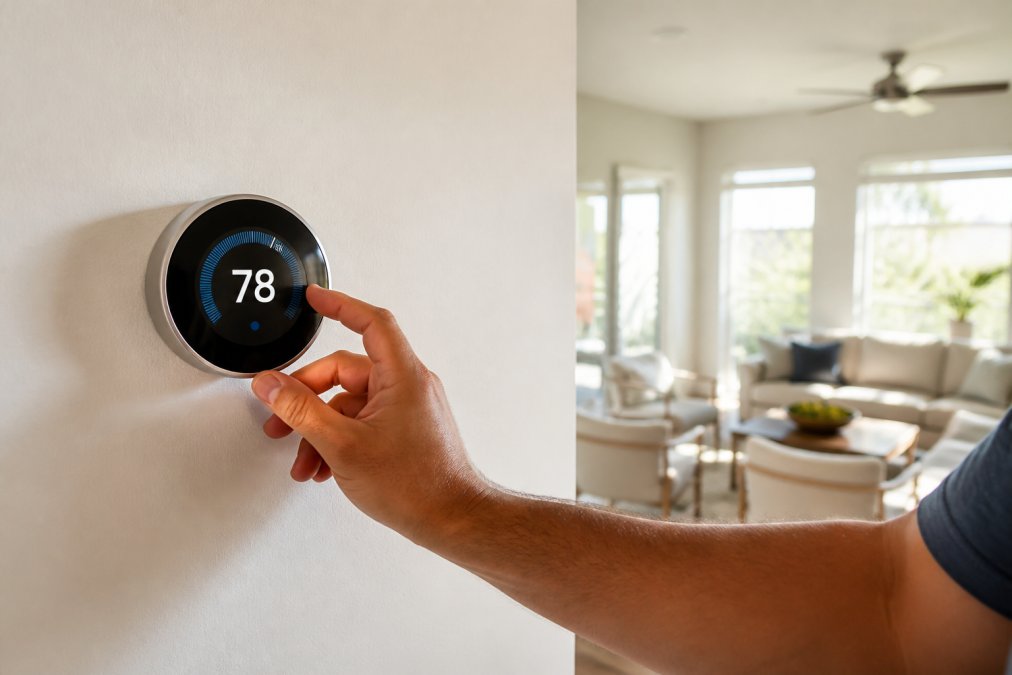
Use a programmable or learning thermostat to automate these adjustments. During peak monsoon season (July-September), set dehumidification to activate when indoor humidity exceeds 55-60% (ashrae.org). Avoid using the "hold" feature for extended periods, as it disables scheduling.
How to Fix Missing C-Wire for Smart Thermostat Installation
The C-wire (common wire) supplies continuous 24-volt power to your thermostat, enabling constant operation and cloud connectivity. Many older Las Vegas homes lack a dedicated C-wire. Installing a smart thermostat without addressing the C-wire issue leads to dead batteries, intermittent connectivity, and failed automations.
Check if you have a C-wire. Turn off power to your HVAC system at the breaker. Remove your existing thermostat and examine the wires. Most systems use five wires: red (power), white (heat), yellow (cool), green (fan), and blue or black (common/C). If you see only four wires and no blue or black wire, you're missing the C-wire.
Option 1: Run a new C-wire. This is the most reliable solution. Locate the furnace or air handler where the thermostat wires originate. Use 18-gauge thermostat wire (available at hardware stores for $15-$30 per 50-foot roll). Connect the new wire's end at the furnace to the common terminal (typically labeled C or COM). At the thermostat, connect it to the C terminal. If you're uncomfortable running wire through walls, hire an HVAC technician; this typically costs $150-$300 but guarantees proper installation.
Option 2: Use a C-wire adapter. Many smart thermostats include adapters that draw power from the heating or cooling circuit, eliminating the need for a dedicated C-wire. This works for most heat pump and air conditioning systems but can cause issues with heat-only systems or certain HVAC configurations.
Option 3: Install a power bridge. Some thermostats include a power bridge module that creates a continuous power loop. Use a power bridge only if you can't run a C-wire and your thermostat doesn't include a C-wire adapter.
Once you've connected the C-wire, turn power back on at the breaker and verify your thermostat powers on immediately without relying on batteries.
Professional Smart Thermostat Installation Benefits
While many smart thermostats support DIY installation, professional installation from an HVAC contractor like RTS Comfort Cooling & Heating offers significant advantages in Las Vegas.
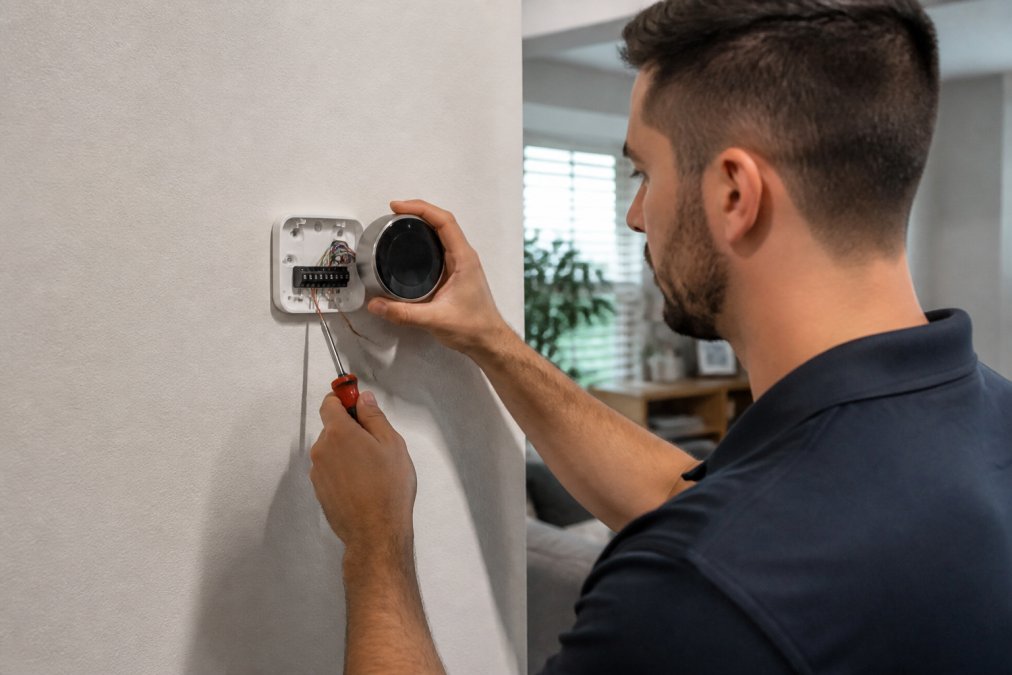
A professional technician diagnoses your specific HVAC system configuration before recommending a thermostat. Older homes sometimes have unusual wiring, multi-stage systems, or heat pumps that require specialized thermostats. Installation takes 30-60 minutes with a professional versus 1-2 hours for a careful DIYer.
RTS Comfort Cooling & Heating provides 24/7 emergency service, so if your thermostat malfunctions during a heat wave, professional support is immediately available. A professional also handles C-wire issues systematically and provides documentation for utility rebate programs. NV Energy and other local utilities offer incentives for installing ENERGY STAR-certified smart thermostats, but rebates may require professional installation documentation.
Call (702) 707-4242 for a free estimate →
Energy Efficiency and Utility Savings in the Desert
Desert climates create extreme energy demands that most homeowners underestimate. The intense summer heat drives HVAC systems to run 12-16 hours daily, and inefficient thermostats waste thousands of dollars annually.
Geofencing reduces energy consumption by automatically adjusting temperature when nobody's home. Instead of maintaining 78°F for an empty house, the thermostat raises the setting to 82-85°F, reducing runtime by 30-40% during away periods. For a household that's away 8+ hours daily, this alone saves $15-$30 monthly.
Learning algorithms optimize schedules based on your actual behavior. After 1-2 weeks, the thermostat understands when you wake, leave home, return, and sleep. Users report 15-25% annual savings compared to manual scheduling.
Remote room sensors prevent cooling wasted on empty spaces, reducing energy consumption by 10-15%. Humidity control during monsoon season reduces overall runtime by activating dehumidification cycles that remove moisture while maintaining comfort.
Demand response programs offered by NV Energy pay customers to reduce consumption during peak demand hours. Smart thermostats can participate automatically, slightly raising temperature settings during peak periods in exchange for bill credits. Annual savings through demand response can reach $100-$200.
Combined, these features typically reduce heating and cooling costs by 20-31% annually (energy.gov). For Las Vegas homeowners paying $150-$250 monthly for summer HVAC operation, this translates to $360-$930 in annual savings. The thermostat pays for itself in 3-8 months through energy savings alone.
Smart Home Integration and Remote Temperature Control
Modern smart thermostats integrate with broader home automation ecosystems, allowing control through voice assistants, smartphone apps, and automation routines. Voice control through Amazon Alexa, Google Assistant, or Apple Siri lets you adjust temperature without touching the thermostat. Smartphone apps enable remote temperature adjustment from anywhere.
Automation routines integrate thermostats with other smart home devices. You can create a "Leaving Home" routine that locks doors, closes blinds, and sets the thermostat to away mode with a single command.
Geofencing automates away-mode activation based on phone location. Integration with weather data allows predictive adjustments. Multi-user access lets household members adjust settings from their phones.
Which Smart Thermostat Should You Choose?
For air quality concerns: Choose the Ecobee Smart Thermostat Premium for its built-in air quality monitor.
For maximum energy savings: The Google Nest Learning Thermostat (4th Gen) learns your schedule and automatically optimizes cooling, with users reporting up to 31% energy savings.
For multi-room comfort: The Honeywell Home T9 with room sensors solves uneven cooling across different spaces.
For budget-conscious homeowners: The Google Nest Thermostat ($129.99) or Wyze Thermostat ($79.98) provide core smart features without premium pricing.
For privacy-focused buyers: The Emerson Sensi Touch prioritizes data privacy and doesn't sell personal information to third parties.
For Carrier system owners: The Carrier Côr integrates seamlessly with Carrier HVAC equipment and includes features optimized for desert climates.
For complex HVAC systems: The Honeywell Home T10 Pro supports multi-stage systems and heat pumps common in Las Vegas.
For design-conscious homeowners: The LUX KONO offers customizable faceplates to match your interior design.
Professional installation from RTS Comfort Cooling & Heating ensures your thermostat is compatible with your specific system and properly configured. The technician handles C-wire issues, verifies operation, and provides documentation for utility rebate programs. Call (702) 707-4242 for a free estimate and expert guidance on which thermostat best fits your home.
Choosing a smart thermostat in Las Vegas requires understanding your HVAC system's specific needs and your climate control priorities. RTS Comfort Cooling & Heating's professional installation service ensures your thermostat works optimally with your equipment, maximizes energy savings through proper configuration, and qualifies you for utility rebate programs. Get started with RTS Comfort Cooling & Heating and transform your home's climate control efficiency.
Frequently Asked Questions
Q: What thermostat setting should I use during summer in Las Vegas?
A: For desert climates, set your smart thermostat to 78°F when home and 82°F when away. This balances comfort with energy efficiency. Many smart thermostats learn your preferences and automatically adjust based on occupancy detection and geofencing. Using a programmable schedule prevents wasting energy during peak heat hours. The Ecobee Smart Thermostat Premium and Google Nest Learning Thermostat both excel at optimizing summer settings for high-heat environments.
Q: Do I need a C-wire for a smart thermostat in my Las Vegas home?
A: Most smart thermostats require a C-wire (common wire) for reliable power. However, some models like the Google Nest Thermostat and Wyze Thermostat can function without one using Power Sharing technology or included adapters. If your home lacks a C-wire, professional installation can add one safely, a critical step that prevents thermostat malfunctions and HVAC system damage. Contact RTS Comfort Cooling & Heating at (702) 707-4242 for a free assessment of your wiring setup.
Q: How much can a smart thermostat save on my energy bills?
A: Smart thermostats typically reduce heating and cooling energy use by 10-31% depending on the model and your usage patterns. The Google Nest Learning Thermostat claims up to 31% savings through automatic scheduling, while the Emerson Sensi Touch achieves approximately 23% reduction. Savings depend on your current thermostat behavior, system efficiency, and how consistently you use geofencing and scheduling features. Many models qualify for NV Energy demand response programs, offering additional rebates.
Q: What makes professional smart thermostat installation better than DIY?
A: Professional installation ensures proper wiring, voltage compatibility, and HVAC system integration, mistakes can damage your system or void warranties. Technicians verify C-wire availability, test system diagnostics, and configure settings for desert climate performance. They identify compatibility issues with older HVAC systems and ensure the thermostat communicates correctly with furnace and AC units. RTS Comfort Cooling & Heating provides expert installation with system verification, saving you troubleshooting time and preventing costly repairs.
This article was written using GrandRanker