 how-to
Should You Turn Off Your AC During a Thunderstorm?
Last Updated: October 30, 2026
Quick Summary
Yes, turning off your AC during a thunderstorm is a smart way to prevent AC damage from power surges. Shutting the system down removes it from the power flow while the storm is active. Turning it off does not protect against a direct lightning strike, and it does not replace a surge protector.
- Turn off the AC when you see lightning nearby or hear thunder.
- Leave it off until the storm has passed and power is stable.
- Wait a few minutes after power returns before turning the AC back on.
- Whole-house surge protectors install at the main panel and protect all home circuits, including AC.
- Turning off the AC does not protect against a direct lightning strike.
Table of Contents
- Why Electrical Storms Put Your AC at Risk
- Should You Turn Off AC During a Thunderstorm?
- How to Safely Shut Down Your AC Before a Storm
- HVAC Surge Protector Options Compared
- How to Reset AC After a Power Outage
- Signs of Electrical Damage to an Air Conditioner
- Booking Your Storm-Ready AC Inspection
- Frequently Asked Questions
Why Electrical Storms Put Your AC at Risk
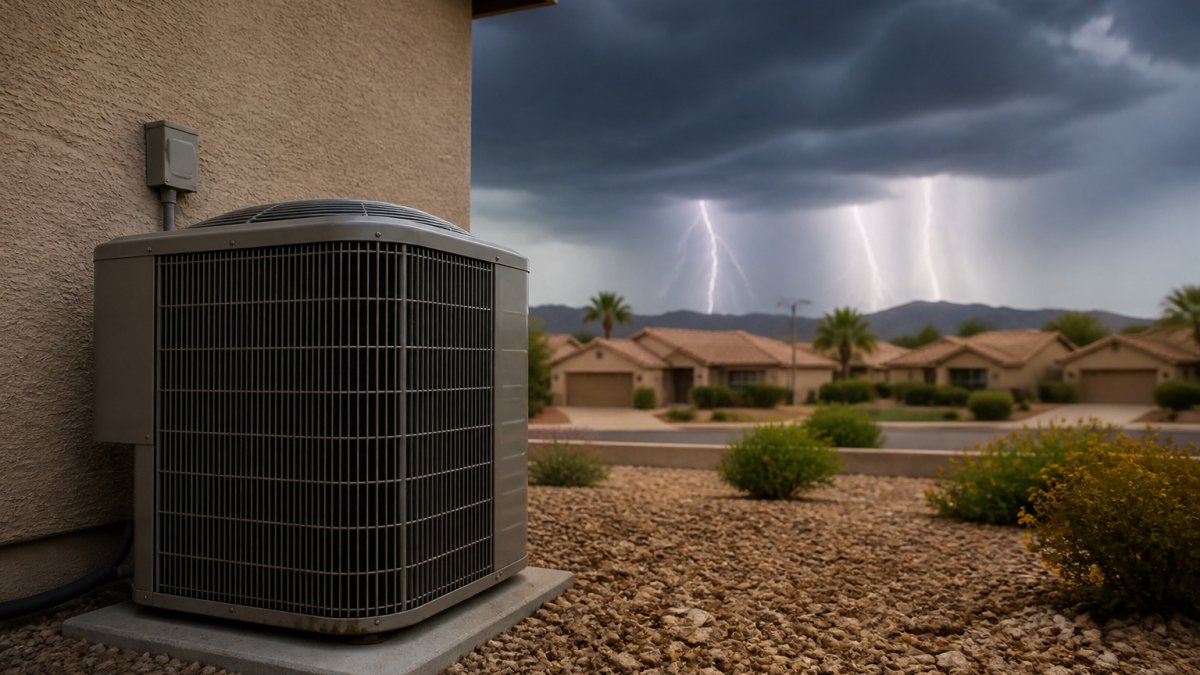
Lightning and power surges are among the most common reasons air conditioners fail during summer storms in the United States, so knowing how to prevent AC damage matters.
Your AC is full of electronics. The control board, the contactor, and the capacitor all depend on steady voltage.
Surges don't always come from lightning.
Watch out: a unit that restarts on its own after a storm can look fine while its control board is quietly failing.
Should You Turn Off AC During a Thunderstorm?
Yes, turning off your AC during a thunderstorm is a smart precaution to prevent AC damage from power surges. Shutting the system down removes it from the power flow while the storm is active, which can reduce the chance of damage when power returns.
Turning it off does not protect against a direct strike, and it does not replace a surge protector. It only removes the system from the power flow while the storm is active.
- Turn off the AC when you see lightning nearby or hear thunder.
- Leave it off until the storm has passed and power is stable.
- Wait a few minutes after power returns before turning it back on.
How to Safely Shut Down Your AC Before a Storm
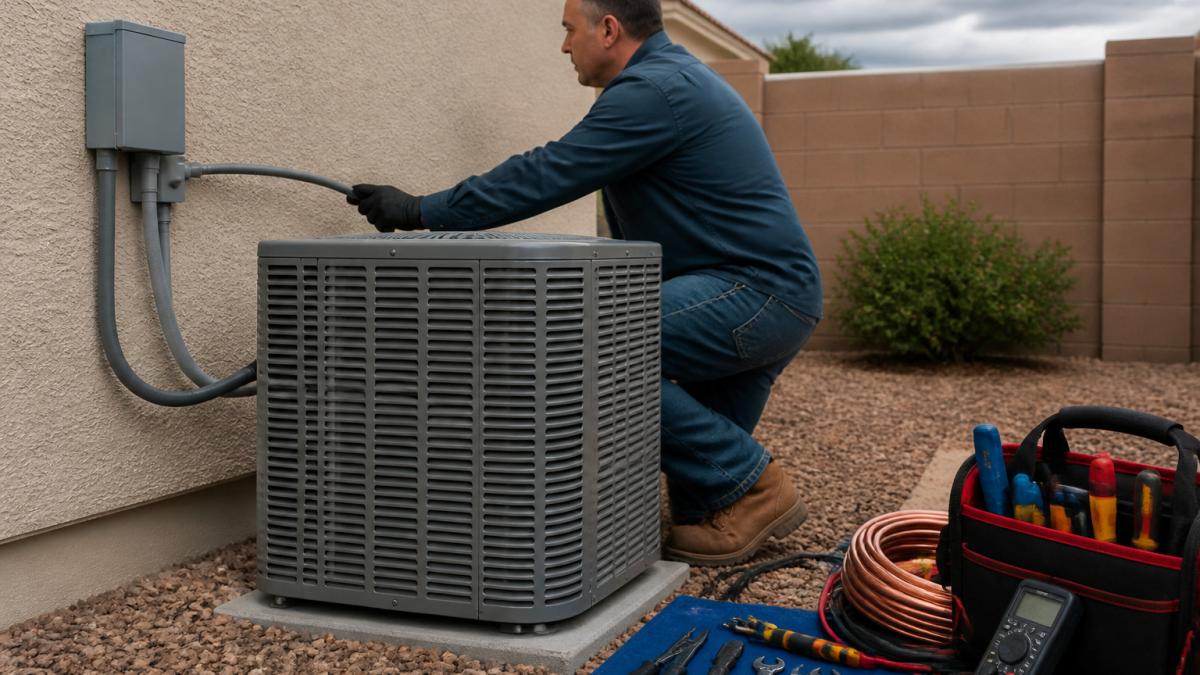
Shutting down the system in the right order keeps you safe and protects the equipment. Work through these steps before the storm arrives, not while lightning is overhead.
Turning Off the Thermostat and Breaker
Start at the thermostat. Set it to "Off" so the system cannot call for cooling while you work. This is the simplest step, and it is safe to do from inside the house.
Next, go to your electrical panel and find the breaker labeled for the AC or heat pump. Switch it to the off position.
Never open the electrical panel or the outdoor disconnect box while it is raining or lightning is active.
Step checklist:
- Set the thermostat to "Off"
- Switch off the AC breaker at the main panel
- Switch off the outdoor disconnect, if your home has one
- Confirm the outdoor fan has stopped
Protecting the Outdoor Condenser
The outdoor condenser holds the compressor and fan, and it is exposed to wind-blown debris and storm damage. Before a storm, clear loose branches, leaves, and yard items from around the unit so it can breathe once the weather passes.
Check that the unit sits level and that the top grille is clear. Standing water and debris can damage the fan and coils.
HVAC Surge Protector Options Compared
A surge protector gives your system ongoing defense, not just storm-day safety. The two categories that matter most for an air conditioner are panel-level whole-house protection and equipment-level HVAC protection. They are complementary, not interchangeable, and neither one guarantees protection from a direct lightning strike.
Call (702) 707-4242 for a free estimate →
| Option | Where It Installs | What It Protects | Best For | Key Limitation |
|---|---|---|---|---|
| Whole-house surge protector | At the main electrical panel, wired to a dedicated breaker | All circuits in the home, including the AC branch circuit | Broad coverage for electronics, appliances, and HVAC | Clamps surges at the panel; a surge that enters downstream or a direct strike can still reach equipment |
| Dedicated HVAC surge protector | At the AC disconnect or adjacent to the outdoor unit | The condenser, compressor, contactor, and control board | Focused protection for the most expensive equipment | Protects only the HVAC circuit; does not shield the rest of the home |
| Point-of-use surge strip | Plugged into a wall outlet | Thermostats, Wi-Fi adapters, and small low-voltage devices | Inexpensive supplemental protection | Not suitable for 240-volt AC equipment; limited capacity |
How the Two Layers Work Together
A whole-house protector at the panel diverts large surges before they spread through the home's wiring. A dedicated HVAC protector at the disconnect catches residual energy that reaches the AC circuit and responds faster to events close to the equipment. Using both layers can cover failure modes that a single device may not.
Neither device is a lightning rod. A direct strike can overwhelm any surge protector; the goal is to reduce damage from nearby strikes, utility switching, and outage-related voltage events.
Selection, Installation, and Maintenance
- Compatibility: Match the protector to the system's voltage and amperage. A central AC or heat pump typically uses a 240-volt circuit; confirm the protector's rating matches the disconnect and breaker size.
- Installation: Panel-level units connect to the main panel and should be installed by a licensed electrician. Equipment-level units install at the AC disconnect; check the manufacturer's warranty terms before installing.
- Status indicators: Most quality units have an LED or indicator that shows whether protection is still active. Check it after any storm or outage.
- Replacement after a surge: A protector that has absorbed a large surge may be spent even if the equipment still runs. If the indicator shows a fault, replace the unit rather than assume it is still protecting the AC.
- Ongoing checks: Inspect the protector during annual HVAC maintenance and after any event that trips the AC breaker.
How to Reset AC After a Power Outage
Restarting in the right order protects both you and the equipment. The goal is to confirm power is stable, reset only what needs resetting, and stop if anything looks or sounds wrong.
Before You Touch Anything
- Wait until the storm has passed and you no longer hear thunder or see lightning.
- Confirm the lights have stopped flickering and stayed on for at least 5 minutes.
- Do not approach the outdoor unit, disconnect box, or electrical panel if there is standing water nearby or visible damage such as scorch marks or a downed line.
- If you smell burning or see smoke, leave the area and call 911, then your utility.
Safe Restart Sequence
- Check the panel first. Look for a tripped AC breaker. A breaker in the middle position is tripped; push it fully to OFF, then back to ON. If it trips again immediately, stop and call a technician.
- Reset at the thermostat. Set the thermostat to OFF, wait a minute, then switch it to COOL and set a temperature below room temperature. This lets the system run its own startup delay.
- Wait out the compressor delay. Many systems have a 5-minute short-cycle delay; the outdoor unit may not start immediately, and that is normal.
- Listen at the outdoor unit. A steady hum and fan movement are normal. Grinding, buzzing, repeated clicking, or a fan that starts and stops are not, switch the system off at the thermostat and breaker.
- Confirm cooling. After 10-15 minutes, check that supply air is cool and the outdoor unit is running steadily.
Thermostat vs. Breaker: When to Use Which
Use the thermostat for normal on/off control and for the first restart attempt. Use the breaker only when the system will not respond, when the breaker is visibly tripped, or when you need to cut power for safety. Repeatedly flipping the breaker to force a restart can damage the compressor and mask the real fault.
When Not to Reset
Do not reset or operate the system if:
- The breaker trips again within seconds.
- You see scorch marks, melted insulation, or a burning smell near the panel or outdoor unit.
- The outdoor unit is submerged or sitting in standing water.
- The thermostat display is blank or repeatedly resets.
In any of these cases, switch off the thermostat and breaker if it is safe to do so, and schedule an HVAC technician or electrician. A failed capacitor, control board, or contactor will not fix itself with another reset.
Signs of Electrical Damage to an Air Conditioner
Storm damage is not always obvious. Some symptoms appear right away, while others show up days or weeks later.
- The system will not start, or the outdoor fan runs but the compressor stays silent.
- The breaker trips every time the AC turns on.
- The unit blows warm air or runs but does not cool.
- You smell burning, or see scorch marks near the outdoor unit or panel.
- The thermostat display is blank or resets on its own.
A common mistake is assuming the system is fine because it runs at all. A failing capacitor or control board can keep the fan spinning while the compressor never engages. If your system shows any of these signs after a storm, turn it off and schedule an inspection rather than repeatedly restarting it.
Booking Your Storm-Ready AC Inspection
Storm season is the right time to confirm your system is ready. A professional inspection checks the electrical connections, the control board, the capacitor, and the surge protection already in place. It can catch small problems before the next storm turns them into a failed compressor.
RTS Comfort Cooling & Heating offers 24/7 emergency service for Las Vegas homeowners. You can call (702) 707-4242 for a free estimate.
If your system has already shown signs of storm damage, contact us for emergency service. Before the next storm, you can also review how to tell whether a power outage damaged your AC compressor, or read our guide on how to reset AC after a power outage so you know the steps before you need them.
Frequently Asked Questions
Can a power surge damage an air conditioner?
Yes. Lightning strikes and utility power surges can send a voltage spike through the electrical system, damaging the compressor, control board, capacitors, and other electrical components. Damage is not always immediate, and a unit may run for a while before failing. A surge protector installed at the panel or on the HVAC circuit reduces this risk.
Should I turn off my air conditioner before a storm?
Turning the system off at the thermostat and, if you are comfortable doing so safely, at the dedicated AC circuit breaker before a storm is a reasonable precaution. It reduces the chance that a surge will reach a running compressor. Do not go near the outdoor unit during lightning activity, and do not touch the electrical panel if it is wet or you are unsure of the work. If you cannot safely shut the system off, a licensed HVAC technician can advise on protection options.
How do I safely restart my AC after a power outage?
Wait until utility power is stable, then confirm the thermostat is set to off. Check that the outdoor disconnect and the AC circuit breaker are in the correct position, and restore the breaker if it tripped. Turn the thermostat back on and wait several minutes before expecting cooling, since the compressor has a built-in delay to protect it. If the unit does not start, hums without running, or trips the breaker again, switch it off and call a licensed HVAC technician rather than repeatedly resetting it.
How much does it cost to install a surge protector on an HVAC system?
Costs vary with the type of protector, the electrical panel, and local labor rates, so there is no single figure to quote. A dedicated HVAC surge protector installed at the disconnect or panel is typically a smaller expense than a replacement compressor or control board. For an accurate price for your home, contact RTS Comfort Cooling & Heating at (702) 707-4242 for a free estimate.
Storm season is hard on any AC system, and the best defense is preparation. RTS Comfort Cooling & Heating can help you set up a shutdown plan, choose protection that fits your home, and keep your system running through the next storm.