 how-to
HVAC Maintenance Tips for Older Las Vegas Homes
Table of Contents
- Why Older Las Vegas Homes Need a Different HVAC Maintenance Plan
- The 5-Minute Monthly HVAC Maintenance Checklist
- Seasonal Tune-Up Schedule for Desert Climates
- Why Is My AC Not Cooling? Troubleshooting Older Systems
- Ductwork Integrity and Improving Indoor Air Quality in Older Homes
- Signs Your Old HVAC Needs Replacement vs. Repair
- Smart Thermostat and Insulation Upgrades for Legacy Systems
- Professional vs. DIY Maintenance: What to Leave to the Experts
- Frequently Asked Questions
Last Updated: September 5, 2026
Why Older Las Vegas Homes Need a Different HVAC Maintenance Plan
Older Las Vegas homes carry a double burden: decades of desert heat exposure and mechanical systems designed under less demanding efficiency standards. Standard hvac maintenance tips for older las vegas homes often miss the structural realities of legacy construction, which is why the RTS Comfort Cooling & Heating team emphasizes a specialized approach. A home built in the 1980s or 1990s typically has different ductwork, insulation levels, and wiring than modern builds.
The core tension is simple: your system is working harder than it was designed to, while the home envelope leaks more conditioned air than it should. This accelerates wear on every component, from the compressor to the evaporator coil. Your maintenance plan must prioritize system longevity and energy efficiency over quick fixes.
The 5-Minute Monthly HVAC Maintenance Checklist
A consistent monthly routine is the single most effective way to extend the life of an aging system. Most owners focus only on the thermostat or wait until something breaks, but a short preventative session can catch small issues before they become emergency repairs.
Air Filter Replacement: The Single Most Important Task
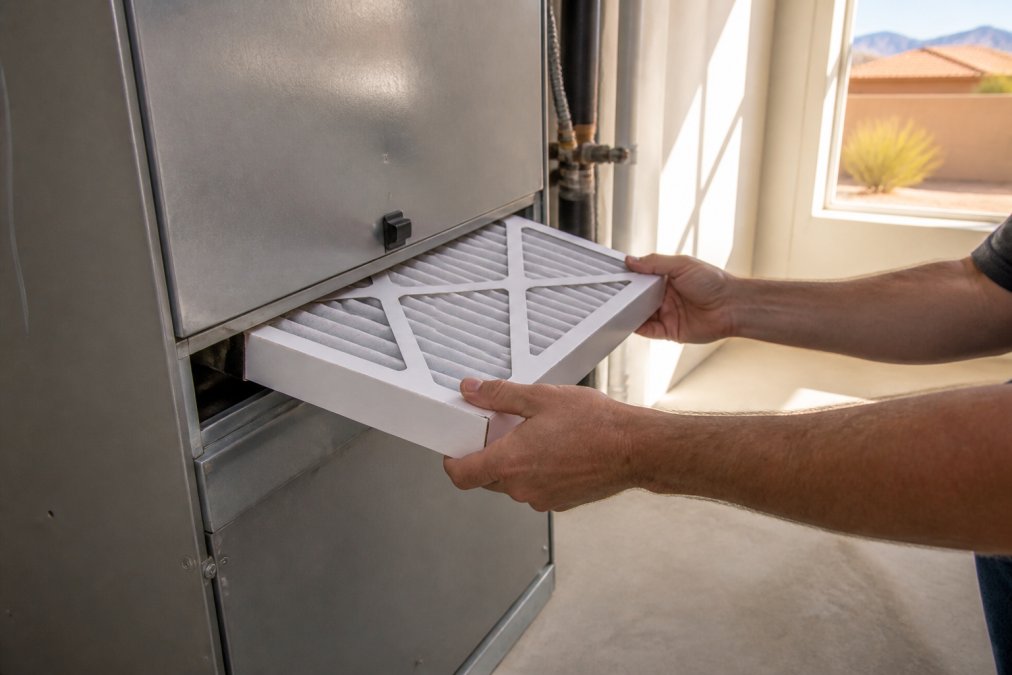
The air filter is the first line of defense for your entire HVAC system. A clogged filter restricts air flow, forcing the blower motor to work harder and causing the evaporator coil to freeze or overheat. For older systems, this strain is magnified.
Check your filter every 30 days during peak cooling season. Hold it up to the light; if you cannot see through it, replace it. Choose a filter with a MERV rating between 8 and 11 for a balance of particle capture and air flow. A filter with too high a MERV rating, like 13 or above, can actually restrict air flow too much for older blowers designed for less resistance.
Clearing Debris from Vents and Registers
Walk through each room and confirm that furniture, rugs, and curtains are not blocking supply vents or return registers. Blocked vents create pressure imbalances that cause the system to short-cycle and wear out faster. Vacuum the registers monthly to remove dust buildup.
Seasonal Tune-Up Schedule for Desert Climates
Las Vegas weather demands a tune-up schedule aligned with the extreme temperature swings between summer and winter. The standard recommendation is a professional inspection twice a year, once before cooling season and once before heating season. For older homes, a spring tune-up is non-negotiable.
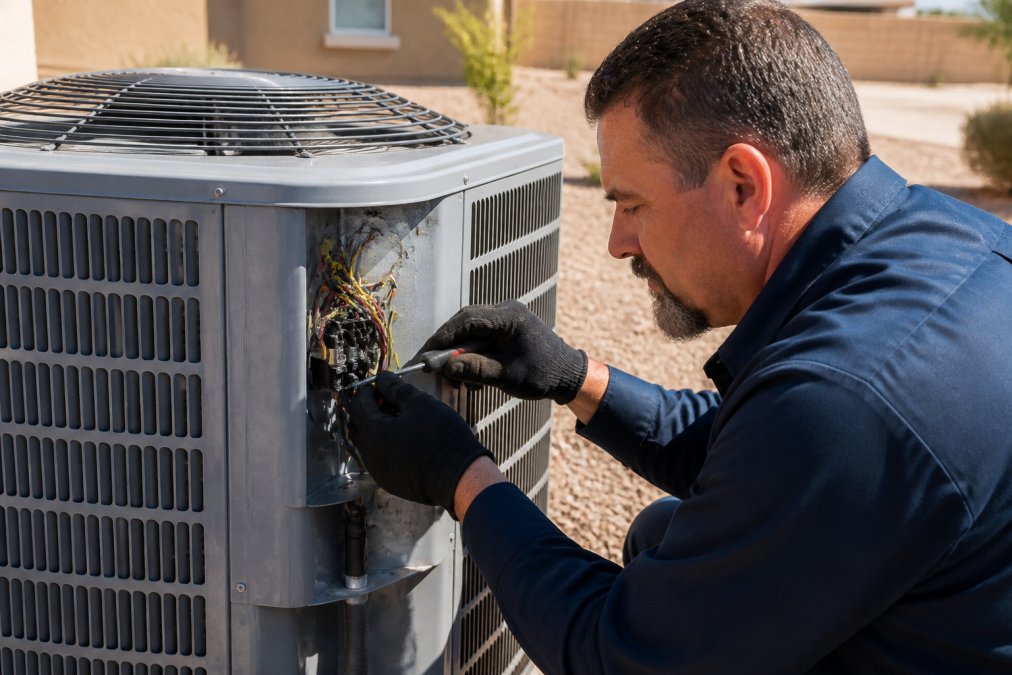
A professional tune-up includes checking refrigerant levels, inspecting the condenser unit, testing thermostat calibration, and lubricating moving parts. This preventative inspection catches worn capacitors and failing contactors before they cause a mid-July breakdown.
| Season | Task | Frequency | Primary Goal |
|---|---|---|---|
| Spring | Professional AC tune-up, condenser cleaning | Annually | Prevent summer breakdowns |
| Monthly | Replace air filter, clear debris | Every 30 days | Maintain air flow |
| Fall | Heating system inspection | Annually | Prepare for winter |
| As Needed | Duct inspection, insulation check | Every 2-3 years | Improve efficiency |
Why Is My AC Not Cooling? Troubleshooting Older Systems
When an older AC stops cooling, the cause is often a simple issue you can diagnose before calling for emergency repair. Start with the thermostat: confirm it is set to "cool" and the temperature is lower than the current room reading. Next, check the outdoor condenser unit for debris blocking the coil fins. If the air flow feels weak or the air is only slightly cool, the issue may be a failing compressor or a dirty evaporator coil.
But in an older Las Vegas home, the most expensive and confusing failure point is refrigerant. If your system was installed before 2010, it almost certainly uses R-22 (Freon). The EPA's refrigerant phase-down stopped all new R-22 production and import on January 1, 2020 (the EPA). The price has roughly tripled since 2018, and it continues to climb as supply dwindles.
The R-22 Math: Repair vs. Retrofit vs. Replace
When a technician tells you your system is low on R-22, the first question is not "how much to refill" but "where is it leaking?" A system that has never leaked will not suddenly lose refrigerant.
Here is the decision framework most practitioners use when an R-22 leak is found:
-
Small, repairable leak (e.g., a Schrader valve or a single fitting): If the leak is accessible and the system is under 12 years old, a repair plus a full R-22 recharge may cost between $400 and $800. This is only worth it if the compressor and coils are otherwise healthy.
-
Evaporator coil leak: This is the most common failure. The coil itself is often $600-$1,000 in parts alone, plus labor and the R-22 recharge. You will likely cross the 50% replacement cost threshold quickly.
-
Retrofit to R-410A (Puron): Some homeowners ask about converting the existing system to use modern R-410A. This is rarely cost-effective. The retrofit requires replacing the expansion valve, flushing the entire line set and coil, and installing a new compressor rated for the higher operating pressure of R-410A. By the time you pay for those parts and labor, you are at 60-80% of a full system replacement cost, and you still have a 15-year-old air handler and ductwork.
-
Full replacement: If the system is over 12 years old and has a refrigerant leak, replacement is the financially sound move. A new SEER2 15-16 system will cut your cooling costs by 30-40% compared to a 1990s-era 10 SEER unit, which directly offsets the monthly payment on a new system.
The Frozen Coil Exception
If the coils are frozen, turn the system off and let it thaw completely before restarting. A frozen coil is usually caused by low refrigerant or restricted air flow, not by hot weather. If you have already replaced the filter and cleared the vents, and the coil still freezes within 24 hours of restarting, you are almost certainly low on refrigerant. Do not keep running the system; each freeze-thaw cycle stresses the compressor.
When basic checks fail to restore cooling, a professional diagnosis is required. Ask the technician to show you the leak location with an electronic leak detector or UV dye before authorizing any R-22 recharge. If they cannot find the leak, the recharge is wasted money.
Ductwork Integrity and Improving Indoor Air Quality in Older Homes
Ductwork in older Las Vegas homes was often installed with less sealing than modern standards require. Leaky ducts in the attic or crawl space can lose a significant portion of conditioned air before it reaches your living space, impacting both energy efficiency and indoor air quality.
Why Duct Leakage Is Worse in Las Vegas Than Almost Anywhere Else
The average Las Vegas attic exceeds 140°F on a summer afternoon. Every gap, disconnected joint, or poorly sealed penetration is not just losing conditioned air, it is actively pulling superheated attic air into the living space on the return side, and dumping expensive cooled air into the attic on the supply side.
A common pattern in homes built between 1980 and 2000 is flex duct that has sagged, been crushed, or disconnected entirely at the plenum. The result is that a 3-ton system may effectively deliver only 2 to 2.5 tons of cooling to the rooms, which explains the "it runs all day but never catches up" complaint so common in older homes.
Call (702) 707-4242 for a free estimate →
The Measurable Impact: Why Sealing Beats Cleaning
Improving indoor air quality in older homes starts with sealing and insulating the duct runs, not just cleaning them. The EPA's "Energy Star Duct Sealing" guidance states that sealing and insulating ducts can improve HVAC efficiency by up to 20%, and in an attic environment as extreme as Las Vegas, the real-world gain is often at the higher end of that range (energystar.gov).
A professional duct inspection with a pressure test will quantify the leakage. If your system leaks more than 20% of its rated air flow, the fix is straightforward: a technician accesses each joint and applies mastic sealant and fiberglass mesh tape to every connection. This is a labor-intensive job, typically 4 to 8 hours for a 2,000-square-foot home, but it is far cheaper than replacing the system.
The Home Envelope Synergy: Maintenance Is Useless If the House Leaks
Here is the angle most maintenance guides ignore: you can have a perfectly tuned HVAC system, and it will still fail to keep you comfortable if the home envelope is poor. Older Las Vegas homes, especially those built before the 1990s, typically have R-19 or R-22 attic insulation, while current code requires R-38 or higher.
Before you spend money on a new high-efficiency system, check three things:
-
Attic insulation depth: Measure it with a ruler. If you have less than 10-12 inches of fiberglass or cellulose, adding insulation to R-38 is the single highest-ROI upgrade you can make. It reduces the thermal load on your HVAC system, allowing it to cycle less frequently and last longer.
-
Attic hatch sealing: The pull-down stair or scuttle hole is often a massive air leak. A foam-insulated cover with a weatherstripped perimeter costs under $100 and stops conditioned air from escaping into the attic.
-
Penetration sealing: Check where plumbing vents, electrical wires, and exhaust fans pass through the ceiling into the attic. These gaps are often unsealed, creating a chimney effect that pulls conditioned air up and out. A can of spray foam and a tube of caulk can close these in an afternoon.
This is a task best left to experts who can access the full duct system and apply mastic sealant to all connections. A reputable contractor will offer a before-and-after pressure test to prove the leakage reduction, not just a visual inspection.
Signs Your Old HVAC Needs Replacement vs. Repair
Knowing whether to repair or replace an aging system is one of the hardest calls a homeowner makes. A general guideline is that if the repair cost exceeds one-third of the replacement cost, replacement is the smarter financial move.
Watch for these signs that your old HVAC needs replacement: frequent breakdowns, rising energy bills despite consistent usage, uneven temperatures between rooms, and unusual noises from the outdoor unit. If your system still uses R-22 refrigerant, the rising cost can make even minor leak repairs prohibitively expensive.
Smart Thermostat and Insulation Upgrades for Legacy Systems
Upgrading an older home's thermostat and insulation delivers immediate returns on comfort and energy bills. A smart thermostat can optimize cooling schedules around your actual occupancy, but compatibility with legacy wiring is the first hurdle. Many older homes lack a C-wire, which provides continuous power to the thermostat.
Before purchasing a smart thermostat, check the wiring at your current thermostat base. If you see only two or three wires, professional installation is recommended to avoid damaging your system. The RTS Comfort Cooling & Heating team handles smart thermostat installation, ensuring compatibility with your furnace and AC wiring.
Insulation works in tandem with your thermostat. Adding attic insulation reduces the thermal load on your HVAC system, allowing it to cycle less frequently. Sealing air leaks around windows, doors, and penetrations completes the home envelope.
Professional vs. DIY Maintenance: What to Leave to the Experts
DIY hvac maintenance tips cover the basics well, but several critical tasks require professional expertise. Filter changes, debris removal, and thermostat checks are safe for homeowners to perform. Anything involving refrigerant, electrical components, or gas lines should be handled by a licensed technician.
For older homes, the value of a professional inspection goes beyond the immediate tune-up. An experienced technician can spot signs of ductwork deterioration, failing capacitors, and worn contactors that lead to unexpected failures. A twice-yearly professional service contract is the most reliable way to protect your investment.
Keeping an older Las Vegas home comfortable requires a proactive maintenance plan that addresses the unique challenges of desert heat and legacy construction. RTS Comfort Cooling & Heating offers the full range of services these homes need, from routine tune-ups and duct cleaning to attic insulation and smart thermostat installation. Our team handles the complex repairs and system diagnostics that protect your home's longevity, with 24/7 emergency service when the unexpected happens. Call (702) 707-4242 for a free estimate.
Frequently Asked Questions
How often should you service an air conditioner in extreme heat?
In a desert climate, a professional HVAC tune-up twice a year is the minimum. Schedule one in early spring before the cooling season and another in early fall for the heating season. During summer heat waves, check your air filter monthly and clear debris from the outdoor condenser unit every few weeks. This routine prevents system breakdowns when you need cooling the most. If your system is older than 10 years, consider adding a mid-summer inspection to catch refrigerant leaks or failing parts early.
What is the $5000 rule for HVAC systems?
The $5,000 rule is a guideline contractors use to decide between repairing and replacing an aging system. Multiply the estimated repair cost by the age of your unit in years. If the result exceeds $5,000, replacement is usually the better financial choice. For example, a $700 repair on a 10-year-old unit equals $7,000, which suggests replacement. However, this is only a starting point. A system with R-22 refrigerant may be expensive to recharge, making replacement even more practical even if the repair cost is lower.
Can older homes handle modern high-efficiency HVAC units?
Yes, but it requires careful planning. Modern high-efficiency units have different airflow requirements and may need ductwork modifications to perform correctly. Older homes often have undersized or leaky ducts, which can reduce efficiency and strain the new equipment. A professional load calculation is essential before installation. Also, check if your home's electrical panel can support the new unit. In many cases, upgrading ductwork and adding insulation alongside the new system is the best way to achieve real energy savings.
What's the most overlooked home maintenance task?
For older homes in a desert climate, it is cleaning the outdoor condenser unit and checking the ductwork. Homeowners remember to change filters, but debris, dirt, and plant growth around the condenser restrict airflow and force the compressor to work harder. Leaky ducts in the attic silently waste up to 30% of conditioned air. Both issues increase your energy bills and shorten the system's lifespan. Add these tasks to your seasonal checklist to protect your investment and keep your home comfortable.
This article was written using GrandRanker