 how-to
Why Your AC Runs Constantly in Summer: 7 Fixes
Table of Contents
- Is It Normal for AC to Run All Day?
- Dirty Air Filter Causing AC to Run Constantly
- Thermostat Calibration and Settings Problems
- AC Freezing Up and Restricted Airflow
- Refrigerant Leaks and Low Refrigerant Levels
- What's the Average AC Runtime Per Day?
- Oversized or Undersized HVAC Systems
- Home Insulation and Air Leaks
Last Updated: August 29, 2026
Is It Normal for AC to Run All Day?
Your air conditioning system running continuously during summer isn't necessarily normal, and it often signals an underlying problem. Most HVAC systems cycle on and off throughout the day, running roughly 15-20 minutes per cycle (energy.gov). When your AC runs constantly without cycling off, something is preventing your system from reaching the thermostat's set temperature.
The difference between normal operation and constant running matters because continuous operation drives up energy consumption and puts strain on your compressor. A system that never stops working will wear out faster and cost significantly more to operate. Understanding why this happens is the first step toward fixing it.
At RTS Comfort Cooling & Heating, we diagnose this issue. The causes fall into several categories: airflow problems, refrigerant issues, thermostat malfunctions, and system sizing problems. Each has a specific fix, and most are preventable with proper maintenance.
Dirty Air Filter Causing AC to Run Constantly
A clogged air filter is one of the most common reasons your AC runs constantly. When the filter becomes packed with dust, pet hair, and debris, airflow through your system drops sharply. Your AC has to work harder and run longer to move cool air through the ductwork.
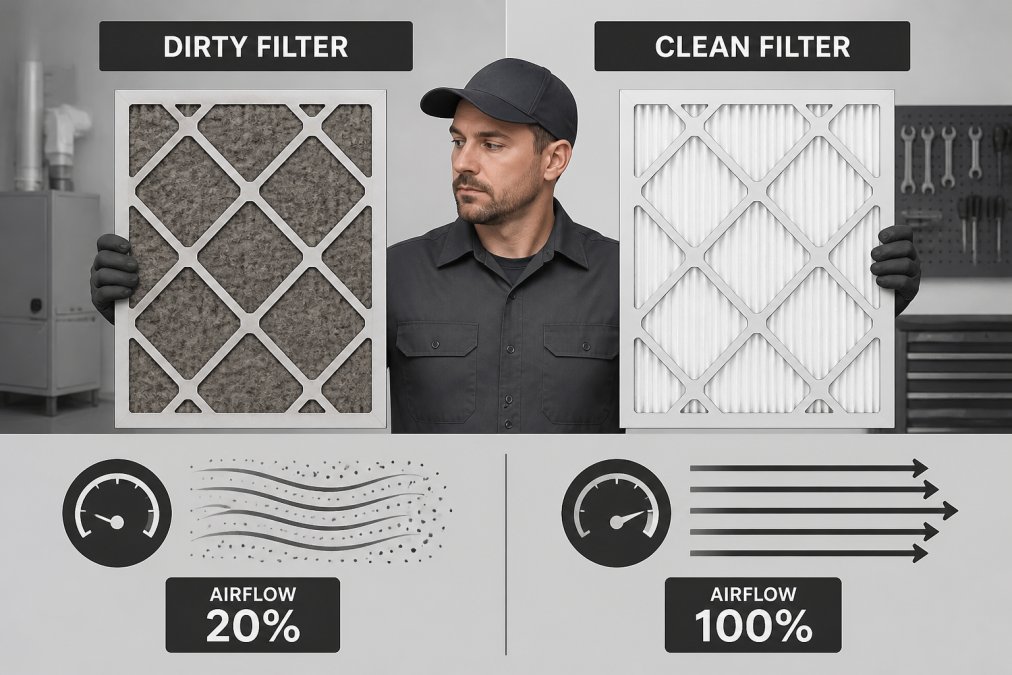
The air filter's job is straightforward: trap particles before air enters the evaporator coil. When it clogs, the system compensates by running longer cycles to push the same amount of air through. Your thermostat never gets satisfied because the cooling capacity drops while demand stays constant.
Most residential systems need a filter change every 30-90 days, depending on household conditions (the EPA). If you have pets, allergies, or live in a dusty area, check your filter monthly. A quick visual inspection takes seconds and prevents hours of unnecessary runtime.
Signs your filter needs replacement:
- Visible dust buildup on the filter surface
- Reduced airflow from supply vents
- AC running longer than usual
- Dust smell when the system cycles on
Replacing a filter is the easiest fix you can do yourself. Turn off your system, locate the filter housing (usually near the return air vent or furnace), slide out the old filter, and insert a new one with the arrow pointing toward the unit. This single action often cuts runtime by 20-30% if the filter was severely clogged.
:::pro Check your filter every month during cooling season. Mark it on your calendar. A clean filter costs $15-30 and prevents AC from running constantly, far cheaper than emergency repairs. :::
Thermostat Calibration and Settings Problems
A miscalibrated thermostat is another frequent culprit behind constant AC running. If your thermostat reads incorrectly, your system chases a temperature it can never reach. A thermostat that reads 2-3 degrees higher than actual room temperature will keep the AC running indefinitely (nist.gov).
Thermostat calibration drift happens gradually. Over time, the internal sensor loses accuracy. If your thermostat shows 72°F but your room is actually 70°F, your AC will run constantly trying to reach an impossible target.
Test your thermostat's accuracy:
- Place a reliable thermometer near your thermostat (not in direct sunlight or near vents)
- Wait 15 minutes for the thermometer to stabilize
- Compare the reading to your thermostat display
- If the difference exceeds 1 degree, recalibration is needed
Many modern thermostats have a calibration adjustment in the settings menu. Check your device manual for the offset adjustment feature. Some systems allow you to add or subtract 1-2 degrees from the reading to match actual temperature.
Another common setting problem is an overly aggressive temperature setpoint. Setting your thermostat to 68°F on a 95°F day creates a massive cooling load. Your system will run constantly trying to bridge that 27-degree gap. Raising the setpoint to 72-74°F significantly reduces runtime while remaining comfortable.
Programmable and smart thermostats offer another advantage: they can learn your schedule and adjust temperatures automatically. RTS Comfort Cooling & Heating installs smart thermostats that provide data on your system's actual runtime patterns. This data reveals whether constant running is a problem or normal for your specific setup and cooling load.
AC Freezing Up and Restricted Airflow
When your evaporator coil freezes, your AC runs constantly but produces little to no cold air. Ice buildup on the coil blocks airflow completely, so your system cycles longer and longer trying to cool the house. This creates a vicious cycle: the longer it runs, the colder the coil gets, and the more it freezes.
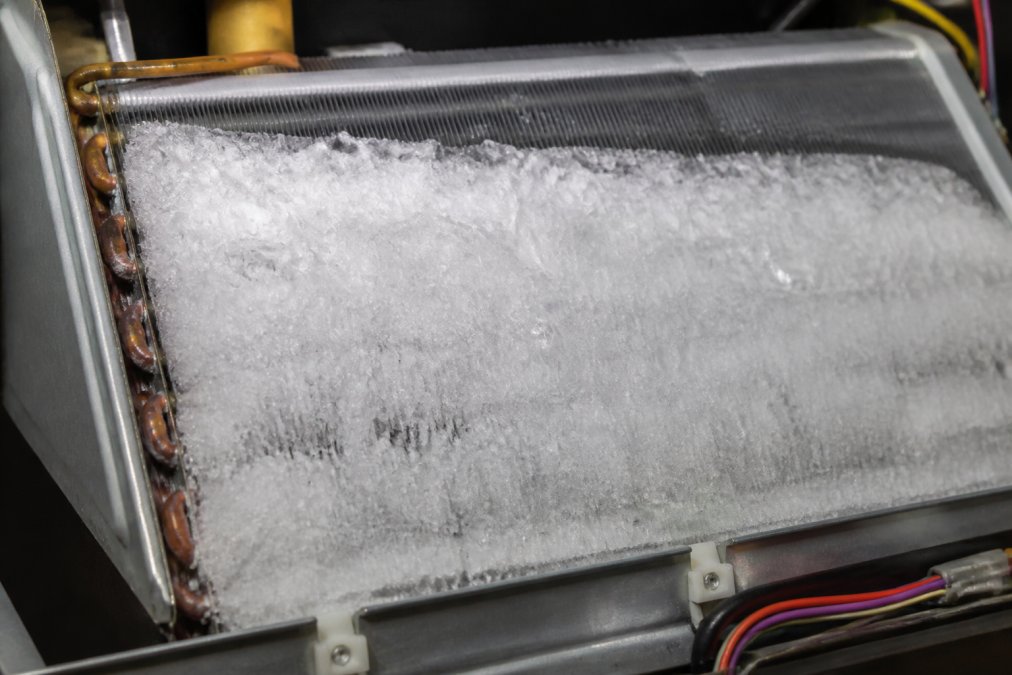
Frozen coils result from two conditions: low refrigerant levels or severely restricted airflow. When airflow drops, the coil temperature falls below freezing point. Moisture in the air condenses on the coil and freezes solid. The system keeps running because the thermostat senses warm air (the coil isn't cooling), but the ice prevents any heat transfer.
Low refrigerant is a refrigerant leak issue, covered in the next section. But frozen coils often start with airflow problems. A dirty evaporator coil, blocked return air vents, or a failing blower motor all reduce airflow and trigger freezing.
Check for these airflow problems:
- Return air vents blocked by furniture or curtains
- Evaporator coil caked with dust and debris
- Blower motor running weakly or making noise
- Ductwork disconnected or crushed in attic or crawl space
If you see ice on your outdoor condenser unit or suspect a frozen coil, turn off your system immediately. Running a frozen system will damage the compressor. Let the ice melt completely (4-8 hours with the system off), then identify what caused the freezing before restarting.
Many frozen coil problems trace back to a clogged air filter or blocked return air vents. Once you address the airflow restriction, the coil thaws and normal operation resumes. If freezing returns after clearing blockages, refrigerant loss is the likely cause and requires professional service.
Refrigerant Leaks and Low Refrigerant Levels
Refrigerant is the lifeblood of your cooling system. It circulates through the evaporator coil (indoor unit) and condenser coil (outdoor unit), absorbing heat and releasing it outside. Low refrigerant levels prevent your system from cooling effectively, so it runs constantly trying to reach your setpoint.
Refrigerant doesn't get "used up" like gasoline. A properly sealed system maintains the same refrigerant charge for years. If levels drop, you have a leak somewhere in the system. Common leak points include:
- Copper line connections (especially at bends)
- Evaporator coil seams
- Condenser coil fins
- Compressor shaft seal
A refrigerant leak is not a DIY fix. Federal regulations require certified technicians to handle refrigerant. Attempting to add refrigerant without fixing the leak is like filling a bucket with a hole in the bottom, temporary and wasteful.
Signs of low refrigerant:
- AC runs constantly but air stays warm
- Ice forms on refrigerant lines or evaporator coil
- Hissing or bubbling sounds from the system
- Higher than normal energy bills
- System cycles on and off rapidly (short cycling)
If you suspect a leak, call a professional immediately. Continuing to run a low-refrigerant system damages the compressor. Compressor failure costs $1,500-3,000 to replace and is the most expensive repair in HVAC. Early detection of a small leak prevents catastrophic failure.
Call (702) 707-4242 for a free estimate →
Professional technicians use specialized equipment to locate leaks, repair them, and recharge the system to manufacturer specifications. This service is essential for restoring normal operation and preventing constant AC running caused by refrigerant loss.
What's the Average AC Runtime Per Day?
Understanding normal AC runtime helps you recognize when constant running is actually a problem. Average daily runtime depends on outdoor temperature, home size, insulation quality, and thermostat settings.
On a typical 85°F summer day, a properly functioning AC system runs 8-12 hours total, not continuously, but in cycles. Each cycle might run 15-20 minutes, then the system shuts off for 10-15 minutes while the house maintains temperature. This cycling pattern is normal and healthy.
On extremely hot days (95°F+), runtime extends to 12-16 hours. During heat waves, 18-20 hours of daily runtime is not unusual. But even in extreme heat, a healthy system still cycles off periodically rather than running constantly without breaks.
If your system runs 20+ hours daily or never cycles off, something is wrong. Constant running without cycling indicates the system can't satisfy the thermostat setpoint. This points back to the problems covered above: dirty filters, low refrigerant, thermostat issues, or undersized capacity.
Smart thermostats track your system's actual runtime and provide this data in their apps. You can see daily, weekly, and monthly runtime patterns. This historical data is invaluable for diagnosing problems. If runtime suddenly jumped from 10 hours to 18 hours daily, something changed, either outdoor conditions intensified or your system developed an issue.
Oversized or Undersized HVAC Systems
System sizing is critical. An undersized unit can't meet cooling demand, so it runs constantly. An oversized unit cycles on and off rapidly without running long enough to dehumidify the house. Both scenarios cause problems.
An undersized system is the more common cause of constant AC running. If your 3-ton unit is cooling a 4,000-square-foot home with poor insulation, the system will run all day trying to overcome the cooling load. No amount of maintenance fixes an undersized unit, it simply lacks the capacity.
Proper sizing depends on square footage, climate zone, insulation R-value, window area and orientation, and local cooling degree days. A professional load calculation considers all these factors. If your home was built or significantly remodeled without updating the HVAC system, undersizing is likely.
Replacing an undersized system with properly sized equipment solves constant running caused by inadequate capacity. A correctly sized unit runs longer cycles (25-30 minutes) but fewer of them, delivering better dehumidification and comfort.
An oversized system is less common but creates different problems. It cools the house quickly, then shuts off. But it cycles back on frequently without running long enough to remove humidity. This rapid cycling (called short cycling) wears out components faster and prevents proper humidity control.
The right-sized system for your home depends on professional assessment. RTS Comfort Cooling & Heating performs load calculations that determine the exact capacity your home needs. This analysis prevents both undersizing and oversizing, ensuring your system runs efficiently without constant operation.
Home Insulation and Air Leaks
Even a perfectly functioning AC system will run constantly if your home loses cooled air faster than the system can cool it. Poor insulation and air leaks create an impossible cooling load.
Air leaks around windows, doors, electrical outlets, and ductwork allow conditioned air to escape. Inadequate attic insulation lets heat transfer directly into living spaces. When your home is losing cool air continuously, your AC never reaches the setpoint, so it runs all day.
Common air leak locations:
- Window and door frames
- Gaps around pipes and electrical lines
- Attic access hatches
- Basement rim joists
- Ductwork in unconditioned spaces
A blower door test identifies air leaks precisely. This test pressurizes your home and measures how much air escapes. The results show exactly where sealing efforts will have the most impact. Sealing the biggest leaks often reduces AC runtime by 15-20%.
Attic insulation is equally important. Most homes need R-38 to R-60 insulation depending on climate. If your attic has less than R-30, heat gain through the attic ceiling overwhelms your AC system. Adding insulation reduces the cooling load and allows your system to cycle normally.
These improvements work together with your AC system. A properly sealed, well-insulated home allows your system to reach setpoint and cycle off. Without addressing insulation and air leaks, even a new, correctly sized system will run excessively.
RTS Comfort Cooling & Heating offers attic insulation and air sealing services. These upgrades reduce energy consumption and allow your AC to operate normally. Combined with system maintenance, they're the most cost-effective way to stop constant AC running caused by excessive cooling load.
Constant AC running in summer is never normal, and it always has a cause. Whether it's a dirty filter, low refrigerant, thermostat drift, or undersized capacity, the problem is fixable. Start with the simplest checks, filter replacement and thermostat calibration, then move to professional diagnostics if those don't solve it.
RTS Comfort Cooling & Heating diagnoses constant AC running with precision testing and data analysis. Our team identifies the exact cause, recommends the most cost-effective fix, and ensures your system runs efficiently. Call (702) 707-4242 for a free estimate and get your AC cycling normally again.
Frequently Asked Questions
Q: Is it normal for my AC to run constantly on 100-degree days?
A: Your AC running continuously during extreme heat is not unusual, but it depends on your thermostat setting and home size. If your thermostat is set to 72°F on a 100°F day, your system will work harder and run longer. However, constant running that never cycles off suggests a problem: dirty air filters, refrigerant leaks, or a system that's undersized for your cooling load. Professional inspection can determine if your AC is operating normally or failing.
Q: Can a dirty air filter cause the AC to run all day?
A: Yes. A dirty air filter restricts airflow to the evaporator coil, reducing cooling efficiency and forcing your HVAC system to run longer to reach your set temperature. This also increases the risk of frozen evaporator coils, which further reduces performance. Check your air filter monthly and replace it every 1-3 months, depending on dust and pet hair in your home. Clean filters improve efficiency and reduce constant running.
Q: How much will it cost to fix my AC if it's running constantly?
A: Repair costs depend on the underlying cause. A simple air filter replacement costs far less than a refrigerant leak repair or compressor service. Rather than guessing, contact a professional for a free diagnostic. RTS Comfort Cooling & Heating offers 24/7 emergency service and can identify the exact problem. Call (702) 707-4242 for a free estimate tailored to your system.
Q: What temperature should I set my thermostat to during a heat wave?
A: During extreme heat, set your thermostat to 78°F or higher when home, and 85°F when away. Each degree you lower increases energy consumption by 3-5%. If your AC is running constantly even at 78°F, the problem is not your setting, it's your system. Smart thermostats can track runtime and alert you to excessive cycling, helping you identify problems early before they worsen.
This article was written using GrandRanker