 ultimate-guide
HVAC Maintenance Checklist for Homeowners (2026)
Table of Contents
- Why a Seasonal HVAC Maintenance Checklist Matters
- The Essential HVAC Maintenance Checklist for Homeowners
- How Often to Change Air Filters for Maximum Efficiency
- Signs Your HVAC Needs Repair Before a Full Breakdown
- HVAC Preventative Maintenance Cost vs. Emergency Repair
- DIY vs. Professional Maintenance: Where to Draw the Line
- Conclusion: Schedule Your Seasonal Tune-Up
- Frequently Asked Questions
Last Updated: September 7, 2026
Why a Seasonal HVAC Maintenance Checklist Matters
Your HVAC system works hardest when you notice it the least. In the desert climate, it runs for months without a break, pushing air through filters, coils, and ductwork that collect dust, pollen, and debris. Skipping routine care rarely causes an immediate failure, but it steadily drives up energy consumption and shortens the system's service life. A basic hvac maintenance checklist for homeowners is the difference between a system that runs for fifteen years and one that quits a few summers early (energy.gov).
The good news is that catching these issues early takes about an hour per season. This guide walks through the exact maintenance tasks that matter, how often to perform them, and when a problem is beyond a DIY fix.
The Essential HVAC Maintenance Checklist for Homeowners
An effective hvac maintenance checklist covers two timeframes. Monthly tasks take minutes and prevent the most common airflow problems. Seasonal tasks require a bit more effort but protect the expensive components: the compressor, blower motor, and coils.
Monthly Tasks: Filters and Thermostat Checks
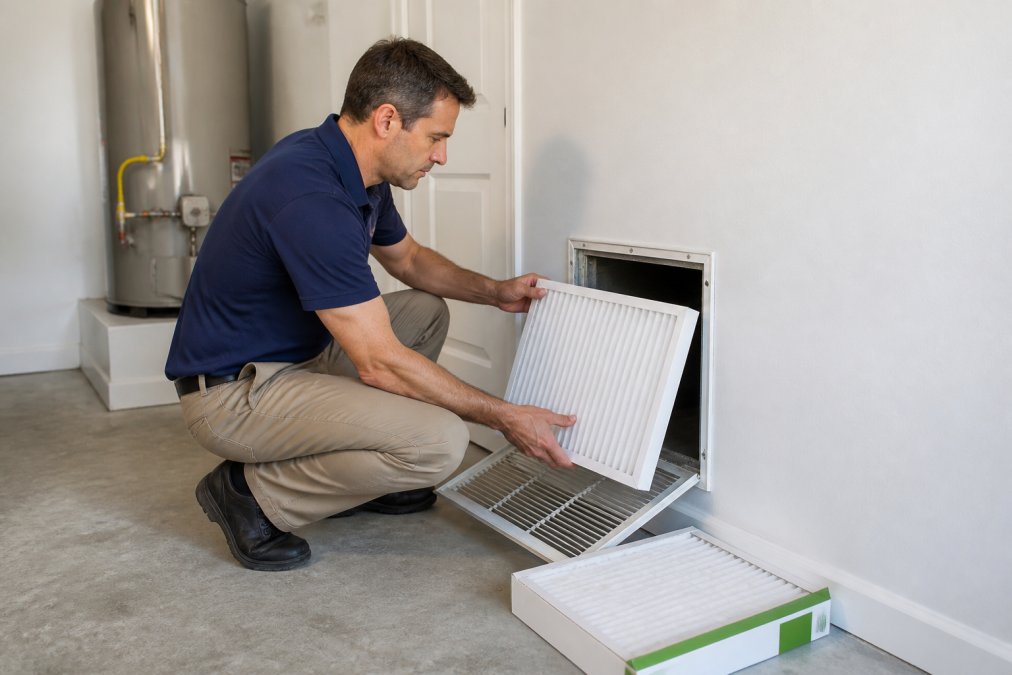
The air filter is the single most important component you can maintain yourself. A clogged filter restricts airflow, forcing the blower motor to work harder and allowing dust to bypass into the system. Check it monthly and replace it when it looks dirty. While you are at it, confirm your thermostat is set correctly and running in the right mode for the season.
Seasonal Tasks: Coils, Drain Lines, and Outdoor Units
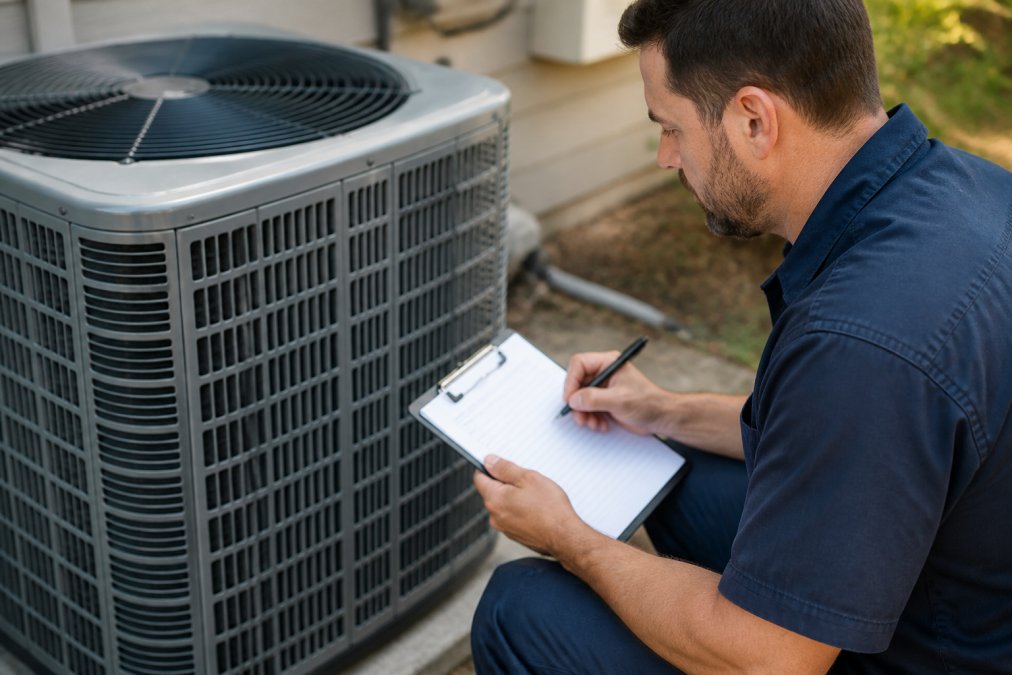
Twice a year, before heavy cooling and heating seasons, work through the deeper items. Clean the condenser coils on the outdoor unit with a gentle spray, clear debris from the fan blades, and pour a cup of vinegar through the condensate drain line to prevent algae buildup. Inspect the area around the outdoor unit and keep at least two feet of clearance so airflow is not restricted.
How Often to Change Air Filters for Maximum Efficiency
The standard answer is every 30 to 90 days, depending on the filter type and your household. Basic fiberglass filters should be changed monthly (the EPA). Higher-efficiency filters with a MERV rating of 8 to 13 can last up to three months, but they also restrict airflow more, so check them more frequently.
Households with pets or allergy sufferers should change filters closer to the 30-day mark. A filter that stays clean for months in an empty home can clog in three weeks when dogs shed constantly. Mark a reminder on your calendar rather than relying on memory, since a forgotten filter is the most common cause of reduced airflow and frozen evaporator coils.
Signs Your HVAC Needs Repair Before a Full Breakdown
Some issues announce themselves clearly. Unusual noises like grinding or squealing point to a failing blower motor or worn bearings. Weak airflow from the air registers suggests a blocked filter, dirty coils, or ductwork leaks. A system that short-cycles, turning on and off frequently, often indicates a refrigerant problem or an oversized unit.
Strange odors are another red flag. A musty smell when the system runs often comes from mold in the ductwork or a dirty evaporator coil. A burning odor could mean an electrical issue or an overheating motor. Both warrant immediate attention rather than waiting for the next seasonal inspection.
HVAC Preventative Maintenance Cost vs. Emergency Repair
Preventative maintenance is far less expensive than emergency repair, but the exact figures vary by provider and the scope of work. A professional tune-up typically covers thermostat calibration, electrical connection checks, refrigerant level verification, and lubrication of moving parts. Emergency service calls carry premium rates, especially during extreme weather when systems fail under peak load.
Consider the return on investment. A well-maintained system runs more efficiently, which lowers monthly utility bills. Catching a worn capacitor during a tune-up costs a fraction of replacing a compressor that failed because it was running under stress. For most homeowners, the math favors scheduling regular maintenance over waiting for a breakdown.
DIY vs. Professional Maintenance: Where to Draw the Line
The line between DIY and professional work is not just about skill, it is about warranty protection, safety, and the increasingly complex technology inside modern HVAC systems. Here is the clearest breakdown you will find, including the smart-home angle that most checklists ignore.
Call (702) 707-4242 for a free estimate →
Safe for Any Homeowner (No Tools Required)
- Air filter replacement, Pull the old filter, note the dimensions printed on the frame, and slide in a new one with the arrow pointing toward the blower. This is the single highest-impact task you can do.
- Clearing debris from the outdoor unit, Remove leaves, grass, and twigs by hand or with a soft brush. Keep 24 inches of clearance.
- Keeping supply and return vents unobstructed, Move furniture, rugs, and curtains away from registers. Closed or blocked vents increase duct pressure, which reduces airflow and can cause the heat exchanger to overheat.
- Checking the condensate drain line, Pour vinegar through the access tee quarterly.
DIY with Caution (Basic Tools, Moderate Risk)
- Cleaning condenser coils, Safe if you pull the disconnect first and use a garden hose, not a pressure washer.
- Straightening bent coil fins, A fin comb is inexpensive and the task is straightforward.
- Replacing a standard thermostat, If you are replacing a basic 24V thermostat with another basic model, this is a 30-minute job. Turn off power at the furnace or air handler first, and label your wires before disconnecting.
The Smart Home Gray Zone (Where Competitors Go Silent)
Modern HVAC systems are no longer just mechanical, they are networked devices. A smart thermostat like the ecobee or Nest Learning Thermostat runs firmware that needs updates, and the sensors that feed it data need periodic attention. Most maintenance checklists completely ignore this layer, but it matters for system efficiency and reliability.
What you can do yourself:
- Check for firmware updates, Open your thermostat's app and look for a firmware version or software update section. Manufacturers push updates that fix bugs and improve scheduling algorithms. An outdated thermostat can misread occupancy or fail to engage recovery mode properly, costing you efficiency.
- Clean the thermostat's internal sensor, Dust accumulates on the temperature sensor inside the thermostat housing. Gently vacuum the vents with a soft brush attachment. A dirty sensor reads 2-3 degrees off, which makes your system run longer than necessary.
- Verify Wi-Fi connectivity, A thermostat that drops offline cannot receive firmware updates or adjust to time-of-use utility rates. Check the signal strength in the thermostat's settings. If it is weak, move your router closer or add a Wi-Fi extender.
- Replace smart thermostat batteries, Most smart thermostats have a backup battery (often a C-cell or lithium coin cell). When it dies, the thermostat may lose its schedule or fail to power on during a power outage. Replace it annually.
- Check remote sensor placement, If you use room sensors, confirm they are not blocked by furniture or curtains and that their batteries are fresh. A sensor reading 5 degrees high will cause overcooling or overheating.
What requires a professional:
- Wiring new thermostat types, Going from a basic 4-wire thermostat to a smart thermostat that needs a C-wire (common wire) for continuous power often requires running new wire or installing an add-a-wire kit. This involves the furnace control board and is best left to a technician.
- Diagnosing communication errors, If your system uses a communicating thermostat (common with high-end variable-speed systems from Carrier, Trane, or Lennox), error codes like "Comm Error" or "Sensor Fault" indicate a wiring or board issue. These systems use proprietary protocols, and DIY troubleshooting can void the equipment warranty.
- Software configuration for multi-stage systems, Setting up a smart thermostat to control a two-stage compressor or variable-speed blower requires configuring the correct staging logic. Incorrect settings cause short-cycling or poor humidity control.
The Warranty Factor
Before you attempt any DIY task beyond filter replacement, read your equipment warranty. Most manufacturers, including Carrier, Trane, Lennox, and Goodman, require proof of professional maintenance at least annually to honor compressor or heat exchanger warranties. A $150 tune-up twice a year protects a $4,000-$6,000 compressor replacement. Skipping professional visits to save $300 a year is a false economy if it voids a 10-year parts warranty.
What Always Requires a Licensed Technician
- Refrigerant handling, The EPA requires Section 608 certification to handle refrigerants (the EPA). Adding refrigerant without locating and repairing the leak first is both illegal and wasteful, the new charge will leak out again.
- Electrical work inside the unit, Line-voltage connections, capacitor replacement, and contactor swaps involve 240V. A mistake can cause arc flash, equipment damage, or fire.
- Heat exchanger repair or replacement, This is a carbon monoxide safety issue, not a DIY project.
- Ductwork modification, Sealing and insulating ducts requires measuring airflow and static pressure with specialized tools. Guessing at duct sizing can starve the system of return air.
If your system is under warranty, keep every professional maintenance invoice in a folder. When a major component fails, the manufacturer will ask for proof of maintenance before approving a warranty claim. Homeowners who cannot produce it often face a denied claim and a full-price repair bill.
Conclusion: Schedule Your Seasonal Tune-Up
A seasonal hvac maintenance checklist protects your comfort and your budget, but it has limits. Monthly filter changes and debris clearance keep the system running efficiently between professional visits. For refrigerant checks, electrical inspections, and ductwork evaluation, a licensed technician should handle the work.
The RTS Comfort Cooling & Heating team provides comprehensive HVAC services across the Las Vegas area, including routine tune-ups, duct cleaning, and 24/7 emergency repair when a system fails at the worst possible time. Our technicians also handle smart thermostat installation for homeowners who want better control over their energy use. Call (702) 707-4242 for a free estimate and schedule your seasonal maintenance before the next heat wave hits.
Frequently Asked Questions
What is the $5000 rule for HVAC systems?
The $5,000 rule is a general guideline used by HVAC professionals to help homeowners decide between repairing and replacing an aging system. Multiply the age of your unit by the estimated repair cost. If the result exceeds $5,000, replacement is usually the smarter financial choice. For example, a 10-year-old system needing a $600 repair totals $6,000, which suggests replacement. This rule is a starting point, not a guarantee. A licensed technician should assess your system's overall condition, efficiency ratings, and energy bills before you commit to a major expense.
What regular maintenance should be done on an HVAC system?
Regular maintenance centers on tasks that keep airflow and heat transfer efficient. Monthly, inspect or replace your air filter based on its MERV rating. Seasonally, clear debris from the outdoor condenser unit, trim vegetation at least 2 feet back, and remove leaves from the fins. Check that all supply and return air registers are open and unblocked. Professionally, a tune-up covers refrigerant levels, electrical connections, blower motor lubrication, and drain line cleaning. Following a structured HVAC maintenance checklist for homeowners ensures these critical points are not forgotten.
What's the most overlooked home maintenance task?
Cleaning the condensate drain line is frequently ignored until it causes a shutdown. This line removes humidity from your home; when algae or mold clogs it, water backs up and trips the safety switch, stopping your AC. Most homeowners never inspect it until water appears. In humid climates, pouring a cup of white vinegar down the drain line every few months prevents buildup. During professional tune-ups, technicians should flush the line and clear the condensate pan to keep the dehumidification process working correctly and protect your indoor air quality.
What are 5 items that regularly scheduled maintenance will check?
A standard professional tune-up includes five core checks. First, the technician verifies the thermostat calibration and settings. Second, they inspect and tighten electrical connections, checking voltage and capacitors. Third, they lubricate moving parts like the blower motor and fan bearings to prevent friction failure. Fourth, they check the refrigerant charge and look for leaks. Fifth, they clean the evaporator and condenser coils and ensure the condensate drain is clear. These steps directly address common failure points and keep your system running at peak airflow efficiency.
How often should a professional inspect my HVAC system?
A professional inspection should happen at least once per year. Because most systems both cool and heat, a bi-annual tune-up is ideal: one visit in spring for the air conditioner and one in fall for the furnace or heat pump. These seasonal inspections catch wear from the previous heavy-use period before the next one starts. During these visits, a technician will address your HVAC preventative maintenance cost concerns by identifying minor issues early, which prevents the higher expense of emergency repairs during extreme weather when you are most reliant on the system.