 how-to
7 Ways to Prevent Dust Buildup in Air Ducts
Last Updated: November 12, 2026
Quick Summary
To prevent dust buildup in air ducts, check your filter monthly and replace it every one to three months, seal leaks and disconnected joints, and clean vent covers once a month. For most homes, a MERV 8 to MERV 11 filter balances dust capture against airflow without straining the blower.
- Basic fiberglass filters should be replaced every 30 days, pleated filters every 60 to 90 days.
- A clogged filter restricts airflow and pulls unfiltered dust in through leaky duct joints.
- Vacuum vent covers with a brush attachment and wipe them with a damp cloth monthly.
- Seal small duct gaps with mastic or metal-backed tape, not standard cloth duct tape.
- The EPA does not recommend routine duct cleaning for health reasons.
Table of Contents
- Why Dust Accumulates in Air Ducts
- How Often to Change HVAC Air Filter
- Choosing the Right Air Vent Dust Filter and MERV Rating
- How to Get Rid of Dust in Air Vents
- Sealing Duct Leaks and Disconnected Joints
- Does Air Duct Cleaning Reduce Dust?
- Reducing Household Dust and Managing Humidity
- Schedule Your Duct Inspection with RTS Comfort Cooling & Heating
- Frequently Asked Questions
Why Dust Accumulates in Air Ducts
Dust buildup in air ducts starts with a simple fact: your HVAC system moves a lot of air, and that air carries particles.
In a dry climate, this happens faster.
Most homeowners never think about how to prevent dust buildup in air ducts until the dust becomes impossible to ignore.
Here is the core principle: stop dust at the source, keep the system's filter working, and seal the paths that let unfiltered air slip in.
How Often to Change HVAC Air Filter
The short answer: check your filter every month and replace it every one to three months, depending on the filter and your home. Homes with pets, heavy dust, or constant system use should lean toward the one-month end.
Filter replacement is one of the most important ways to keep dust out of air ducts. A clogged filter stops catching particles and starts restricting airflow.
A realistic schedule looks like this:
- Basic fiberglass filters: replace every 30 days
- Pleated filters: replace every 60 to 90 days
- Homes with pets or allergy sufferers: replace every 30 to 45 days
- Peak cooling or heating season: check monthly, replace as needed
Set a reminder on your phone. The filter is easy to forget, and it is the cheapest dust-control tool you own.
Recommended filter replacement intervals by filter type
Choosing the Right Air Vent Dust Filter and MERV Rating
Higher MERV does not always mean better. The right MERV rating balances particle capture against airflow, and your system can only handle so much restriction. This is the section where most homeowners accidentally make dust problems worse, so it is worth getting specific.
MERV stands for Minimum Efficiency Reporting Value. It measures how well a filter captures particles of different sizes. Here is how the common ranges break down:
| MERV Rating | Captures | Best For | Watch Out |
|---|---|---|---|
| MERV 1-4 | Large dust, lint | Basic dust protection | Lets fine particles through |
| MERV 5-8 | Pollen, mold spores, dust mites | Most homes | Good balance for standard systems |
| MERV 9-12 | Fine dust, some smoke | Allergy-sensitive homes | May strain older blowers |
| MERV 13+ | Very fine particles | Specialized setups | Often too restrictive for standard residential systems |
For most homes, a MERV 8 to MERV 11 filter is the sweet spot. For specific filter recommendations suited to dusty desert homes and allergens, see our guide to the best HVAC filters for desert dust and allergens.
The airflow trade-off, explained
A filter is a resistance device. The higher the MERV, the more tightly woven the media, and the harder the blower has to work to pull air through it. When airflow drops, three things happen: the system runs longer, the blower motor heats up, and static pressure builds inside the ductwork. That pressure finds the weakest points, including leaky joints and disconnected sections, and pulls unfiltered attic or crawl space air into the system.
Most residential systems are designed for a filter with a pressure drop in the range of 0.1 to 0.2 inches of water column at the system's rated airflow. A MERV 13 filter in a slot designed for a MERV 8 can push that number higher, especially as it loads. If you want higher filtration without the restriction, the better path is usually a larger filter surface area (a thicker filter or a media cabinet) rather than a higher MERV in the same slot.
Match the filter to the slot, not the shelf
Filter thickness matters as much as MERV. A 1-inch filter has less surface area than a 4-inch or 5-inch media filter, so it loads faster and restricts airflow sooner.
Check the filter frame for gaps. A filter that does not seal against the slot lets air slip past unfiltered. Many homeowners fix this with a simple foam gasket or a correctly sized filter rather than a higher MERV rating.
What about washable and electrostatic filters?
Washable electrostatic filters can capture dust, but they require regular cleaning and their performance drops as they load. They are a reasonable option for some homes, but they are not a substitute for a properly sized pleated filter in a system that was designed for one.
Watch out: buying the highest MERV filter on the shelf can backfire. Restricted airflow forces the blower to work harder and can pull dust through gaps instead of through the filter.
How to Get Rid of Dust in Air Vents
Dust in the vents themselves is the most visible problem, and it is the easiest to fix. The goal is to remove what has settled on vent covers and registers without pushing it deeper into the ducts.
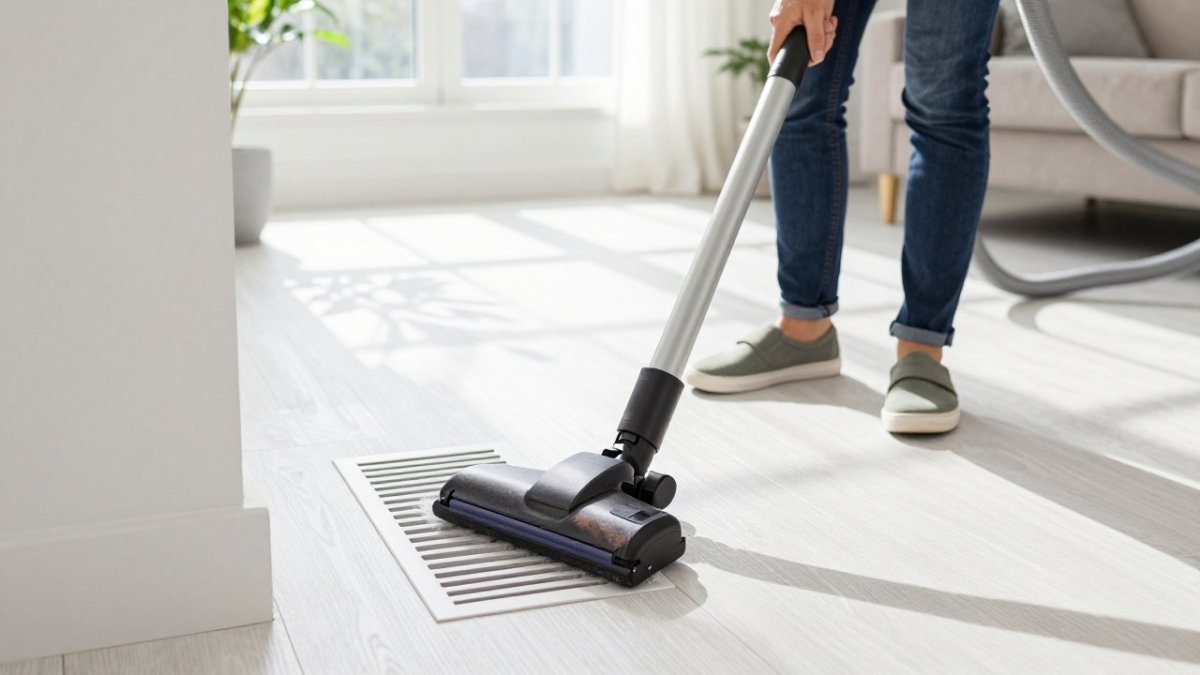
Follow these steps once a month:
- Turn off the HVAC system at the thermostat.
- Remove the vent covers and register grilles.
- Vacuum each cover with a brush attachment, front and back.
- Wipe the grilles with a damp cloth to catch what the vacuum missed.
- Vacuum the visible duct opening a few inches deep, gently.
- Reinstall the covers and turn the system back on.
A dryer sheet works as a quick anti-static wipe on vent covers between cleanings. It helps reduce how fast dust clings to the surface. For supply vents and return vents alike, the routine is the same.
Sealing Duct Leaks and Disconnected Joints
Leaky ducts pull in unfiltered air from attics, crawl spaces, and wall cavities. That air is often the dustiest in the house. Sealing leaks is one of the highest-impact prevention steps, and it is often overlooked.
Check the accessible ductwork in your attic or basement for:
- Visible gaps at joints and seams
- Disconnected sections, especially at flex duct connections
- Crushed or kinked flexible ductwork
- Torn or worn duct tape and mastic
Small gaps can be sealed with mastic or metal-backed tape rated for HVAC use. Standard cloth duct tape dries out and fails. If you are unsure whether your ducts are leaking, our guide to the warning signs of leaking ducts walks through what to look for.
Does Air Duct Cleaning Reduce Dust?
Professional duct cleaning can help, but it is not a cure-all. Cleaning removes accumulated debris from duct surfaces, which reduces the dust that gets blown into rooms. It does not stop new dust from entering. Filter changes, sealing, and home cleaning still do the ongoing work.
The evidence on health claims is mixed. Many homeowners report less dust and better indoor air quality after cleaning, but results depend on how dirty the system was and whether the source problems were fixed.
What the guidance actually says
The U.S. Environmental Protection Agency (EPA) does not recommend routine air duct cleaning for health reasons and states that duct cleaning has never been shown to consistently prevent health problems (the EPA). The EPA does suggest considering cleaning when there is visible mold growth inside the ductwork, when ducts are infested with vermin, or when ducts are clogged with excessive dust and debris (the EPA).
The National Air Duct Cleaners Association (NADCA) publishes a standard for assessing duct cleanliness, and reputable contractors will often use before-and-after photos or a vacuum test to show what was removed. Ask for that evidence rather than accepting a general claim that your ducts were dirty.
Safe DIY boundaries
You can handle the visible, accessible parts of duct maintenance yourself: removing and washing vent covers, vacuuming the first few inches of the duct opening with a brush attachment, and wiping down register grilles.
Watch out: if you see visible mold growth, smell a persistent musty odor, notice pest droppings or nesting material, or find damaged or crushed ductwork, stop and call a qualified professional.
When professional cleaning is worth it
Consider professional cleaning if you see:
- Visible dust blowing from vents after a filter change
- Heavy buildup inside registers
- Recent renovation or construction dust
- A musty smell from the system
- Persistent allergy symptoms at home
- Visible mold or pest activity inside the ductwork
If you are weighing the cost, our professional duct cleaning pricing guide breaks down what drives the price. And if you are not sure whether your ducts actually need it, our article on the signs your ducts need cleaning helps you check before you spend.
How to verify results after cleaning
Do not expect a specific percentage reduction in dust. Instead, check observable signs: the filter should stay cleaner longer, visible dust on registers should recur more slowly, and airflow at supply vents should feel consistent. If dust returns quickly, the source problem (leaks, filter bypass, or household dust) was not addressed, and cleaning alone will not fix it.
Reducing Household Dust and Managing Humidity
Every particle you keep out of the air is one less particle that can end up in your ducts. Whole-home dust control starts with the basics:
- Dust and vacuum weekly, using a vacuum with a HEPA filter
- Wash bedding in hot water on a regular schedule
- Use entry mats and remove shoes indoors
- Keep windows closed during windy periods
- Run a standalone air purifier in high-traffic rooms
Humidity control matters more than most people realize. Too-dry air lets dust float and settle everywhere; too-much moisture encourages mold and makes dust cling. Aim for a relative humidity around 30% to 50% indoors (the EPA). A whole-home humidifier or dehumidifier, depending on the season, keeps the balance steady.
The EPA's guidance on indoor air quality recommends source control, ventilation, and filtration as the core pillars. Duct maintenance fits squarely into that framework.
Schedule Your Duct Inspection with RTS Comfort Cooling & Heating
Prevention works best when you know what is actually happening inside your system. Our team handles duct cleaning and full HVAC service for homes across the area, with 24/7 emergency availability when something fails.
RTS Comfort Cooling & Heating also offers smart thermostat installation and indoor air quality services. Call (702) 707-4242 for a free estimate.
Dust will always find a way in, but you can control how much settles in your ducts. Start with the filter, seal the leaks, and clean the vents on a schedule.
Frequently Asked Questions
What can you put in your air vents to keep dust down?
Vent filters or register filters are the most direct option. These are thin filters that sit behind the vent cover and catch dust before it enters the room. Look for filters labeled for HVAC use and check them monthly. Avoid using dense materials like cloth or cardboard, which can block airflow and strain your system. For central systems, your main air handler filter does most of the work, so vent filters are a supplement, not a replacement.
Why is there so much dust coming out of my air vents?
Dust blowing from vents usually points to a dirty air filter, a loose duct connection, or a buildup inside the ductwork itself. Start by checking the air filter at the air handler and replacing it if it is clogged. Then inspect visible duct joints for gaps or disconnected sections. If dust persists after these steps, a professional duct inspection can identify crushed ductwork or hidden leaks that are pulling dust into the system.
Do vent filters help reduce dust?
Vent filters can reduce dust settling on floors and furniture near the register, but they are not a cure-all. They work best as a supplement to a properly maintained central air filter and sealed ductwork. Change or clean vent filters every one to three months depending on dust levels. If you have pets or live in a dusty area, check them more often. Do not use vent filters as a substitute for fixing duct leaks or replacing the main HVAC filter.
When should you have air ducts professionally cleaned?
The EPA recommends duct cleaning when there is visible mold growth inside the ducts, vermin infestation, or a significant buildup of dust and debris. If you notice musty odors, uneven airflow, or dust blowing from vents after filter changes, a professional inspection is warranted. Routine cleaning every three to five years is reasonable for most homes, but homes with pets, smokers, or recent renovations may need it more often. A technician can assess whether cleaning will actually improve your situation.